
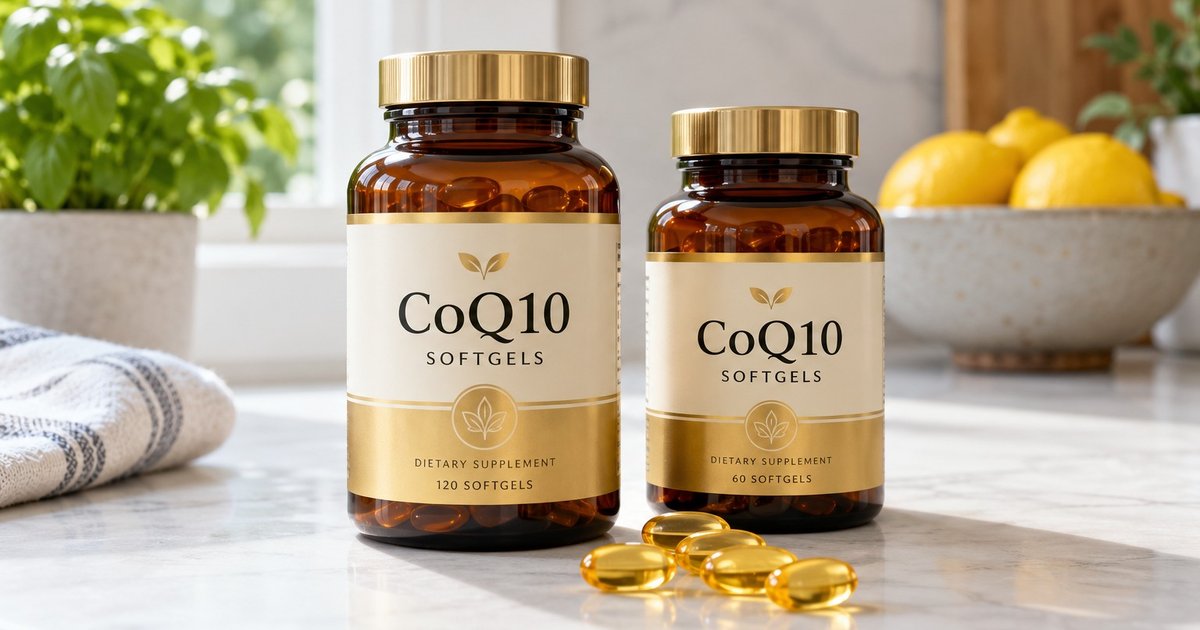
Ubiquinone is the oxidised form of coenzyme Q10 (CoQ10) and ubiquinol is the reduced form. Your body converts one into the other all the time, and most of the CoQ10 circulating in the blood is in the ubiquinol form. Head-to-head studies on which form is better absorbed have produced mixed results, and how a product is formulated, and whether you take it with a meal containing fat, appears to matter at least as much as which form is on the label.
This guide includes a few product links near the end. As an Amazon Associate, michelle.net.au earns from qualifying purchases, at no extra cost to you.
This guide explains the difference between the two forms in plain language, what absorption research has and has not shown, how CoQ10 labels work in different countries, how to compare two products on the shelf, and the medicine interactions to raise with your doctor or pharmacist before you start. It is educational only and is not a recommendation to take CoQ10.
At a glance
- Same molecule, two states: ubiquinone (oxidised) and ubiquinol (reduced) swap back and forth in the body.
- Absorption is low for both: CoQ10 is fat-soluble and poorly absorbed, so it is generally taken with a meal that contains some fat.
- The evidence on “which is better” is not settled: some studies favour ubiquinol, others found no significant difference when ubiquinone was well formulated.
- Read the milligrams per serving, the form and the delivery format, not just the front-of-pack claim.
- Medicines matter: CoQ10 may interact with warfarin and insulin. If you take these, or a statin, talk to your doctor or pharmacist first.
What CoQ10 is
Coenzyme Q10 is a fat-soluble compound that the human body makes itself. It sits in cell membranes and plays a role in how cells produce energy. Its production shares part of a pathway (the mevalonate pathway) with cholesterol, which is why it comes up in conversations about cholesterol-lowering statin medicines.
You also get small amounts from food. According to the Linus Pauling Institute at Oregon State University, typical dietary intake is only around 3 to 6 mg a day, with meat, poultry and fish among the richest sources, and soybean and canola oils, nuts and seeds also contributing. Supplements usually contain far more than that per capsule, which is one reason the question of absorption gets so much attention.
In Australia you may see CoQ10 listed on the label or on the ARTG (Australian Register of Therapeutic Goods) under its approved ingredient name, ubidecarenone. It is the same substance.
Ubiquinol vs ubiquinone: the difference explained
CoQ10 can carry electrons. When it is carrying them it is in its reduced form, ubiquinol. When it has handed them over it is in its oxidised form, ubiquinone. In the body, enzymes convert between the two continuously, and the Linus Pauling Institute notes that the reduced form is the one that acts as a fat-soluble antioxidant in membranes.
That does not automatically mean swallowing ubiquinol is better. Supplemental ubiquinone can be converted to ubiquinol after absorption, and ubiquinol readily oxidises back to ubiquinone when exposed to air or stomach conditions. A 2020 review in the journal Antioxidants argued that claims of superior ubiquinol absorption are overstated, but its authors work for a company that makes ubiquinone products, so its conclusions are best read alongside independent research.
| Feature | Ubiquinone | Ubiquinol |
|---|---|---|
| Chemical state | Oxidised | Reduced |
| How it may appear on a label | “Coenzyme Q10”, “CoQ10” or “ubidecarenone” (Australia), often without naming the form | Usually named specifically as “ubiquinol” |
| Main form in the bloodstream | No (converted after absorption) | Yes |
| Stability | More stable in storage | Oxidises easily, so packaging and storage matter more |
| Absorption evidence | Depends heavily on formulation; poorly dispersed powders appear to absorb less well | Some studies report higher blood levels; other head-to-head studies found no significant difference |
| What to compare | Delivery format, mg per serving, cost per mg | Delivery format, mg per serving, cost per mg, packaging |
What absorption research actually shows
Both forms share the same basic problem: CoQ10 is a large, fat-soluble molecule that the gut does not absorb well. The Linus Pauling Institute states that less than 5% of an oral dose is thought to reach the circulation, and that CoQ10 is best absorbed with a fat-containing meal. It also notes that doses above 100 mg a day are generally split into two or three doses.
Formulation is where products really differ. CoQ10 needs to be dissolved into individual molecules before it can be taken up, and crystalline CoQ10 that has not been properly dispersed appears to be absorbed poorly. That is why softgels with CoQ10 dissolved in an oil are common, and why two ubiquinone products can perform quite differently from each other.
So when you read that “ubiquinol is better absorbed”, ask: better than which ubiquinone, in what formulation, measured how, and in whom? Many comparisons are small, short and measure blood levels rather than any health outcome, and people vary widely in how much they absorb.
How to read a CoQ10 label
Label rules differ by country, so the same product can look quite different depending on where it is sold. For a broader walk-through of panels and claims, see how to read a supplement label.
Label rules by country
- Australia: CoQ10 products are usually listed complementary medicines carrying an AUST L number. Listed medicines are checked for safety and quality ingredients, but the TGA does not evaluate them for efficacy before they go on sale, and claims must use permitted indications.
- United States: CoQ10 is sold as a dietary supplement with a Supplement Facts panel. The FDA does not approve dietary supplements before sale, and structure/function statements must carry a disclaimer that the FDA has not evaluated them.
- Canada: look for an eight-digit Natural Product Number (NPN), which shows Health Canada has licensed the product.
- European Union and United Kingdom: CoQ10 is sold as a food supplement, and only health claims that appear on the authorised register may be used.
If you buy from overseas websites, the rules of the seller’s country apply, not yours. The guide on buying supplements internationally covers what to check.
Label checklist
- Find the form. Does it say ubiquinol, or just CoQ10, coenzyme Q10 or ubidecarenone? If the form is not named, it is almost always ubiquinone.
- Check the amount per serving, not per capsule. Some products need two or more capsules to reach the headline dose.
- Look at the delivery format. Oil-filled softgel, dry powder capsule, chewable or liquid. Oil-based formats are common because CoQ10 is fat-soluble.
- Read the other ingredients. Oils (for example soybean or olive oil), gelatin or plant-based capsule shells, and any added vitamins. Check for allergens and whether it suits your diet.
- Check for added extras. Combination products may include other ingredients you are already taking elsewhere, such as vitamin E or fish oil.
- Look for independent testing. A third-party quality seal tells you about testing for content and contaminants, not about benefits. See what USP, NSF and other seals mean.
- Check storage and expiry. This matters more for ubiquinol, which oxidises easily. Blister packs or sealed, opaque bottles help.
- Work out the cost per milligram. Divide the price by the total milligrams in the pack, so you compare like with like. Prices change, so recheck when you reorder.
Worked example: comparing two labels
Imagine two products on the same shelf. Product A is 60 softgels, each containing 100 mg of CoQ10 (ubiquinone) in oil, with a serving of one softgel. Product B is 60 softgels of ubiquinol, 50 mg each, with a serving of two softgels.
- Product A gives 100 mg per serving and 60 servings, or 6,000 mg in total.
- Product B also gives 100 mg per serving, but only 30 servings, or 3,000 mg in total.
The packs look identical in size, yet Product B lasts half as long. Divide each price by its total milligrams and you have a fair comparison. Then decide whether any difference in form is worth the difference in cost to you, ideally after a conversation with your pharmacist.
Medicines and safety: what to raise with your doctor or pharmacist
CoQ10 is generally well tolerated in studies. The US National Center for Complementary and Integrative Health (NCCIH) states that no serious side effects have been reported and that mild side effects such as insomnia or digestive upsets may occur. The Linus Pauling Institute notes gastrointestinal symptoms are reported more often at doses of 200 mg a day or more. Being well tolerated is not the same as being right for you, though, and interactions are the bigger issue.
Warfarin
NCCIH lists warfarin, the anticoagulant (blood thinner), as a medicine CoQ10 may interact with. The Linus Pauling Institute notes a small number of case reports in which CoQ10 reduced warfarin’s effect, and advises that people taking warfarin should not start CoQ10 without consulting the prescriber, with blood clotting tests (INR) checked more often if they are used together. If you take warfarin or any other blood thinner, talk to your doctor or pharmacist before starting, changing or stopping CoQ10.
Statins
Statins work on the same production pathway that the body uses for CoQ10, and the Linus Pauling Institute notes that statins have been shown to lower circulating CoQ10 levels, possibly because they lower the blood fats that carry it. This is why CoQ10 is often marketed to people on statins. However, NCCIH states that the overall scientific evidence does not support the idea that CoQ10 can reduce the muscle pain associated with statin use, although individual study results have varied. Never stop or change a statin because of a supplement. If you have muscle aches on a statin, talk to your doctor or pharmacist.
Other medicines and situations
- Insulin and diabetes medicines: NCCIH lists insulin as a possible interaction, so ask before starting.
- Cancer therapy: NCCIH notes CoQ10 may not be compatible with some types of cancer therapy. Check with your oncology team.
- Pregnancy and breastfeeding: safety data are limited. Ask your doctor or midwife first.
- Several supplements at once: bring every product, or photos of the labels, to your pharmacist so they can check the whole list.
What studies have tested so far
CoQ10 has been studied in many settings, and the results are less clear than marketing suggests. NCCIH summarises the research this way: findings on heart failure are inconclusive, CoQ10 probably does not have a meaningful effect on blood pressure based on limited evidence, and a large NIH-funded study found it did not improve symptoms in early Parkinson’s disease. Research in several other conditions is too limited for conclusions. NCCIH’s fact sheet was last updated in 2019, so newer studies may exist, but it remains a useful neutral summary. For a wider framework on weighing evidence before you buy anything, see the supplements evidence and label guide.
Who this decision suits, and who should pause
| Your situation | What to consider |
|---|---|
| Healthy adult curious about CoQ10 | Ask whether there is a clear reason to take it. If you go ahead, compare well-formulated products on mg per serving and cost per mg; the form is a secondary detail. |
| Taking warfarin or another blood thinner | Talk to your doctor or pharmacist before starting. Clotting tests may need closer monitoring. |
| Taking a statin | Discuss it with your doctor or pharmacist. Do not change your statin on your own. |
| Using insulin or having cancer therapy | Check with your care team first, as NCCIH flags possible interactions. |
| Already found one product hard to swallow or upsetting your stomach | Ask your pharmacist about splitting the dose, taking it with food, or a different format. |
Common mistakes to avoid
- Assuming “active form” means “better result”. The body converts between the forms, and head-to-head evidence is mixed.
- Comparing capsules instead of servings. A two-capsule serving halves how long the pack lasts.
- Taking it on an empty stomach. CoQ10 is fat-soluble and is generally taken with a meal containing some fat.
- Not telling your prescriber. This matters most with warfarin, insulin and cancer therapy.
- Stopping a statin because of a supplement article. Always talk to your doctor first.
- Storing ubiquinol in a warm, bright spot. Follow the storage directions on the pack.
- Doubling up. Check combination products, such as heart-health blends or multivitamins, for CoQ10 you are already taking. The guide to multivitamins after 50 shows how to spot overlaps.
Questions to ask your pharmacist
- Is there any reason CoQ10 is not suitable with my current medicines?
- Does this product state the form, and does that matter for me?
- Should I take it with a particular meal, or split the dose?
- Is this a listed medicine (AUST L), or the equivalent licence where I live?
- What should I watch for, and when should I come back to you?
Sources this guide draws on: the NCCIH (US National Center for Complementary and Integrative Health) fact sheet on coenzyme Q10; the Linus Pauling Institute Micronutrient Information Center entry on coenzyme Q10; a 2020 review on CoQ10 absorption published in the journal Antioxidants (authors affiliated with a CoQ10 manufacturer); the Australian Register of Therapeutic Goods (TGA); and general labelling rules from the US FDA, Health Canada and EU food supplement law.
Handy kit for this guide
These are practical tools, not supplements or medicines. As an Amazon Associate, michelle.net.au earns from qualifying purchases, at no extra cost to you. Prices and availability are set by Amazon and may vary by country.
- Ezy Dose Weekly AM/PM Pill Organiser (X-Large)
Seven days with separate morning and evening compartments, so you can see at a glance what has already been taken.
View on Amazon - Vaydeer Metal 7-Day Travel Pill Case
Slim metal case with a built-in desiccant, for keeping a week of tablets dry in a bag or suitcase.
View on Amazon - Bambaw Insulated Stainless Steel Water Bottle (32 oz)
Plastic-free and keeps water cold all day, useful when a label says to take a product with a full glass of water.
View on Amazon
Frequently asked questions
Is ubiquinol better than ubiquinone?
Not clearly. Some studies have found higher blood levels with ubiquinol, while other head-to-head studies found no significant difference when ubiquinone was well formulated. The body converts between the two forms, so formulation, dose and taking it with food all matter.
Can I take CoQ10 with a statin?
Many people ask this because statins lower circulating CoQ10 levels. NCCIH states the overall evidence does not support CoQ10 reducing statin-related muscle pain. Talk to your doctor or pharmacist before combining them, and never stop a statin on your own.
Does CoQ10 interact with warfarin?
NCCIH lists warfarin as a possible interaction, and case reports describe CoQ10 reducing warfarin’s effect. If you take warfarin, talk to your doctor or pharmacist before starting or stopping CoQ10, as your clotting tests may need closer monitoring.
When is the best time to take CoQ10?
Because it is fat-soluble, CoQ10 is generally taken with a meal containing some fat. Larger daily amounts are often split across meals. NCCIH notes insomnia as a possible mild side effect, so some people prefer earlier in the day; ask your pharmacist what suits you.
What is ubidecarenone on an Australian label?
Ubidecarenone is the approved ingredient name for coenzyme Q10 used on the Australian Register of Therapeutic Goods. If a label only says ubidecarenone or CoQ10 without naming ubiquinol, it is usually the ubiquinone form.
Can I get enough CoQ10 from food?
The body makes its own CoQ10, and food supplies a modest amount, typically a few milligrams a day from foods such as meat, fish, oils, nuts and seeds. Whether a supplement adds anything for you is a question for your doctor or pharmacist.
The form on the label is the detail that gets the most marketing, but it is rarely the deciding factor. Check the milligrams per serving, the formulation, the cost per milligram and, above all, your medicines. A five-minute conversation with your pharmacist will tell you more about whether CoQ10 belongs in your routine than any front-of-pack claim. For more on why absorption varies between products, see the guide to supplement bioavailability.