
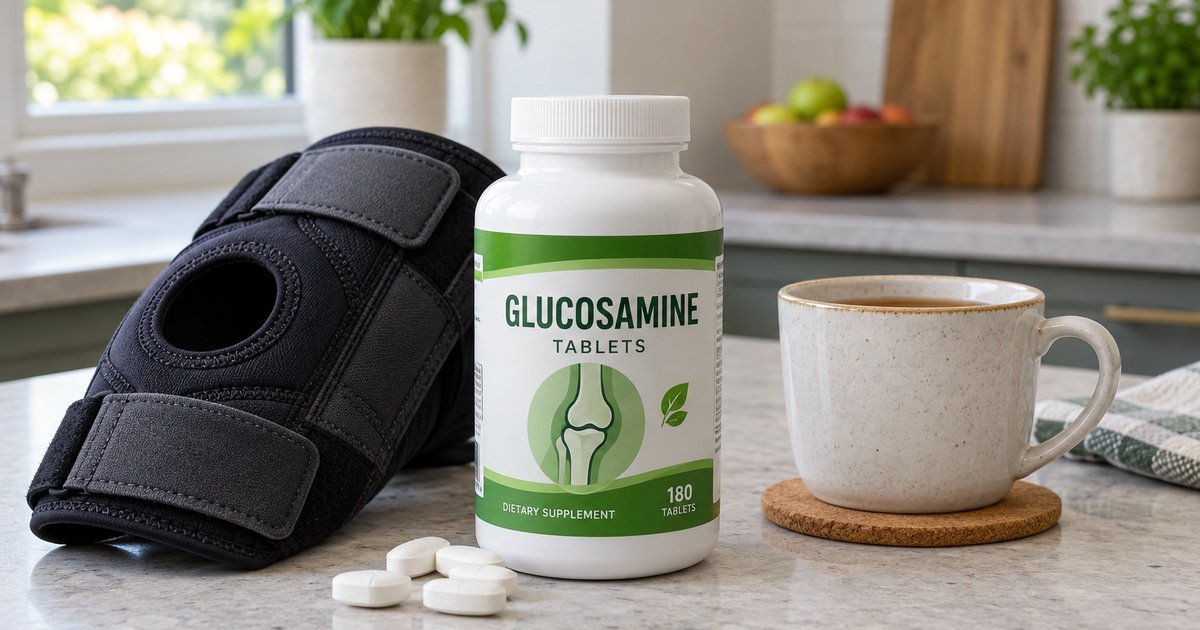
Does glucosamine work? The large, independent reviews give a mixed and mostly modest answer. The biggest publicly funded trial, the United States GAIT study, found glucosamine and chondroitin performed little differently from placebo for knee osteoarthritis symptoms overall, while other analyses have reported small effects, often in studies funded by manufacturers or using prescription-grade products. Major clinical guidelines disagree, and many advise against them for knee and hip osteoarthritis.
This guide includes a few product links near the end. As an Amazon Associate, michelle.net.au earns from qualifying purchases, at no extra cost to you.
This guide summarises what the major trials and reviews actually tested and found, why the results conflict, how to read a glucosamine or chondroitin label, and the safety points, such as shellfish sources and warfarin, that are worth raising with your doctor or pharmacist.
- Mixed evidence: the US National Center for Complementary and Integrative Health (NCCIH) describes the evidence on knee symptoms as inconsistent and the expert reviews as conflicting.
- GAIT, the largest independent trial: overall, results for the supplements were not meaningfully different from placebo over 24 weeks.
- Product form matters: some positive results came from prescription crystalline glucosamine sulfate or pharmaceutical-grade chondroitin, which may differ from supplements on the shelf.
- Check safety first: glucosamine is often made from shellfish, and both supplements have been linked with bleeding risk in people taking warfarin.
- Talk to your doctor or pharmacist before starting, especially if you take other medicines or have diabetes, allergies or a bleeding disorder.
What glucosamine and chondroitin are
Glucosamine and chondroitin are natural components of cartilage, the tissue that cushions the ends of bones in joints. As supplements, glucosamine is sold mainly as glucosamine sulfate or glucosamine hydrochloride, and chondroitin is sold as chondroitin sulfate. They are often combined in one product, sometimes alongside other ingredients such as MSM.
How they are regulated differs by country. In the United States they are sold as dietary supplements; in Australia they are generally sold as listed complementary medicines; and in some European countries certain glucosamine and chondroitin preparations are prescription medicines. That difference matters when reading the research, because studies of prescription-grade products do not automatically apply to everyday supplements.
The GAIT trial: what it tested and found
The Glucosamine/Chondroitin Arthritis Intervention Trial (GAIT) was funded by the US National Institutes of Health and published in the New England Journal of Medicine in 2006. It remains one of the largest independent trials of these supplements.
How it was designed
- 1,583 people with painful knee osteoarthritis took part across 16 US rheumatology centres.
- Participants were randomly assigned to one of five groups for 24 weeks: glucosamine (1,500 mg a day), chondroitin sulfate (1,200 mg a day), both together, celecoxib (a prescription anti-inflammatory used as a comparison), or placebo.
- The glucosamine used was glucosamine hydrochloride.
- A “response” was defined as at least a 20 per cent reduction in knee pain scores.
What it found
- Across all participants, the supplements were not significantly different from placebo. The response rate was about 60 per cent on placebo, compared with 64 to 66 per cent across the supplement groups and 70 per cent on celecoxib.
- The high placebo response is a key point: many people felt better regardless of what they took.
- In a smaller subgroup with moderate-to-severe pain, the combination group had a higher response rate than placebo. The researchers described this as exploratory and preliminary, needing confirmation in further studies.
The follow-up on joint structure
An ancillary GAIT study published in 2008 followed 572 participants for two years and measured the space between bones on knee X-rays, a marker of cartilage loss. According to the NCCIH summary, there was no difference in joint space width between placebo and any of the supplement or celecoxib groups.
What the big reviews and other trials found
Cochrane review of chondroitin (2015)
A Cochrane review of 43 randomised trials involving 9,110 people found that chondroitin, alone or with glucosamine, was associated with a small improvement in pain scores compared with placebo in short-term studies. However, most of the trials were judged to be of low quality, several were funded by manufacturers, and the result did not hold up in all sensitivity analyses. Chondroitin had a lower rate of serious adverse events than the comparison groups.
Other pooled analyses
The NCCIH fact sheet summarises several more recent analyses:
- A 2018 analysis of 29 studies (6,120 participants) reported that glucosamine or chondroitin alone was associated with lower overall pain scores, but the combination was not.
- A 2014 analysis of glucosamine (25 studies) found that studies of the prescription glucosamine formulation generally reported better results. NCCIH notes this may reflect genuine product differences or bias, because those studies were older, at higher risk of bias and funded by a pharmaceutical company.
- A 2019 analysis of chondroitin found a benefit with a great deal of inconsistency between studies, and among the better-quality studies, brands differed significantly.
An Australian trial
A two-year Australian trial published in 2015, with 605 participants, measured joint space narrowing in the knee. Only the combination of glucosamine and chondroitin was associated with less narrowing than placebo; neither supplement alone was. This conflicts with the GAIT X-ray findings, which is one reason reviewers describe the structural evidence as uncertain.
Hips, hands and other joints
Research on other joints is limited. NCCIH reports that a two-year hip study found no difference from placebo with glucosamine sulfate, while a six-month hand study found a difference favouring chondroitin. These are single studies and need confirmation.
What clinical guidelines say
Professional bodies have reached different conclusions from the same evidence, which partly explains the confusion.
| Guideline body | Region | Position (knee and/or hip osteoarthritis) |
|---|---|---|
| American College of Rheumatology and Arthritis Foundation (2019) | United States | Strongly recommends against glucosamine and chondroitin, alone or combined, for knee |
| OARSI (2019) | International | Strongly recommends against glucosamine and chondroitin for knee |
| Royal Australian College of General Practitioners (2018) | Australia | Conditional recommendation against glucosamine, chondroitin and the combination for knee and hip |
| NICE osteoarthritis guidance | United Kingdom | Has advised clinicians not to offer glucosamine or chondroitin products for osteoarthritis |
| American Academy of Orthopaedic Surgeons (2021) | United States | Lists both among options that may help in mild-to-moderate knee osteoarthritis, noting inconsistent evidence |
| ESCEO (2019) | Europe | Supports prescription crystalline glucosamine sulfate and prescription chondroitin sulfate; discourages other formulations |
Guidelines are updated over time, so ask your doctor which current guidance applies where you live.
Why the results conflict
- Different products: prescription crystalline glucosamine sulfate, glucosamine hydrochloride and over-the-counter supplements are not interchangeable, and quality varies between brands.
- Who funded the study: industry-funded trials have tended to report more favourable results than independent ones.
- Study quality: many older trials were small, short or had a higher risk of bias.
- A strong placebo response: osteoarthritis symptoms naturally go up and down, and many people improve on placebo.
- Different outcomes: some studies measured pain scores, others joint function or X-ray changes, over different time frames.
Sulfate vs hydrochloride: reading the label
Labels can be confusing, so it helps to know what to look for.
| Label term | What it means | What to check |
|---|---|---|
| Glucosamine sulfate | The form used in many European and prescription-product studies | Often stabilised with potassium chloride or sodium chloride, so the label may show a combined weight; check how much glucosamine itself is provided |
| Glucosamine hydrochloride | The form used in the GAIT trial | Evidence from sulfate studies should not be assumed to apply |
| Chondroitin sulfate | The usual chondroitin form; source is often animal cartilage, such as bovine, porcine, chicken or shark | Source animal if you have dietary, religious or ethical preferences |
| Source: shellfish, crustacean or mollusc | Glucosamine is commonly made from the shells of shellfish | Allergy warnings; some products use non-shellfish sources, often fermentation-derived |
| Amount per tablet vs per daily dose | You may need several tablets to reach the stated daily amount | Compare products on the daily dose, not the tablet count |
For a broader walk-through of labels and evidence, see the site’s guide to choosing supplements without wasting money and how to read a supplement label. Independent testing seals can also tell you something about quality, as explained in the guide to USP, NSF and Informed Sport seals.
Safety and interactions
NCCIH reports that large studies have not found major safety problems for most people. There are, however, some important cautions.
- Warfarin and blood thinners: regulators have received reports of increased INR (a blood clotting measure) and bleeding in people taking warfarin with glucosamine, with or without chondroitin. Australia’s TGA and the UK’s MHRA have both received such reports. Anyone taking warfarin or other blood thinners should talk to their doctor or pharmacist before starting, stopping or changing the dose of these supplements.
- Shellfish allergy: because glucosamine is often made from shellfish, check the source carefully. In Australia, the TGA requires warning statements on medicines containing certain shellfish-derived ingredients. If you have a shellfish allergy, ask your doctor or pharmacist before use.
- Blood glucose: NCCIH notes glucosamine may raise blood glucose in some people, so people with diabetes should check with their doctor.
- Pregnancy and breastfeeding: safety has not been well studied, so these supplements are generally best avoided unless your doctor advises otherwise.
- Side effects: mild digestive upsets are among the most commonly reported.
- Other medicines and surgery: tell your doctor, pharmacist and surgeon about every supplement you take.
Questions to ask your doctor or pharmacist
- Is there any reason this supplement is unsuitable with my current medicines, especially blood thinners?
- Is the source suitable for me if I have a shellfish allergy?
- Do I need any extra monitoring, such as INR checks or blood glucose readings?
- Which form and daily amount were used in the studies, and does this product match it?
- How would we judge whether it is worth continuing, and when should I review it?
- What other approaches to managing osteoarthritis are recommended in my situation?
Common mistakes to avoid
- Assuming all glucosamine is the same: research on prescription crystalline glucosamine sulfate does not automatically apply to a hydrochloride supplement.
- Counting tablets instead of milligrams: compare the stated daily amount of glucosamine and chondroitin.
- Ignoring the source: shellfish-derived glucosamine matters for anyone with an allergy.
- Not mentioning it to your doctor: supplements can interact with medicines such as warfarin.
- Relying on supplements alone: guidelines for osteoarthritis put strong emphasis on exercise, strength work and a healthy weight, discussed in the guide to strength training and bone density.
- Trusting dramatic marketing: the research is mixed and modest, so be cautious of products that promise more.
If you are comparing joint-related supplements, the site’s summary of what the research says about collagen and joint comfort takes a similar look at another popular option, and the guide to turmeric, curcumin and black pepper absorption covers a third.
Many glucosamine products also contain MSM, so it helps to know what the MSM research actually measured before paying extra for a combination.
Sources this guide draws on: the National Center for Complementary and Integrative Health fact sheet “Glucosamine and Chondroitin for Osteoarthritis” (updated October 2023); the NIH-funded Glucosamine/Chondroitin Arthritis Intervention Trial (Clegg and colleagues, New England Journal of Medicine, 2006) and its 2008 ancillary X-ray study; the 2015 Cochrane review of chondroitin for osteoarthritis; the RACGP Guideline for the management of knee and hip osteoarthritis (2018); NICE osteoarthritis guidance; published positions of the ACR, OARSI, AAOS and ESCEO; and pharmacovigilance reports on warfarin and glucosamine from the TGA, MHRA and Singapore’s Health Sciences Authority.
Handy kit for this guide
These are practical tools, not supplements or medicines. As an Amazon Associate, michelle.net.au earns from qualifying purchases, at no extra cost to you. Prices and availability are set by Amazon and may vary by country.
- Ezy Dose Weekly AM/PM Pill Organiser (X-Large)
Seven days with separate morning and evening compartments, so you can see at a glance what has already been taken.
View on Amazon - Vaydeer Metal 7-Day Travel Pill Case
Slim metal case with a built-in desiccant, for keeping a week of tablets dry in a bag or suitcase.
View on Amazon - Bambaw Insulated Stainless Steel Water Bottle (32 oz)
Plastic-free and keeps water cold all day, useful when a label says to take a product with a full glass of water.
View on Amazon
Frequently asked questions
Does glucosamine actually work for knees?
The evidence is mixed. The large, independent GAIT trial found results similar to placebo overall, while some other analyses have reported small effects, often in industry-funded studies or with prescription-grade products. Several major guidelines advise against it for knee osteoarthritis, so talk to your doctor about whether it is worth trying in your situation.
Is glucosamine sulfate better than glucosamine hydrochloride?
There is no strong head-to-head evidence. Many of the more positive trials used prescription crystalline glucosamine sulfate, while GAIT used hydrochloride. NCCIH notes that differences between studies may reflect product differences or bias, so the question remains open.
How long did the studies run?
GAIT’s main phase lasted 24 weeks, and its X-ray follow-up ran for two years. The trials in the Cochrane chondroitin review ranged from one month to three years.
Can I take glucosamine if I am allergic to shellfish?
Many glucosamine products are made from shellfish shells, so check the label and ask your doctor or pharmacist before taking it. Some products use non-shellfish sources.
Is glucosamine safe with warfarin?
Regulators in several countries have received reports of increased INR and bleeding in people taking warfarin with glucosamine. Do not start, stop or change the dose without talking to your doctor or pharmacist, who may recommend extra monitoring.
Is glucosamine and chondroitin better than either alone?
The results conflict. GAIT’s combination group was not significantly different from placebo overall, a 2018 analysis found no pain-score difference for the combination, and an Australian trial found less joint space narrowing only with the combination.
Glucosamine and chondroitin are among the most studied joint supplements, yet the best independent research shows modest or uncertain results. If you are considering them, read the label carefully, check the source and form, and talk to your doctor or pharmacist about whether they suit you and your medicines.