
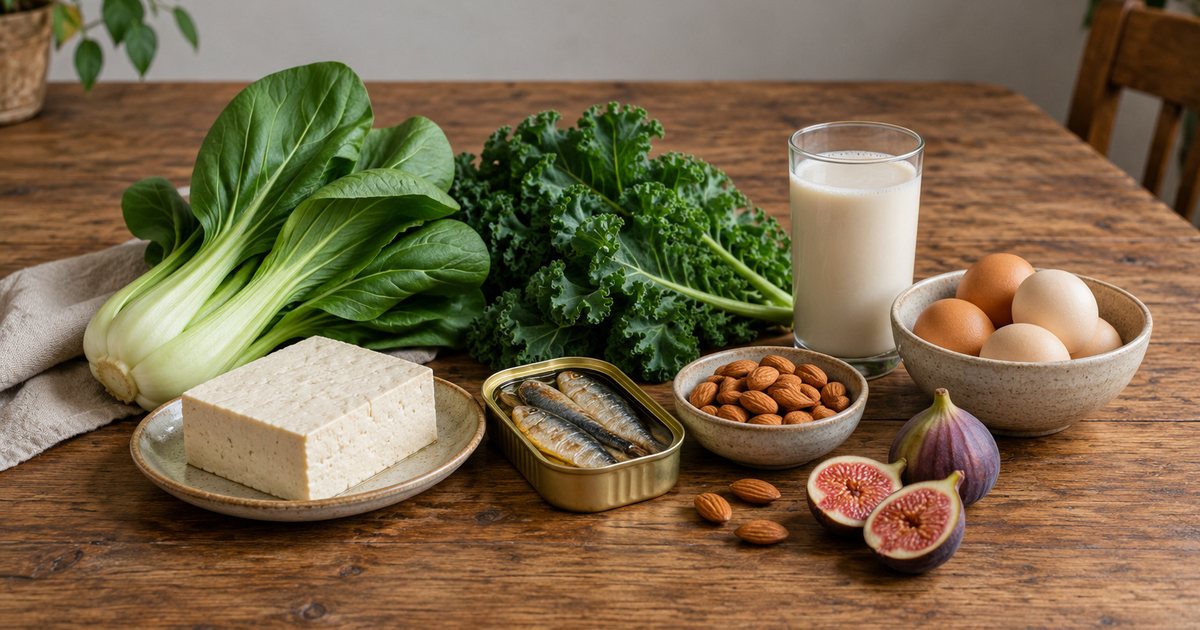
Do eggs have calcium? Yes, but only a little. One large egg contains roughly 24 mg of calcium according to United States Department of Agriculture (USDA) food composition data, which is around 2% of the 1,000 mg a day most adults are advised to get, so eggs are a minor source rather than a reliable way to meet your needs.
This guide includes a few product links near the end. As an Amazon Associate, michelle.net.au earns from qualifying purchases, at no extra cost to you.
If you avoid dairy, the calcium has to come from somewhere else. This guide sets out a practical list of non-dairy calcium foods with realistic serves, explains why some plant foods give you far more usable calcium than others, and walks through a sample day that reaches the recommended intake without milk, cheese or yoghurt.
At a glance
- Eggs are a small source: about 24 mg per large egg, so even two eggs a day add under 50 mg.
- Daily targets rise with age: in Australia, the recommended intake is 1,000 mg for most adults and 1,300 mg for women over 50 and men over 70.
- The strongest non-dairy sources are calcium-set tofu, canned fish eaten with the soft bones, and calcium-fortified plant milks.
- Not all greens are equal: spinach is high in calcium on paper but only about 5% is absorbed, while kale and bok choy are absorbed about as well as milk.
- Spread it out: the body absorbs calcium best in smaller amounts across the day.
How much calcium is in an egg?
USDA FoodData Central lists a whole large egg (about 50 g without the shell) at roughly 24 mg of calcium, or about 48 mg per 100 g. Some nutrition labels round this down to 20 mg. Either way, it is a small amount compared with the foods further down this page.
Eggs still earn a place in a bone-friendly diet. They provide protein, and egg yolks contain a small amount of vitamin D, which the body needs to absorb calcium. They simply should not be counted on as a calcium source. If you have been told you need more calcium, adding eggs will barely move the total.
What about eggshells?
Eggshells are mostly calcium carbonate, and powdered eggshell is sometimes sold or made at home as a supplement. Home preparation raises food safety questions and gives no reliable way to know how much calcium you are getting. If you are thinking about any calcium supplement, the safer path is a labelled product chosen with your doctor or pharmacist; the guide to calcium citrate vs carbonate explains how the two common forms differ.
How much calcium do you need each day?
Recommendations differ slightly between countries, so check the advice where you live. The figures below are from Australia’s Nutrient Reference Values (published by the NHMRC) and the United States NIH Office of Dietary Supplements.
| Adult group | Australia and New Zealand RDI (mg/day) | United States RDA (mg/day) |
|---|---|---|
| Women 19 to 50 | 1,000 | 1,000 |
| Men 19 to 50 | 1,000 | 1,000 |
| Women 51 to 70 | 1,300 | 1,200 |
| Men 51 to 70 | 1,000 | 1,000 |
| Women over 70 | 1,300 | 1,200 |
| Men over 70 | 1,300 | 1,200 |
There is also an upper limit. The NIH Office of Dietary Supplements sets it at 2,500 mg a day for adults up to 50 and 2,000 mg a day from age 51, counting food and supplements together. Most people who eat a varied diet without supplements will not come close, but it is one reason not to stack several calcium products on top of each other.
Non-dairy calcium foods: a practical list
The table below lists things rich in calcium that contain no dairy, with a realistic serve for each. Figures come from the NIH Office of Dietary Supplements calcium fact sheet (based on USDA data) and from Osteoporosis Australia’s calcium fact sheet (now Healthy Bones Australia). Brands vary, especially for tofu and fortified drinks, so always check the label.
| Food | Typical serve | Calcium (approx. mg) | Absorption note |
|---|---|---|---|
| Sardines, canned, with bones | 90 g | 325 to 486 | Eat the soft bones; that is where the calcium is |
| Calcium-fortified orange juice | 1 cup | about 350 | Fortified, so check the label; also high in natural sugar |
| Calcium-fortified soy milk | 1 cup (250 ml) | about 300 | Shake well; added calcium can settle at the bottom |
| Firm tofu, set with calcium sulfate | ½ cup | about 250 | Only if the label lists a calcium coagulant |
| Pink or red salmon, canned, with bones | 90 g | 180 to 200 | Mash the bones into the flesh |
| Soybeans, cooked | ½ cup | about 130 | Moderate absorption |
| Fortified breakfast cereal | 1 serve | varies, often around 130 | Check the nutrition panel |
| Kale, cooked | 1 cup | about 94 | Low oxalate; well absorbed |
| Chickpeas, cooked | 1 cup | about 90 | Moderate; contains phytate |
| Dried figs | 3 figs | about 80 | Also adds fibre and sugar |
| Chia seeds | 1 tablespoon | about 76 | Easy to add to breakfasts |
| Bok choy (Chinese cabbage), raw | 1 cup shredded | 65 to 74 | Low oxalate; well absorbed |
| Tahini | 1 tablespoon | about 66 | Energy-dense, so keep serves modest |
| Almonds | 10 nuts | about 30 | Small contribution |
| Wholemeal bread | 1 slice | about 30 | Adds up across the day |
| Egg, whole | 1 large | about 24 | Minor source |
| Spinach, boiled | ½ cup | about 123 | Only about 5% absorbed because of oxalate |
Why absorption matters as much as the number
The milligrams on a food chart tell you how much calcium is in the food, not how much your body takes up. Plant foods contain natural compounds that can bind calcium, and the effect varies widely.
Oxalate: the spinach problem
Spinach looks like a calcium star on paper, but it is very high in oxalate (oxalic acid), which binds calcium into a form the gut cannot absorb well. The NIH Office of Dietary Supplements reports that only about 5% of the calcium in spinach is absorbed, compared with about 27% from milk. Rhubarb, silverbeet and beet greens are also high in oxalate. Spinach is still a nutritious vegetable; it just should not be counted toward your calcium total.
Low-oxalate greens: kale, bok choy and friends
Kale, bok choy, broccoli and other members of the cabbage family are low in oxalate. Research on calcium bioavailability from plant foods, including work by Connie Weaver and colleagues published in the American Journal of Clinical Nutrition in 1999, found that calcium from these greens is absorbed about as well as calcium from milk. The catch is quantity: a cup of cooked kale has about a third of the calcium in a glass of milk, so greens work best as one contributor among several.
Phytate in beans, grains and seeds
Phytate (phytic acid), found in beans, wholegrains, nuts and seeds, can also reduce calcium absorption, though usually less than oxalate. Soaking, sprouting and cooking reduce phytate somewhat. A mixed diet tends to balance these effects out, which is why the NIH notes that oxalate and phytate are unlikely to matter much for people eating a varied diet.
Fortified foods: check the coagulant and the shake
Calcium-set tofu and fortified plant milks are among the most useful non-dairy options, but the calcium is only there if it was added. For tofu, look for calcium sulfate or calcium chloride in the ingredients; tofu set with magnesium chloride (nigari) alone contains much less. For plant milks, check the nutrition panel per 100 ml, because organic and “barista” versions are often unfortified. Shake the carton before pouring.
How to get calcium without dairy: step by step
- Know your target. Use the table above to find the figure for your age and sex.
- Pick two anchor foods. Choose two high-calcium staples you will actually eat most days, such as a fortified plant milk and calcium-set tofu, or canned salmon with bones.
- Read labels when you shop. Check that plant milks are fortified and that tofu lists a calcium coagulant.
- Add low-oxalate greens. Include kale, bok choy or broccoli most days rather than relying on spinach.
- Layer in small sources. Chia, tahini, almonds, figs, chickpeas and wholemeal bread each add a little.
- Spread it across meals. Several smaller amounts are absorbed more efficiently than one large dose.
- Think about vitamin D. Calcium absorption depends on adequate vitamin D; the guide to vitamin D in Australia covers sun, food and testing.
- Talk to your doctor or dietitian if you think you are falling short, especially if you have osteoporosis or take medicines that affect bone.
A sample dairy-free day
This example shows one way to reach about 1,300 mg using foods from the list. Amounts are approximate and depend on brands, so use it as a template rather than a precise prescription.
| Meal | Food | Approx. calcium (mg) |
|---|---|---|
| Breakfast | 1 cup fortified soy milk with cereal, plus 1 tablespoon chia seeds | about 375 |
| Lunch | 90 g canned salmon with bones on 2 slices wholemeal bread, with a boiled egg | about 285 |
| Snack | 10 almonds and 3 dried figs | about 110 |
| Dinner | ½ cup calcium-set firm tofu stir-fried with 1 cup bok choy and 1 cup cooked kale | about 415 |
| Evening | 1 cup fortified soy milk as a warm drink | about 300 |
| Total | about 1,485 |
Notice where most of the calcium comes from: fortified soy milk, tofu and canned fish supply well over two-thirds of the total. The egg adds about 24 mg. If you do not eat fish, a second serve of tofu or a fortified cereal can fill the gap. The fibre from beans, greens and figs is a bonus, and the guide to reading dietary fibre labels explains how to compare products.
Who should pay closer attention
- Women after menopause, because recommended intakes rise and bone loss speeds up in the years after menopause.
- Adults over 70, whose recommended intake is higher and whose appetite may be smaller.
- People following a vegan diet, who rely entirely on fortified foods and plants.
- People with lactose intolerance, who may be able to use lactose-free dairy instead of cutting dairy out entirely; check with a dietitian.
- Anyone taking medicines that affect bone or calcium, such as long-term corticosteroids; ask your doctor or pharmacist.
Food is only one part of bone health. Weight-bearing and muscle-strengthening exercise matter too, as the guide to strength training and bone density explains.
Common mistakes
- Counting eggs as a calcium source. At about 24 mg each, they make almost no difference to the daily total.
- Relying on spinach. Its calcium is poorly absorbed; use kale, bok choy or broccoli instead.
- Assuming every plant milk is fortified. Many organic, homemade and specialty versions contain very little calcium.
- Buying tofu without checking the coagulant. Calcium content varies widely between brands.
- Throwing away the fish bones. The soft bones in canned salmon and sardines are where the calcium is.
- Getting it all at once. One big calcium hit is absorbed less efficiently than several smaller ones.
- Adding supplements without adding up food. Combined intake can exceed the upper limit; review totals with your doctor or pharmacist first.
Quick checklist for your next shop
- Plant milk with calcium listed on the nutrition panel (look for around 120 mg per 100 ml or more)
- Firm tofu with calcium sulfate or calcium chloride in the ingredients
- Canned salmon or sardines with bones
- Kale, bok choy or broccoli
- Chia seeds, tahini or almonds for small top-ups
- Canned chickpeas or soybeans
- A fortified cereal if you eat one
For a broader picture of how calcium sits alongside other nutrients, see the vitamins and minerals starter guide, and for another bone-related mineral found in many of the same foods, the guide to magnesium foods.
Sources this guide draws on: NIH Office of Dietary Supplements Calcium Fact Sheet for Health Professionals; USDA FoodData Central; NHMRC Nutrient Reference Values for Australia and New Zealand; Osteoporosis Australia (Healthy Bones Australia) calcium fact sheet; Weaver, Proulx and Heaney, “Choices for achieving adequate dietary calcium with a vegetarian diet”, American Journal of Clinical Nutrition, 1999.
Handy kit for this guide
These are practical everyday products, not supplements or medicines. As an Amazon Associate, michelle.net.au earns from qualifying purchases, at no extra cost to you. Prices and availability are set by Amazon and may vary by country.
- The Blue Zones Kitchen by Dan Buettner
100 everyday recipes built around beans, greens and whole grains.
View on Amazon - The Complete Mediterranean Cookbook (America’s Test Kitchen)
500 kitchen-tested recipes with plenty of fish, legumes and vegetables.
View on Amazon - Etekcity Digital Kitchen Scale
Reads in grams, handy for portions, recipes and checking a scoop against a label.
View on Amazon
Frequently asked questions
Do eggs have calcium?
Yes, a little. A large egg contains roughly 24 mg of calcium, about 2% of a typical adult target of 1,000 mg. Eggs are useful for protein and provide a small amount of vitamin D, but they are not a meaningful calcium source.
What non-dairy food has the most calcium?
Among everyday foods, canned sardines with bones, calcium-set firm tofu and calcium-fortified plant milks and juices give the most calcium per serve, often 250 mg or more. Exact amounts vary by brand, so check the label.
Is calcium from plant foods absorbed as well as calcium from milk?
It depends on the plant. Low-oxalate greens such as kale and bok choy are absorbed about as well as milk, while spinach is absorbed very poorly. Fortified soy milk and calcium-set tofu are generally considered reasonable sources, though absorption can vary with the type of calcium added.
Can you get enough calcium without dairy?
Yes, with planning. Most people find it easiest to build the day around two or three high-calcium foods, such as fortified plant milk, calcium-set tofu and canned fish with bones, then add greens, seeds and legumes. A dietitian can help if you are unsure.
Should I take a calcium supplement if I don’t eat dairy?
Not automatically. Many health bodies encourage meeting calcium needs from food first, and supplements are best discussed with your doctor or pharmacist, who can consider your diet, bone health and any medicines you take.
Eggs are a good food but a poor calcium source. A few well-chosen staples, read off the label and spread across the day, will do far more for your total than any amount of eggs or spinach.