
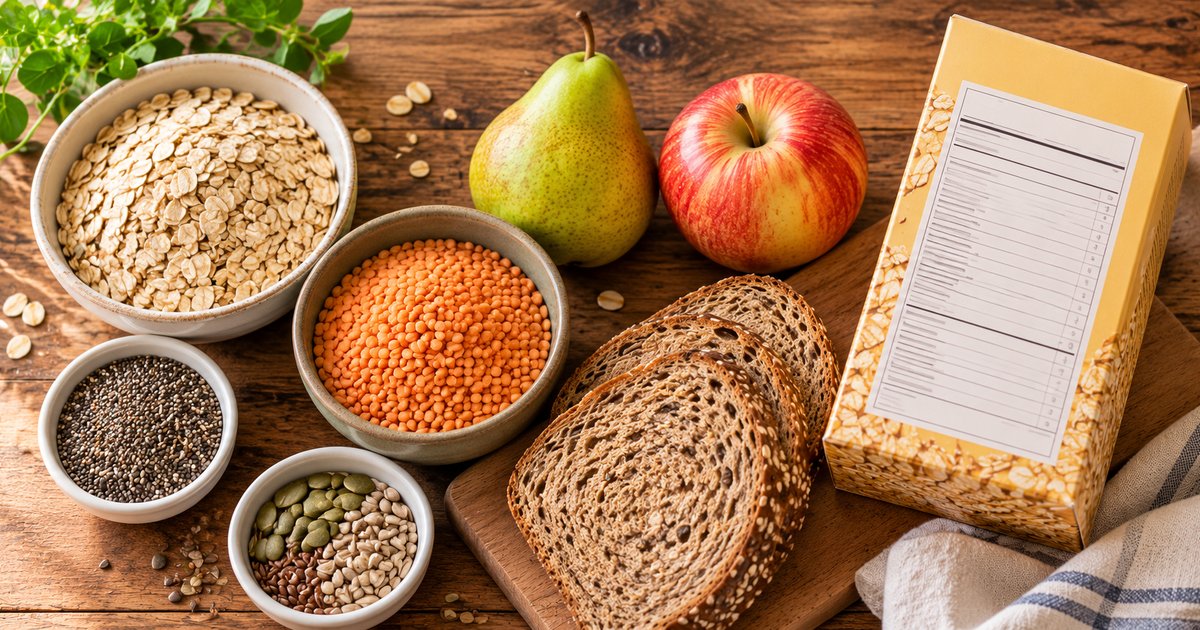
To read the fibre on a food label, find the dietary fibre line in the nutrition panel and compare products using the grams per 100 g column, not the front-of-pack claim. Then check the ingredient list to see where the fibre comes from: whole grains, legumes, fruit and vegetables, or added fibres such as inulin and polydextrose. Reference intakes for adults sit at roughly 25 to 38 g a day depending on the country, age and sex, and most people in countries that survey intakes eat less than that.
This guide includes a few product links near the end. As an Amazon Associate, michelle.net.au earns from qualifying purchases, at no extra cost to you.
This guide explains what dietary fibre is, where it comes from, how much is recommended in different countries, how fibre labels and claims differ between Australia and New Zealand, the United States, the UK and the European Union, and how to compare two products in under a minute.
The only affiliate links in this article are to the practical items listed near the end.
At a glance
- Use grams per 100 g to compare products, and grams per serving to see what you would actually eat.
- Claim thresholds differ by country. “Good source of fibre” means at least 4 g per serving in Australia and New Zealand, 10 to 19 per cent of the Daily Value in the United States, and the EU uses “source of fibre” at 3 g per 100 g.
- Carbohydrate figures are not calculated the same way everywhere. US labels include fibre inside total carbohydrate; Australian, New Zealand, UK and EU labels list it separately.
- Read the ingredients. A high fibre number can come from whole foods or from added, isolated fibres.
- Increase slowly and drink enough fluid, and ask a doctor, dietitian or pharmacist first if you have a digestive condition or take regular medicines.
What dietary fibre is
Dietary fibre is the part of plant foods that is not digested and absorbed in the small intestine. It travels to the large intestine, where some types are fermented by gut bacteria and others pass through largely unchanged.
You will see fibre described in two main ways:
- Soluble and insoluble. Soluble fibre dissolves or swells in water and forms a gel, as with oats and psyllium. Insoluble fibre does not dissolve and adds bulk, as with wheat bran and vegetable skins. Most whole plant foods contain both.
- Fermentable and non-fermentable. This describes what gut bacteria do with it. It is a more useful description of how fibre behaves, but it is almost never printed on a label.
Resistant starch is starch that escapes digestion in the small intestine and behaves like fibre. It occurs in legumes, slightly green bananas and potatoes, pasta or rice that have been cooked and cooled. Whether it is counted in a label’s fibre figure depends on the country’s definition and the laboratory method used.
Where fibre comes from
Fibre occurs naturally only in plant foods. Meat, fish, eggs and dairy contain none unless fibre has been added. The main sources are:
- Legumes: beans, lentils, chickpeas and split peas, which are among the most fibre-dense everyday foods.
- Whole grains: oats, barley, rye, brown rice, wholemeal and wholegrain breads and cereals.
- Vegetables, especially with skins and stalks.
- Fruit, eaten whole rather than juiced, and dried fruit.
- Nuts and seeds, including linseed, chia and almonds.
Refining removes fibre. White flour, white rice and juiced fruit contain less fibre than their whole versions, because most of it sits in the outer layers that processing strips away. That is a fact about composition, not a verdict on any food.
How much fibre is recommended
Reference values differ between countries because they are set by different expert bodies using different methods. The table shows several common ones for adults.
| Country or body | Adult reference value | Type of value |
|---|---|---|
| Australia and New Zealand (NHMRC Nutrient Reference Values) | 30 g a day for men, 25 g a day for women | Adequate Intake |
| United States and Canada (National Academies) | 14 g per 1,000 kcal; about 38 g for men and 25 g for women aged 19 to 50, and 30 g and 21 g from age 51 | Adequate Intake |
| United Kingdom (SACN, 2015) | 30 g a day for adults | Population recommendation |
| European Union (EFSA) | 25 g a day for adults | Adequate Intake |
| World Health Organization (2023) | At least 25 g a day of naturally occurring fibre for adults | Guideline |
An Adequate Intake is a population benchmark set from the intakes of healthy groups. It is not a personal prescription and it is not a promise about any health outcome. Values for children, pregnancy and some medical conditions differ. A doctor or accredited dietitian can tell you what makes sense for you, especially if you have a digestive condition or follow a special diet.
Reading the fibre line on a label
Most nutrition panels list dietary fibre near carbohydrate and sugars. Two columns matter:
- Per 100 g (or per 100 mL) lets you compare products fairly, whatever the pack size.
- Per serving tells you what you would get from a typical portion, but serving sizes are set by the manufacturer and differ between brands.
United States labels show a per-serving figure and a percentage of the Daily Value (%DV) rather than a per-100 g column, so you need to compare serving sizes yourself.
How carbohydrate and fibre fit together
This is the difference that confuses travellers and online shoppers most. On a US Nutrition Facts label, dietary fibre is listed as part of “Total Carbohydrate”, so the carbohydrate figure includes it. On Australian, New Zealand, UK and EU labels, fibre is listed separately and is not included in the carbohydrate figure. The same food can therefore show a higher carbohydrate number on a US-style label than on a European or Australian one.
“Net carbs”, which appears on some low-carbohydrate products, is a marketing term calculated by subtracting fibre (and sometimes sugar alcohols) from total carbohydrate. It is not defined by regulators in these countries and is not comparable between brands. On Australian, New Zealand, UK and EU panels the fibre has already been excluded from carbohydrate, so subtracting it again gives a misleading figure.
Is fibre always on the label?
Not everywhere. Fibre must be declared on US Nutrition Facts labels. In Australia and New Zealand, it has to be declared in the nutrition information panel when the product makes a claim about fibre, and many manufacturers include it anyway. In the EU and UK, fibre is a voluntary addition to the nutrition declaration. A missing fibre line does not mean a food has none; it may simply not be listed.
What fibre claims mean in different countries
Front-of-pack wording is regulated, but the thresholds vary. The table summarises the main rules at the time of writing (October 2026).
| Claim | Australia and New Zealand | United States | European Union and UK |
|---|---|---|---|
| Basic claim (“contains fibre”, “source of fibre”) | At least 2 g per serving | “Good source”: 10 to 19% of the 28 g Daily Value per serving (about 2.8 to 5.3 g) | “Source of fibre”: at least 3 g per 100 g or 1.5 g per 100 kcal |
| Good source | At least 4 g per serving | As above | No separate “good source” level |
| Highest claim | “Excellent source”: at least 7 g per serving | “High”, “rich in” or “excellent source”: 20% or more of the Daily Value (5.6 g or more) per serving | “High fibre”: at least 6 g per 100 g or 3 g per 100 kcal |
| Basis | Per serving | Per serving | Per 100 g or per 100 kcal |
Because Australia, New Zealand and the US base claims on a manufacturer-set serving, a larger serving can make a claim easier to reach. The EU rule is per 100 g, which makes products easier to compare. Other countries set their own rules, so check your local food regulator if you shop elsewhere.
Whole-food fibre and added fibre
Manufacturers can raise a product’s fibre figure by adding isolated or modified fibres such as inulin (often from chicory root), polydextrose, resistant dextrin or wheat dextrin, oat fibre and psyllium. Whether these count as dietary fibre depends on each regulator’s definition, and the rules for added fibres are stricter in some countries than others.
There is nothing hidden about it: added fibres must appear in the ingredient list. The difference is what else comes with the fibre. Whole grains, legumes, fruit and vegetables bring a wider range of nutrients along with it, while a bar or biscuit with added inulin may have a high fibre number and little else. Some people also find large amounts of certain added fibres, inulin in particular, cause wind or bloating. The guide to reading protein bar labels covers this in more detail, because added fibres are common in bars.
Compare two products in under a minute
- Match the column. Use grams per 100 g. On a US label, divide by the serving size to get the same basis.
- Compare the fibre number, not the claim on the front.
- Read the first three ingredients. If whole grains, legumes or vegetables lead the list, most of the fibre comes from whole foods. If an added fibre appears high up, it is doing a lot of the work.
- Check sugar and sodium on the same panel. A high-fibre product can still be high in either.
- Check the serving size you would actually eat, then work out grams of fibre per portion.
- Compare price per 100 g, not per pack.
A worked example (illustrative figures, not real products): Cereal A says “high fibre” and lists 9 g of fibre per 100 g, with oats and wheat bran as the first ingredients. Cereal B says “excellent source of fibre” and lists 12 g per 100 g, but its serving size is 60 g and its third ingredient is inulin. Cereal B has more fibre on paper, partly from added fibre and a large serving. Neither is wrong. The label simply tells you which kind of fibre you are buying and how much you would get from the portion you actually eat.
Getting more fibre from food
Most of the reference values above assume fibre comes from a varied diet. Simple swaps add up across a day:
- wholegrain or wholemeal bread instead of white;
- a handful of lentils, beans or chickpeas added to soups, salads and sauces;
- whole fruit instead of juice;
- oats, barley or brown rice in place of refined grains some of the time;
- vegetables left unpeeled where practical, and a few nuts or seeds.
The guides to nutrition habits for active adults and eating patterns behind the anti-inflammatory food label include more everyday ideas.
People who eat very little fibre and increase it quickly often notice wind, bloating or a change in bowel habits. Dietary guidance generally suggests increasing gradually over a few weeks and drinking enough fluid, because fibre absorbs water. If you have a digestive condition, a medically prescribed diet, or symptoms that concern you, talk to your doctor or an accredited dietitian.
Fibre supplements
Fibre is also sold as powders, capsules and gummies, using psyllium husk, inulin, methylcellulose, wheat dextrin and other ingredients. Read them as you would any supplement: the amount of fibre per serving, the serving size, the type of fibre named, and any added sugar or sweetener. Fibre supplements can change how quickly some medicines are absorbed, so if you take regular medication, ask your pharmacist about timing before you start.
The guides to psyllium fibre supplements and how to read a supplement label cover the details, and the supplements evidence and label guide explains how to judge any supplement before you spend money on it. This article does not recommend any fibre product.
Common mistakes
- Trusting the front of the pack. Claim thresholds vary by country and are often per serving. The panel is the reliable number.
- Comparing per-serving figures with different serving sizes. Always switch to per 100 g.
- Subtracting fibre twice. On Australian, New Zealand, UK and EU labels, fibre is already excluded from carbohydrate.
- Assuming no fibre line means no fibre. In some countries fibre is optional on the panel unless a claim is made.
- Ignoring where the fibre comes from. Added fibres are listed in the ingredients; check them if whole-food fibre matters to you.
- Increasing fibre all at once. A sudden jump is a common reason people give up. Build up slowly with plenty of fluid.
Fibre label checklist
- Find the dietary fibre line and use grams per 100 g.
- Check the serving size you would really eat.
- Read the first three ingredients for whole grains, legumes, fruit or vegetables.
- Look for added fibres such as inulin, polydextrose or resistant dextrin.
- Check sugar and sodium on the same panel.
- Read “net carbs” as marketing, not a regulated figure.
- If you take medicines or have a digestive condition, talk to your doctor or pharmacist before adding fibre supplements.
Sources this guide draws on: National Health and Medical Research Council and New Zealand Ministry of Health, Nutrient Reference Values for Australia and New Zealand (dietary fibre); National Academies of Sciences, Engineering, and Medicine, Dietary Reference Intakes for Energy, Carbohydrate, Fiber, Fat, Fatty Acids, Cholesterol, Protein, and Amino Acids; Scientific Advisory Committee on Nutrition, Carbohydrates and Health (2015); European Food Safety Authority, Scientific Opinion on Dietary Reference Values for carbohydrates and dietary fibre (2010); World Health Organization, guideline on carbohydrate intake for adults and children (2023); Australia New Zealand Food Standards Code, Schedule 4, Nutrition, health and related claims; US Food and Drug Administration, Daily Value and nutrient content claim rules; Regulation (EC) No 1924/2006 on nutrition and health claims.
Handy kit for this guide
These are practical everyday products, not supplements or medicines. As an Amazon Associate, michelle.net.au earns from qualifying purchases, at no extra cost to you. Prices and availability are set by Amazon and may vary by country.
- The Blue Zones Kitchen by Dan Buettner
100 everyday recipes built around beans, greens and whole grains.
View on Amazon - The Complete Mediterranean Cookbook (America’s Test Kitchen)
500 kitchen-tested recipes with plenty of fish, legumes and vegetables.
View on Amazon - Etekcity Digital Kitchen Scale
Reads in grams, handy for portions, recipes and checking a scoop against a label.
View on Amazon
Frequently asked questions
How much fibre should I eat a day?
For adults, reference values range from about 25 g to 38 g a day depending on the country, sex and age. Australia and New Zealand use 30 g for men and 25 g for women, and the UK recommends 30 g for adults. Your own needs depend on your health and diet, so a dietitian or doctor is the right person to ask for personal advice.
What does “good source of fibre” mean?
It depends on where the food is sold. In Australia and New Zealand it means at least 4 g of fibre per serving. In the United States it means 10 to 19 per cent of the 28 g Daily Value per serving. The EU uses “source of fibre” for at least 3 g per 100 g and “high fibre” for at least 6 g per 100 g.
Is fibre included in carbohydrates on a label?
On US Nutrition Facts labels, yes: fibre is part of total carbohydrate. On Australian, New Zealand, UK and EU labels, no: fibre is listed separately and is not counted in the carbohydrate figure. Check which format you are reading before doing any calculations.
Are added fibres like inulin as good as fibre from whole foods?
They count as dietary fibre on the label where regulators accept them, but they do not bring the other nutrients found in whole grains, legumes, fruit and vegetables. Some people also find large amounts cause wind. Whole-food sources are the basis of national dietary guidelines, and added fibres are a matter of personal choice.
Why does more fibre make me bloated?
A sudden increase gives gut bacteria more to ferment, which produces gas. Increasing gradually over several weeks and drinking enough fluid usually makes the change easier. Ongoing or worrying symptoms are a reason to see your doctor.
Should I take a fibre supplement?
Most dietary guidelines encourage getting fibre from food first. Some people use supplements such as psyllium on the advice of a health professional. Because fibre supplements can affect the absorption of some medicines, talk to your doctor or pharmacist before starting one.
Reading fibre on a label takes a few seconds once you know where to look: grams per 100 g, the first few ingredients, and the claim rules for the country the food was labelled for. Use the panel, not the slogan, and build up slowly from whole foods.
This guide is general education about food labels and nutrition. It is not medical or dietary advice. If you have a digestive or other health condition, follow a prescribed diet or take regular medicines, talk to your doctor, pharmacist or an accredited dietitian before changing your diet or using fibre supplements.