
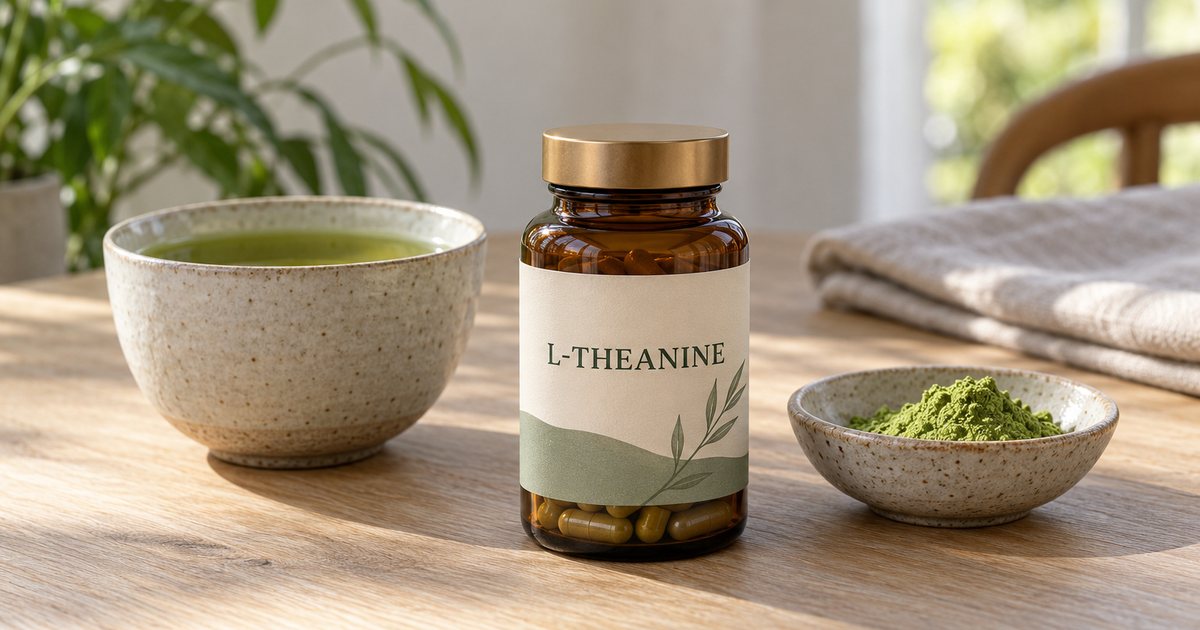
L-theanine is an amino acid found naturally in tea leaves (Camellia sinensis). It is not one of the amino acids your body uses to build protein, and you do not need it in your diet, but it is one of the compounds that gives green tea its savoury, slightly sweet taste. It is also sold on its own as a supplement, usually in capsules containing far more than a cup of tea provides.
This guide includes a few product links near the end. As an Amazon Associate, michelle.net.au earns from qualifying purchases, at no extra cost to you.
This guide explains where L-theanine comes from, how much is in green, black and matcha tea compared with a typical supplement label, what the small human trials have actually measured, and what to check before buying a theanine supplement. The current search results are dominated by shops and brand pages; this guide does not recommend any supplement brand and states study sizes plainly.
At a glance
- What it is: a non-protein amino acid that occurs mainly in tea, with very small amounts in a few mushrooms.
- Tea vs capsules: one Japanese trial noted a cup of green tea typically contains roughly 8 to 30 mg, while supplement labels commonly list 100 to 200 mg or more per capsule.
- What studies looked at: relaxation and stress ratings, sleep quality scores, and attention when taken with caffeine.
- How strong is the evidence? Limited. Most trials are small, short and in healthy adults; reviewers say larger, longer studies are needed.
- Talk to your doctor or pharmacist before using it with medicines, during pregnancy or breastfeeding, or for an ongoing health concern.
What is L-theanine?
Chemically, L-theanine is a close relative of glutamate and glutamine, two amino acids involved in brain signalling and metabolism. Tea plants make it in their roots and move it to the young leaves. Sunlight converts some of it into other compounds, which is why tea grown in shade before harvest tends to be richer in theanine.
The “L” refers to the form found in nature. Supplements may list “L-theanine”, “theanine” or a branded ingredient such as Suntheanine, which is a branded L-theanine ingredient produced by a Japanese company. A branded name tells you who makes the ingredient; it does not by itself tell you how much is in each capsule or whether the product has been independently tested.
Is L-theanine the same as caffeine?
No. Tea contains both, but they are different compounds. Caffeine is a stimulant; L-theanine is not. Much of the research interest comes from the fact that tea delivers the two together, and several trials have tested them in combination.
How much L-theanine is in tea?
Theanine content varies a great deal with tea type, growing conditions, harvest time, leaf grade, how much tea you use and how long you steep it. That is why published figures cover wide ranges and why it is hard to give one number for “a cup of green tea”.
| Source | What to expect | Why it varies |
|---|---|---|
| Green tea (brewed) | Roughly 8 to 30 mg per cup, as cited in a 2019 Japanese trial | Leaf quality, amount of tea, water temperature and steeping time |
| Black tea (brewed) | Also contains theanine; amounts vary widely between products | Leaf grade, processing and brew strength all matter |
| Matcha and shade-grown teas | Often higher than ordinary green tea per serve | Shading raises theanine, and with matcha you consume the whole powdered leaf |
| Herbal “teas” (chamomile, peppermint, rooibos) | No meaningful theanine | Not made from the tea plant |
| Supplement capsule | Commonly 100 to 200 mg or more per capsule on the label | Set by the manufacturer; check the label |
The practical point: getting the amounts used in most trials (200 to 400 mg a day) from tea alone would take many cups, along with a lot of caffeine. Reading green tea L-theanine or matcha tea theanine claims with that in mind helps keep expectations realistic.
What the research has looked at
Research on L-theanine falls into three main areas. In each, the studies are mostly small, short and in healthy volunteers, so results are best read as early findings rather than settled answers.
| Research area | Example study | Size and design | What was measured and found |
|---|---|---|---|
| Stress and relaxation | Williams and colleagues, Plant Foods for Human Nutrition, 2020 (systematic review) | 9 randomised controlled trials, typically using 200 to 400 mg a day | Reported that L-theanine may reduce stress and anxiety ratings in people exposed to stressful conditions; authors said longer, larger studies are needed |
| Sleep quality and stress symptoms | Hidese and colleagues, Nutrients, 2019 | 30 healthy adults aged 20 to 69, crossover, 200 mg a day for 4 weeks vs placebo | Self-rated sleep, stress and anxiety scores improved; some sleep subscales differed from placebo, but many other differences from placebo were not significant |
| Attention with caffeine | Camfield and colleagues, Nutrition Reviews, 2014 (systematic review and meta-analysis) | 11 randomised placebo-controlled trials | The theanine and caffeine combination showed moderate effects on alertness and attention-switching accuracy in the first two hours |
Reading the stress and sleep studies honestly
The Hidese trial is often quoted on product pages. It was well designed in some respects (double-blind, placebo-controlled, crossover), but it had only 30 participants, lasted four weeks per phase, and included healthy people without a diagnosed sleep or anxiety condition. Several improvements seen after L-theanine were not statistically different from the placebo phase. That makes it a useful pilot, not proof of a benefit for everyone.
Reading the caffeine combination studies
Most of the attention studies tested a single dose of theanine with caffeine and measured performance over the following hour or two in a laboratory. It is hard to separate the effect of theanine from the well-known effect of caffeine itself, and short lab tasks do not necessarily reflect everyday life. If you are sensitive to caffeine, the caffeine content of a combined product deserves as much attention as the theanine.
For everyday worries and stress, the guide to everyday anxiety covers signs and next steps, and anyone with ongoing anxiety or sleep problems should talk to a doctor rather than relying on a supplement.
Side effects of L-theanine and safety
In the published trials, L-theanine has generally been well tolerated over periods of weeks. The Hidese trial reported no apparent adverse events and no meaningful changes in blood tests over four weeks. That said, the trials are short and small, and they do not tell us much about long-term use, older adults taking several medicines, or people with medical conditions.
- Medicines: ask your pharmacist before combining L-theanine with sedatives, sleep medicines, blood pressure medicines, stimulants or medicines for mental health conditions.
- Pregnancy and breastfeeding: there is not enough safety information, so seek medical advice first.
- Combination products: many theanine products also contain caffeine, magnesium, herbs or melatonin (where legal), each with its own cautions.
- Driving and alertness: notice how any product affects you before driving or operating machinery.
Theanine supplement labels: what to check
- Find the amount per capsule and per serve. The serve may be one, two or more capsules.
- Check the form. Look for L-theanine (or a named branded L-theanine). “Green tea extract” is not the same thing and may contain mostly other compounds.
- Look for other active ingredients. Caffeine, magnesium, herbs and vitamins change the safety picture.
- Check regulation where you live. Rules differ between countries; in Australia, supplements are regulated by the Therapeutic Goods Administration, and listed products carry an AUST L number.
- Look for independent testing. Third-party seals can confirm what is in the bottle; the guide to supplement certification seals explains what each one means.
- Be wary of big promises. Claims such as “instant calm” go well beyond the evidence.
- Check with your pharmacist if you take any regular medicines.
For a general walk-through of supplement labels, see how to read a supplement label.
Best time to take theanine: what the studies did
This guide cannot give individual dosing advice, but it can describe how the research was done. In the Hidese sleep and stress trial, participants took their tablet before bed each night. In the caffeine combination studies, theanine was usually given as a single dose before a set of morning or daytime tasks. Those timings were chosen for the research questions, not as general recommendations. Your doctor or pharmacist is the right person to advise on whether, when and how much.
L-theanine vs L-tyrosine
| Feature | L-theanine | L-tyrosine |
|---|---|---|
| Type | Non-protein amino acid | Protein-building amino acid |
| Main food sources | Tea | Protein foods such as meat, fish, eggs, dairy, soy and legumes |
| Main research interest | Relaxation ratings, sleep quality, attention with caffeine | Mental performance during demanding or stressful tasks |
| Role in the body | Not required in the diet | A building block of protein and of some brain chemical messengers |
| Evidence strength | Limited, small trials | Limited, small trials |
People often see the two side by side in “focus” products, but they are studied for different reasons and are not interchangeable.
Magnesium and L-theanine products
Magnesium and L-theanine are often combined in evening products. The combination itself has been studied much less than either ingredient alone. If you are comparing these products, the guides to magnesium supplement forms and magnesium glycinate and sleep explain what the magnesium side of the label means. General sleep habits are covered in sleep and ageing.
Common mistakes
- Assuming tea and capsules are equivalent. A cup of tea provides a fraction of the amounts used in most trials.
- Taking small trials as proof. Thirty healthy volunteers over four weeks is a starting point, not a conclusion.
- Ignoring the caffeine. Many “focus” products pair theanine with caffeine, which has its own effects on sleep and heart rate.
- Confusing green tea extract with L-theanine. Extracts are often standardised for other compounds and some carry their own safety warnings.
- Using a supplement instead of seeing a doctor. Persistent poor sleep, anxiety or low mood deserve a proper assessment.
- Stacking several calming products. Combining multiple supplements and medicines can add up; check with a pharmacist.
Sources this guide draws on: Hidese S and colleagues, randomised controlled trial of L-theanine on stress-related symptoms and cognitive function in healthy adults, Nutrients, 2019; Williams JL and colleagues, systematic review of L-theanine and stress and anxiety, Plant Foods for Human Nutrition, 2020; Camfield DA and colleagues, systematic review and meta-analysis of tea constituents on cognition and mood, Nutrition Reviews, 2014; Therapeutic Goods Administration information on listed medicines.
Handy kit for this guide
These are practical tools, not supplements or medicines. As an Amazon Associate, michelle.net.au earns from qualifying purchases, at no extra cost to you. Prices and availability are set by Amazon and may vary by country.
- Ezy Dose Weekly AM/PM Pill Organiser (X-Large)
Seven days with separate morning and evening compartments, so you can see at a glance what has already been taken.
View on Amazon - Vaydeer Metal 7-Day Travel Pill Case
Slim metal case with a built-in desiccant, for keeping a week of tablets dry in a bag or suitcase.
View on Amazon - Bambaw Insulated Stainless Steel Water Bottle (32 oz)
Plastic-free and keeps water cold all day, useful when a label says to take a product with a full glass of water.
View on Amazon
Frequently asked questions
What is L-theanine in simple terms?
It is an amino acid that tea plants make, which contributes to the taste of tea. It is also sold as a supplement. Your body does not need it to function, unlike essential amino acids from protein.
Does green tea have enough L-theanine to make a difference?
A cup of green tea typically contains roughly 8 to 30 mg, while most trials used 200 to 400 mg a day. Whether the smaller amounts in tea have any noticeable effect has not been well studied.
What are the side effects of L-theanine?
Short trials in healthy adults have generally reported it as well tolerated, with few side effects noted. Long-term safety and use alongside medicines are less well studied, so check with your doctor or pharmacist, especially if you take sedatives or blood pressure medicines.
Is matcha higher in theanine than regular green tea?
Often, yes. Matcha is made from shade-grown leaves, which tend to contain more theanine, and you drink the whole powdered leaf. Matcha also contains caffeine, so the overall effect is not the same as a theanine capsule.
What is Suntheanine?
Suntheanine is a branded L-theanine ingredient used by many supplement makers. The brand name identifies the ingredient’s maker; you still need to check the amount per serve, other ingredients and independent testing on the product label.
L-theanine is a genuine and interesting part of tea, and early research is worth following. For now, the evidence is limited and the most honest approach is to enjoy tea for what it is, read supplement labels carefully, and talk to a health professional before adding a capsule.