
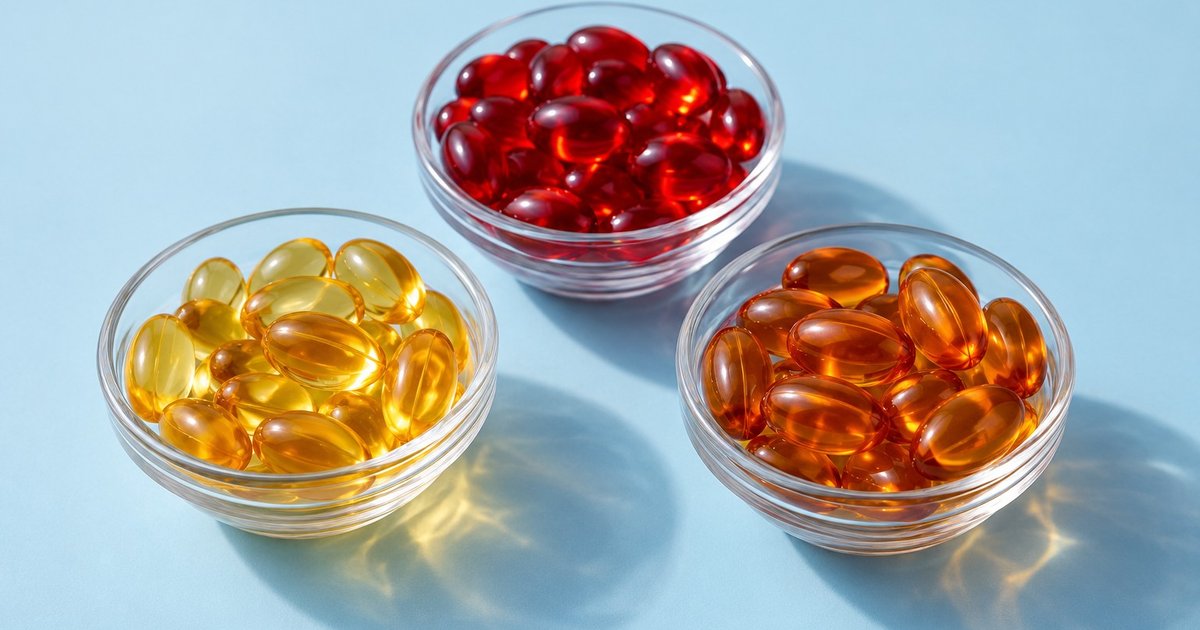
Fish oil, krill oil and algae oil all supply the same two long-chain omega-3 fats, EPA and DHA. The real differences are where the oil comes from, the chemical form the omega-3 is in, how much you get per capsule, what it costs per gram of EPA and DHA, and who can take it: krill is a crustacean, fish oil is not suitable for vegetarians, and algae oil is the plant-based option. Fish oil has by far the largest body of research behind it.
This guide includes a few product links near the end. As an Amazon Associate, michelle.net.au earns from qualifying purchases, at no extra cost to you.
This guide compares the three sources side by side: what each one is, what the research says about absorption, purity and sustainability, who each suits, and how to decide. It does not repeat how to read the EPA and DHA numbers on a label, which is covered in detail in the guide on how to read an omega-3 label.
At a glance
- All three provide EPA and DHA. The amount per capsule, not the source, is usually the bigger difference between products.
- Krill oil carries its omega-3 mostly as phospholipids. Comparisons of absorption with fish oil have been mixed, and many early studies compared unequal doses.
- Algae oil is where the omega-3 in fish originally comes from. It suits vegetarians and vegans, but check the capsule shell.
- Krill oil is a crustacean product and is generally best avoided by anyone with a shellfish allergy unless their doctor says otherwise.
- If you take blood-thinning medicines or are planning surgery, talk to your doctor or pharmacist before taking any omega-3 supplement.
Where each oil comes from
Fish oil
Most fish oil is made from small, oily fish such as anchovies, sardines and mackerel, and some comes from salmon, tuna or by-products of fish processing. Cod liver oil is a separate product made from the liver rather than the flesh, and it naturally contains vitamins A and D as well as omega-3. The crude oil is refined, and many products are concentrated so that a capsule holds more EPA and DHA than the natural oil would.
Krill oil
Krill oil comes from Antarctic krill, a small crustacean that lives in huge swarms in the Southern Ocean. The oil is naturally red because it contains astaxanthin, a pigment also found in salmon and shellfish. Krill sits near the bottom of the food chain, which is often mentioned in marketing in relation to purity.
Algae oil
Fish do not make most of their own EPA and DHA. They accumulate it by eating microalgae, directly or through the food chain. Algae oil goes straight to that source. Commercial algal oil is usually produced from microalgae such as Schizochytrium, grown in closed fermentation tanks rather than harvested from the sea. Early algal products were mostly DHA, but many now include EPA as well.
What about plant oils like flaxseed?
Flaxseed, chia, hemp and walnuts supply a different omega-3 called ALA. The body can convert some ALA into EPA and only a little into DHA, so ALA sources are not a direct substitute for EPA and DHA. Algae oil is the plant-based option that provides EPA and DHA themselves.
Fish, krill and algae oil compared
| Feature | Fish oil | Krill oil | Algae oil |
|---|---|---|---|
| Source | Oily fish flesh (cod liver oil from livers) | Antarctic krill, a crustacean | Microalgae grown in fermentation tanks |
| Main form of omega-3 | Triglycerides; concentrates often ethyl esters or re-esterified triglycerides | Mostly phospholipids, with some free fatty acids and triglycerides | Triglycerides |
| EPA and DHA balance | Usually more EPA than DHA in standard oils; concentrates vary | Usually more EPA than DHA | Often DHA-led; some strains also supply EPA |
| EPA and DHA per capsule | Wide range; concentrates can be high | Usually lower per capsule, so more capsules for the same amount | Wide range depending on the product |
| Extras | Cod liver oil adds vitamins A and D | Astaxanthin and choline from phospholipids | Usually none; often has added antioxidant such as vitamin E to protect the oil |
| Vegetarian or vegan | No | No | Yes, if the capsule shell is plant-based |
| Allergy considerations | Fish allergy: ask your doctor | Shellfish allergy: generally avoid unless advised | Fish and shellfish free |
| Cost per gram of EPA and DHA | Usually the lowest | Usually higher | Usually higher than fish oil |
| Research base | Largest; most major trials used fish-derived omega-3 | Smaller, with many studies funded by makers | Smaller, but growing; uses the same EPA and DHA molecules |
Does krill oil absorb better than fish oil?
This is the most common question in krill oil marketing. Krill oil carries much of its omega-3 as phospholipids, the same type of fat found in cell membranes, and some early studies suggested this led to better uptake than fish oil. A frequently cited review published in 2014 in the journal Lipids in Health and Disease re-examined those comparisons and pointed out that many compared different doses or different types of fish oil product, which makes it hard to draw firm conclusions about phospholipids specifically.
Later comparisons have been mixed, and absorption can also vary with the form of fish oil used and whether the capsule is taken with food. The careful conclusion is that any difference in absorption between krill and fish oil appears modest at most, and it does not outweigh the much larger difference in how many milligrams of EPA and DHA each capsule actually contains. The guide on supplement bioavailability explains why absorbed amount, dose and form need to be read together.
Supplements are not the same as the products in the big trials
Some of the best-known omega-3 trials did not test a typical shop capsule. VITAL and ASCEND used about 1 gram a day of a fish-derived omega-3 product, while REDUCE-IT used 4 grams a day of a purified, prescription form of EPA called icosapent ethyl. Results from a prescription product at a high dose cannot be assumed to apply to an over-the-counter fish, krill or algae oil at a lower dose, and none of these trials compared the three sources with each other.
Purity, contaminants and freshness
Concern about mercury is one of the main reasons people ask about these sources. Mercury tends to bind to protein in fish flesh rather than to fat, and refined fish oils are typically processed, often by molecular distillation, to reduce contaminants such as PCBs and dioxins. Krill, being small and short-lived, has less time to accumulate contaminants. Algae oil is grown in controlled tanks, so it is not exposed to ocean pollutants in the first place.
In practice, any well-made product from a reputable maker should meet strict contaminant limits, whatever the source. The difference that matters more is whether the product has been independently tested. Look for testing information, and see the guide to supplement certification seals for what the main quality marks check.
Freshness is the other quality issue. All three oils can oxidise once exposed to air, heat and light, which can produce a strong fishy or rancid smell. Buy sizes you will finish before the best-before date, store as directed (some products should be refrigerated after opening), and do not use capsules that smell rancid when broken.
Sustainability
Each source raises different environmental questions, and no option is free of trade-offs.
- Fish oil mainly comes from small forage fish that are also eaten by larger fish, seabirds and marine mammals. Fishery management and certification schemes such as the Marine Stewardship Council (MSC) and Friend of the Sea aim to show that a fishery is well managed. Oil made from by-products of fish caught for food uses fish already landed.
- Krill oil comes from the Southern Ocean, where krill fishing is managed by an international body, the Commission for the Conservation of Antarctic Marine Living Resources, which sets catch limits. Some krill fisheries hold MSC certification. Because krill are a key food for whales, penguins and seals, conservation groups continue to debate how and where krill should be fished.
- Algae oil takes nothing from the sea. Its footprint comes from the energy and feedstock, such as sugars, used to grow microalgae in tanks.
If sustainability is a priority, look for a named certification on the pack and information about the species and fishing area, rather than general words such as “responsibly sourced”.
Who each option may suit
| Situation | Option often considered | Why |
|---|---|---|
| You want the most EPA and DHA for the lowest cost | Fish oil, especially a concentrate | Usually the lowest cost per gram of EPA and DHA, and the most researched source |
| You are vegetarian or vegan | Algae oil in a plant-based capsule | The only one of the three without animal ingredients |
| You have a shellfish allergy | Fish or algae oil, after checking with your doctor | Krill is a crustacean |
| You have a fish allergy | Algae oil, after checking with your doctor | Contains no fish protein |
| You find large capsules hard to swallow | Krill oil, or an omega-3 liquid | Krill capsules are often small, though you may need more of them |
| You already take vitamin A or D supplements | Avoid cod liver oil unless advised | Cod liver oil adds vitamins A and D, which can push totals high |
A five-step way to decide
- Check whether you need a supplement at all. Many dietary guidelines suggest eating oily fish regularly. If you already do, a supplement may add little. The guide on what the evidence says about oily fish and other foods covers the food side.
- Rule out sources that do not fit you. Allergies, diet (vegetarian or vegan) and religious or cultural preferences narrow the field quickly.
- Compare EPA plus DHA per serve, not oil per capsule. Use the method in the omega-3 label guide to find the real amount.
- Work out the cost per gram of EPA and DHA. Divide the price by the total EPA and DHA in the pack. This often reverses what the shelf price suggests. If you compare products from different countries, see the guide to buying supplements internationally.
- Check testing, freshness information and medicine interactions. Ask your pharmacist if you take any regular medicines.
Common mistakes to watch out for
- Comparing capsules by their total oil weight. A 1,000 mg capsule of one source and a 500 mg capsule of another can contain similar, or very different, amounts of EPA and DHA.
- Assuming krill’s “better absorption” means a smaller dose is equivalent. The evidence does not support relying on that to make up a large gap in milligrams.
- Swapping fish oil for flaxseed oil and expecting the same thing. Flaxseed supplies ALA, not EPA and DHA.
- Doubling up on vitamin A. Cod liver oil plus a multivitamin plus a separate vitamin A or D product can add up.
- Missing the capsule shell. Many algae oils come in gelatin capsules, which are not vegetarian.
- Ignoring medicines. Omega-3 supplements, especially at higher doses, may add to the effect of blood-thinning medicines. Some large trials using high doses also reported more atrial fibrillation, an irregular heart rhythm. These are questions for your doctor before you start.
Related guide: Cod Liver Oil vs Fish Oil: How to Pick the Right One Safely.
Sources this guide draws on: the NIH Office of Dietary Supplements fact sheet on omega-3 fatty acids; the 2014 re-examination of krill oil bioavailability studies by Salem and Kuratko; published results of the VITAL, ASCEND and REDUCE-IT trials and later reviews of omega-3 and atrial fibrillation; the Commission for the Conservation of Antarctic Marine Living Resources; and the Marine Stewardship Council.
Handy kit for this guide
These are practical tools, not supplements or medicines. As an Amazon Associate, michelle.net.au earns from qualifying purchases, at no extra cost to you. Prices and availability are set by Amazon and may vary by country.
- Ezy Dose Weekly AM/PM Pill Organiser (X-Large)
Seven days with separate morning and evening compartments, so you can see at a glance what has already been taken.
View on Amazon - The Complete Mediterranean Cookbook (America’s Test Kitchen)
500 kitchen-tested recipes with plenty of fish, legumes and vegetables.
View on Amazon - Vaydeer Metal 7-Day Travel Pill Case
Slim metal case with a built-in desiccant, for keeping a week of tablets dry in a bag or suitcase.
View on Amazon
Frequently asked questions
Is krill oil better than fish oil?
Not in any clearly established way. Krill oil carries omega-3 as phospholipids and contains astaxanthin, but studies comparing absorption with fish oil have been mixed, and krill capsules usually contain less EPA and DHA. Fish oil also has a much larger research base. The better choice depends more on your dose, budget, diet and allergies.
Is algae oil as good as fish oil?
Algae oil provides the same EPA and DHA molecules that fish get from their food chain, so per milligram it is supplying the same nutrients. Its research base is smaller, and products vary in their EPA content, so check the label. It is the main option for vegetarians and vegans.
Can I take krill oil if I am allergic to shellfish?
Krill is a crustacean, and many krill oil labels carry a shellfish allergy warning. Most people with a shellfish allergy are advised to avoid it unless their doctor or allergist says otherwise. Algae oil is an alternative that contains no fish or shellfish.
Which omega-3 source has the least mercury?
Well-refined fish oils typically contain very little mercury, krill accumulates less because it is small and short-lived, and algae oil grown in tanks is not exposed to ocean mercury at all. In practice, independent testing of the specific product tells you more than the source alone.
Do krill or algae oil cause fewer fishy burps?
Some people find krill and algae oils easier to take, partly because the capsules are often smaller. Fishy aftertaste is also linked to freshness and to taking capsules on an empty stomach, so taking them with a meal and storing them as directed can help with any source.
Should I take omega-3 if I am on blood-thinning medicine?
Talk to your doctor or pharmacist first. Omega-3 supplements may add to the effect of anticoagulant and antiplatelet medicines, especially at higher doses, and your doctor may want to know before any planned surgery or dental procedure.
Fish, krill and algae oil are three routes to the same two omega-3 fats. Fish oil is usually the most affordable and most studied, krill oil is a smaller-capsule option with an absorption story that is less settled than its marketing suggests, and algae oil is the choice for anyone avoiding animal products. Rule out what does not suit you, compare milligrams of EPA and DHA and the cost per gram, check for independent testing, and ask your pharmacist if you take any medicines.