
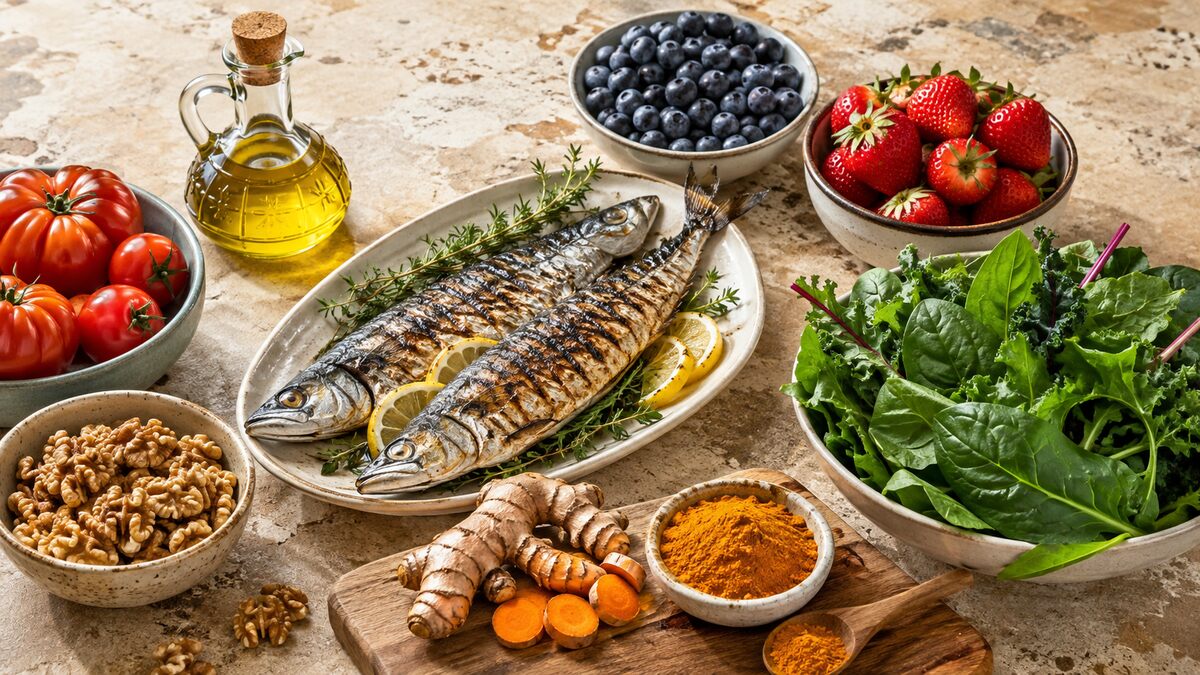
“Anti-inflammatory” has become one of the most overused words in wellness marketing. Strip away the branding, and there is genuine research behind certain dietary patterns and inflammation – it’s just more nuanced than a single food or supplement fixing things.
Foods linked to lower inflammation markers
Research, much of it observational, associates several food groups with lower markers of chronic inflammation:
- Vegetables, particularly tomatoes, spinach, kale, and other leafy greens
- Fruits such as strawberries, blueberries, cherries, and oranges
- Fatty fish, including salmon, mackerel, and sardines
- Nuts, particularly almonds and walnuts
- Olive oil
Researchers point to antioxidants and polyphenols – protective plant compounds – as part of the likely mechanism, along with the healthy fats found in nuts and fatty fish.
Harvard’s Nutrition Source, reviewing the anti-inflammatory diet as a category, describes much the same list and names the markers most often measured: C-reactive protein and tumour necrosis factor. It also states directly that research on the diet’s exact mechanism is not conclusive, and that there is no single anti-inflammatory diet plan.
Foods linked to higher inflammation markers
The same body of research associates higher inflammation markers with regular, high intake of refined carbohydrates (white bread, pastries), fried food, sugar-sweetened drinks, red and processed meat, and solid fats such as margarine and shortening.
Harvard’s review is careful about how it phrases even this better-established half of the picture, noting that Western dietary patterns are associated with increased blood markers of inflammation while adding that the connection may be due to a string of events rather than one direct action. That hedge is doing real work, and it rarely survives translation into a headline.
The important caveat
Most of this evidence comes from observational studies that track eating patterns over time, rather than controlled trials proving cause and effect in isolation. Diet is also intertwined with other factors like body weight and overall calorie intake, and researchers are honest that the exact mechanisms aren’t fully mapped out. In other words, “eat this one food to fight inflammation” oversimplifies a genuinely complex picture.
What the research actually measured
A lot of the field runs on the Dietary Inflammatory Index, a scoring tool published by Shivappa and colleagues in Public Health Nutrition in 2014. Understanding how it was built explains a great deal about the strength of the claims made from it.
The authors screened roughly 6,500 publications through to December 2010 and scored 1,943 qualifying articles, producing weightings for 45 pro- and anti-inflammatory food parameters based on their measured effects on six markers: interleukin-1β, IL-4, IL-6, IL-10, tumour necrosis factor-α, and C-reactive protein. A person’s diet then gets a score.
The authors themselves flag the limits. The index was assembled from studies examining dietary parameters one at a time, though, as they note, people do not consume nutrients or even whole foods in isolation. They also acknowledge that publication bias is likely, since significant findings are more likely to be published than null ones — which means the ingredient-by-ingredient weightings are probably tilted towards showing effects.
Where mechanism stops and evidence begins
The polyphenol story is the clearest example of the gap between a laboratory finding and a human outcome. A 2021 review by Di Lorenzo and colleagues in Nutrients examined how much of these compounds actually reaches the bloodstream, and the numbers are sobering: only about 1–2% of anthocyanins retain their original structure after ingestion, and urinary recovery has been measured at well under 1% of the dose consumed. Plasma concentrations of some flavanols were measured in nanograms per millilitre.
The review’s summary of the problem is direct: these molecules have demonstrated biological activity, but mostly in in-vitro models using pure compounds, where metabolism and food-matrix effects were not taken into account. Cell-culture studies typically apply concentrations that a person eating blueberries will never achieve. Add substantial variation between individuals, driven partly by gut microbiota composition, and the mechanistic case becomes a hypothesis rather than a finding.
Common claims that don’t hold up
Two examples are worth naming, because both are heavily marketed on inflammation grounds.
Turmeric and curcumin have generated an enormous literature. A 2017 miniperspective by Nelson and colleagues in the Journal of Medicinal Chemistry reviewed it and reported that oral bioavailability of curcumin in rats is under 1%, that the compound exhibits every known pattern of assay interference — covalent protein labelling, metal chelation, redox reactivity, aggregation, membrane disruption and fluorescence interference — and that of the 135 clinical trials registered with the NIH at that point, “no double-blinded, placebo controlled clinical trial of curcumin has been successful.”
Fish oil supplements have been tested far more rigorously than most. A 2020 Cochrane review by Abdelhamid and colleagues pooled 86 randomised trials covering 162,796 participants and reported high-certainty evidence that increasing long-chain omega-3 has little or no effect on all-cause mortality (risk ratio 0.97) or cardiovascular events (risk ratio 0.96), with a small reduction in coronary heart disease mortality rated moderate to low certainty. Whole fish and a capsule are clearly not equivalent, and the review’s authors are explicit that most of the supplement evidence points to modest effects at best.
A marker is not an outcome
Almost everything in this field is measured as a change in a blood marker, and it is worth being clear about what that does and does not tell you. C-reactive protein and the interleukins used to build the Dietary Inflammatory Index are signals that inflammatory processes are active; they are not the condition itself, and shifting one of them is not the same as changing how a person fares over decades.
This is why the omega-3 evidence is so instructive. Supplements can move the biochemistry and still, across 86 trials and more than 160,000 people, show little or no effect on the outcomes that were actually counted. Marker studies are cheap, fast and abundant; outcome studies are slow, expensive and comparatively rare. The imbalance in the literature is not a sign of what works — it is a sign of what is easy to measure.
A reasonable takeaway
Rather than chasing a single miracle ingredient, the pattern that keeps showing up across the research looks a lot like a standard healthy diet: more vegetables, fruit, fish, nuts, and olive oil; less ultra-processed and fried food, and fewer sugary drinks.
That is a genuinely unglamorous conclusion, and it is the honest one. The dietary pattern is reasonably well supported; the mechanism is partially mapped; and the individual “anti-inflammatory” ingredients sold on the strength of that mechanism are, for the most part, running well ahead of what has been demonstrated in people.
This article is general information only and is not medical advice. It does not diagnose, treat, or cure any condition. Speak with a qualified healthcare professional before starting any supplement.