
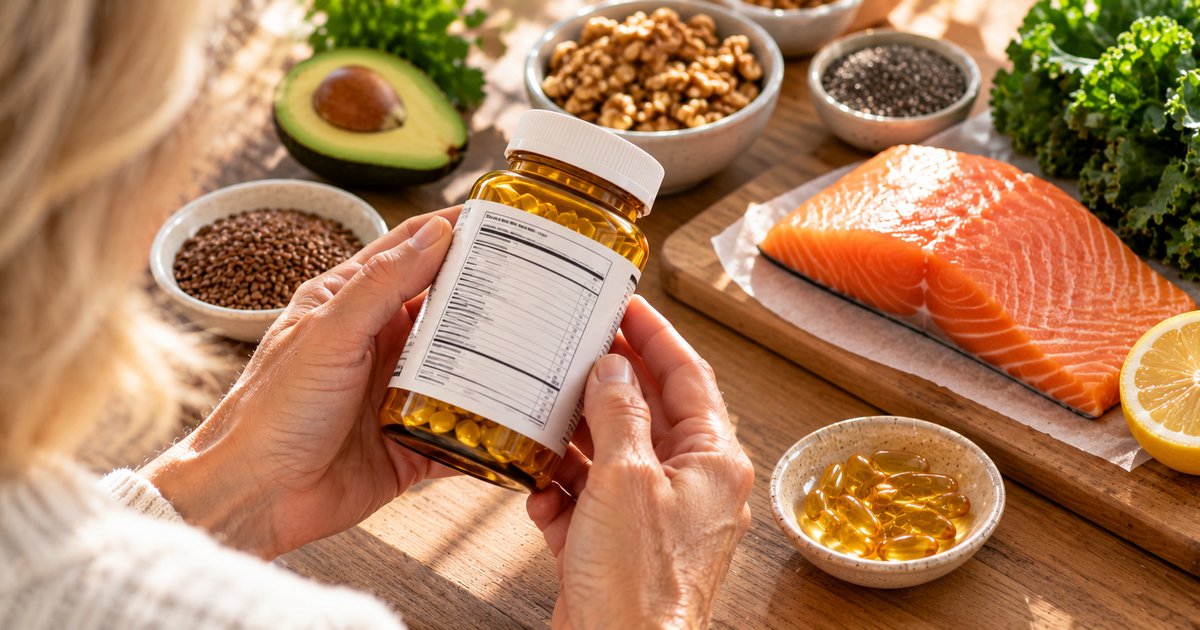
To read an omega-3 label, ignore the big number on the front, which is usually the total amount of oil, and find the EPA and DHA figures on the back. Add them together and check whether that amount is per capsule or per serving of several capsules. That combined EPA plus DHA figure is the number to compare between products and to use when working out value for money. The US National Institutes of Health gives a typical example: a 1,000 mg fish oil capsule containing 180 mg of EPA and 120 mg of DHA, which is 300 mg of EPA and DHA in total.
This guide shows where to find those numbers on Australian, US and European labels, how to work out cost per 1,000 mg of EPA and DHA, what the small print about chemical forms means, what to check on cod liver oil and plant-based products, and the safety points to raise with your doctor or pharmacist. If you are still deciding between fish, krill and algae oil, the comparison of fish oil, krill oil and algae oil covers that choice; this guide is about reading whichever bottle you are holding.
Where this article links to a product, that link may be an affiliate link and this site may earn a commission at no extra cost to you. See our Affiliate Disclosure.
At a glance
- The front number is usually the oil, not the omega-3s. A “1,000 mg” capsule may contain around 300 mg of EPA and DHA.
- Your comparison number is EPA plus DHA per serving, then per capsule.
- Check the serving size. Some labels list amounts for two or more capsules.
- Work out the cost per 1,000 mg of EPA and DHA to compare value fairly.
- Plant “omega-3” is often ALA, a different fatty acid that the body converts to EPA and DHA only in small amounts.
- If you take blood-thinning medicine or are having surgery, talk to your doctor or pharmacist first.
Why the front number misleads
Fish oil is a mixture of fats. EPA (eicosapentaenoic acid) and DHA (docosahexaenoic acid), the long-chain omega-3s most people are buying it for, are only part of it. The large figure on the front of the pack, such as 1,000 mg or 1,500 mg, usually describes the weight of oil in each capsule.
The NIH Office of Dietary Supplements’ example of a typical capsule, 1,000 mg of fish oil providing 180 mg of EPA and 120 mg of DHA, works out at about 30 per cent EPA and DHA. Concentrated products contain a much higher proportion, and some contain less. The only way to know is to read the panel.
Where to find EPA and DHA on the label
Label layouts differ by country, but the information is usually there if you know where to look.
| Label style | How it usually reads | What to look for |
|---|---|---|
| Australia (listed medicines) | “Each capsule contains: fish oil, natural 1,000 mg, containing omega-3 marine triglycerides 300 mg as EPA 180 mg and DHA 120 mg” | The EPA and DHA lines under the “containing” or “equivalent to” wording; an AUST L number shows it is listed with the Therapeutic Goods Administration |
| United States (Supplement Facts panel) | Serving size, then rows such as “Total omega-3 fatty acids”, “EPA” and “DHA” in mg per serving | The serving size at the top, and EPA and DHA rows rather than the total |
| European Union and UK (food supplements) | A table of amounts per recommended daily dose, often listing fish oil, EPA and DHA | The daily dose (number of capsules) the amounts refer to |
| Liquids and emulsions | Amounts per teaspoon (about 5 mL) or per measured dose | The dose volume, and whether you would use the measure provided |
Labelling rules change and vary in other countries, so read these as typical patterns at the time of writing (October 2026), not legal definitions.
“Total omega-3” is not always the same as EPA plus DHA
Some panels list a “total omega-3” figure that is higher than EPA and DHA added together. The difference may be other omega-3s, such as DPA (docosapentaenoic acid) or ALA. If you are comparing products on EPA and DHA, use those two lines and add them yourself.
“Omega-3-6-9” blends
Products sold as omega-3-6-9 often combine fish oil with plant oils that provide omega-6 and omega-9 fats. Most diets already supply plenty of these. Check the EPA and DHA lines: per capsule they are often lower than in a plain fish oil.
Your step-by-step label check
- Find the serving size. Is it one capsule, two, three, or a teaspoon?
- Find EPA and DHA and add them. That is EPA plus DHA per serving.
- Divide by the number of capsules in a serving to get EPA plus DHA per capsule.
- Work out total EPA plus DHA in the bottle: per-capsule amount multiplied by capsules in the bottle.
- Work out cost per 1,000 mg of EPA plus DHA: price divided by total EPA plus DHA, multiplied by 1,000.
- Check the form (triglyceride or ethyl ester) if it is stated. Use it as a tiebreaker.
- For cod liver oil, read the vitamin A and D lines too.
- For plant-based products, confirm EPA and DHA rather than ALA.
- Check the expiry date and storage instructions, and keep the packaging so you have the batch number.
Worked example: comparing value
The figures below are illustrative, not real products or real prices. Prices change and vary by country and retailer.
| Bottle A | Bottle B | |
|---|---|---|
| Front of pack | “Fish oil 1,000 mg” | “Concentrated omega-3, 1,200 mg EPA + DHA” |
| Serving size | 1 capsule | 2 capsules |
| EPA plus DHA per serving | 300 mg | 1,200 mg |
| EPA plus DHA per capsule | 300 mg | 600 mg |
| Capsules in bottle | 200 | 120 |
| Total EPA plus DHA in bottle | 60,000 mg | 72,000 mg |
| Price | $20 | $30 |
| Cost per 1,000 mg EPA plus DHA | about $0.33 | about $0.42 |
Bottle B’s front-of-pack figure is per two-capsule serving, which makes it look four times stronger than Bottle A. Per capsule, it is twice as concentrated, which means fewer capsules to swallow for the same amount. Per 1,000 mg of EPA and DHA, Bottle A costs less in this example. Neither result is always true: do the sums each time, because concentration and price vary widely.
The small print: triglyceride or ethyl ester
Concentrating fish oil involves processing, and the omega-3s can end up in different chemical forms. Labels that mention it may say natural triglyceride, re-esterified triglyceride (rTG), free fatty acid, or ethyl ester (EE).
The NIH Office of Dietary Supplements summarises the evidence carefully: re-esterified triglycerides, natural triglycerides and free fatty acids have somewhat higher bioavailability than ethyl esters, and all forms significantly increase blood levels of EPA and DHA. “Somewhat higher” is the accurate phrase, and it is far less dramatic than some marketing suggests. Use the form as a tiebreaker between two otherwise similar products, not as the main decision.
Product types: what to check on each label
| Product | Main label check | Watch out for |
|---|---|---|
| Standard fish oil | EPA plus DHA per capsule | A large front number that describes the oil, not the omega-3s |
| Concentrated fish oil | EPA plus DHA per capsule and per serving | Amounts listed per two or more capsules |
| Krill oil | EPA plus DHA per capsule, which is often lower than in fish oil | Front-of-pack wording about phospholipids or astaxanthin instead of EPA and DHA amounts |
| Cod liver oil | EPA and DHA, plus vitamin A and vitamin D | Total vitamin A if you also take a multivitamin |
| Algae (algal) oil | DHA, and whether EPA is included | Assuming it contains EPA when only DHA is listed |
| Flaxseed, chia or other plant oils | ALA content | “Omega-3” claims without EPA or DHA |
| Gummies | EPA plus DHA per gummy and per serving | Low omega-3 amounts and added sugar |
For the strengths and trade-offs of each source, including sustainability and shellfish allergy, see the fish, krill and algae oil comparison.
Cod liver oil and vitamin A
Cod liver oil naturally provides vitamins A and D as well as EPA and DHA. Vitamin A is a nutrient where more is not better: upper limits are set for preformed vitamin A, and intakes from several supplements can add up. If you take a multivitamin as well, add up the vitamin A from both labels, and talk to your doctor or pharmacist, particularly if you are pregnant or planning a pregnancy. The vitamins and minerals guide explains how reference values and upper limits work, and the guide to reading a vitamin D label explains IU and micrograms.
Plant omega-3 (ALA) is a different nutrient
Flaxseed, chia and walnut products provide ALA (alpha-linolenic acid), the plant omega-3. The body can convert ALA into EPA and then DHA, but the NIH describes this conversion as very limited, with reported rates of less than 15 per cent. A label that says “omega-3” without listing EPA or DHA is usually describing ALA. If you avoid fish and want EPA and DHA themselves, algal oil is the direct plant-based source.
Percentages and reference values
An Adequate Intake has been set in the United States for ALA: 1.6 g a day for adult men and 1.1 g a day for adult women. No general requirement has been set there for EPA and DHA in healthy adults. That is why some omega-3 panels show a percentage based on ALA, or show “Daily Value not established” next to EPA and DHA. Other countries publish their own reference values, so figures can differ. A missing percentage is not a fault in the product; it reflects which reference values exist.
Safety points to discuss with your doctor or pharmacist
- Upper amounts: no Tolerable Upper Intake Level has been set for EPA and DHA in the United States. The US Food and Drug Administration has concluded that supplements providing no more than 5 g a day of EPA and DHA combined are safe when used as recommended, and the European Food Safety Authority has said long-term intakes of up to about 5 g a day appear safe.
- Immune function: the Institute of Medicine noted that high doses (900 mg a day of EPA plus 600 mg a day of DHA or more for several weeks) might reduce immune function.
- Bleeding: high intakes of EPA and DHA might increase bleeding time. Most research has found that 3 to 6 g a day of fish oil does not significantly change anticoagulant status in people taking warfarin, but prescribing information for omega-3 medicines advises periodic monitoring with anticoagulants. If you take any blood-thinning medicine, talk to your doctor or pharmacist before starting.
- Surgery: mention omega-3 supplements to your surgeon or anaesthetist as you would any other medicine.
- Allergies: check the source if you are allergic to fish or shellfish.
The general principles of serving sizes, percentages and proprietary blends are covered in the guide to reading a supplement label, and the guide to supplement certification seals explains what independent testing marks do and do not tell you.
Freshness and storage
Omega-3 oils can oxidise, so the storage instructions on the pack matter. Follow them, check the expiry date against how long the bottle will take you to finish, and avoid buying a very large bottle you will not use in time. A strongly rancid smell when you open a capsule is a reasonable prompt to stop using that bottle and contact the retailer with the batch number, which is a good reason to keep the original packaging.
Common mistakes
- Comparing front-of-pack numbers. One may describe oil per capsule and another EPA and DHA per two-capsule serving.
- Missing the serving size. It changes every calculation.
- Using “total omega-3” instead of EPA plus DHA when comparing fish oils.
- Assuming plant omega-3 is the same as fish oil. ALA is a different fatty acid with limited conversion.
- Doubling up on vitamin A with cod liver oil and a multivitamin.
- Paying extra for the form alone. Differences in bioavailability between forms are modest.
- Not mentioning the supplement to your doctor or pharmacist, especially if you take blood thinners or are having surgery.
For the wider picture on judging any supplement before you buy, see the supplements evidence and label guide.
Related guide: Cod Liver Oil vs Fish Oil: How to Pick the Right One Safely.
Related guide: What Does Omega-3 Do? The Smart, Simple Guide to Best Foods.
Sources this guide draws on: NIH Office of Dietary Supplements, Omega-3 Fatty Acids Fact Sheet for Health Professionals; US Food and Drug Administration, Dietary Supplement Labeling Guide; European Food Safety Authority, Scientific Opinion on the Tolerable Upper Intake Level of EPA, DHA and DPA (2012); Institute of Medicine, Dietary Reference Intakes for Energy, Carbohydrate, Fiber, Fat, Fatty Acids, Cholesterol, Protein, and Amino Acids; Therapeutic Goods Administration (Australia) information on listed medicines.
Handy kit for this guide
These are practical everyday products, not supplements or medicines. As an Amazon Associate, michelle.net.au earns from qualifying purchases, at no extra cost to you. Prices and availability are set by Amazon and may vary by country.
- The Blue Zones Kitchen by Dan Buettner
100 everyday recipes built around beans, greens and whole grains.
View on Amazon - The Complete Mediterranean Cookbook (America’s Test Kitchen)
500 kitchen-tested recipes with plenty of fish, legumes and vegetables.
View on Amazon - Etekcity Digital Kitchen Scale
Reads in grams, handy for portions, recipes and checking a scoop against a label.
View on Amazon
Frequently asked questions
What does 1,000 mg mean on a fish oil label?
It usually means each capsule contains 1,000 mg of fish oil, not 1,000 mg of omega-3s. The EPA and DHA amounts are listed separately and are often much lower, around 300 mg combined in a typical capsule. Always check the EPA and DHA lines.
How do I calculate EPA and DHA per capsule?
Add the EPA and DHA amounts on the panel, then divide by the number of capsules in the stated serving. For example, 1,200 mg of EPA and DHA per two-capsule serving is 600 mg per capsule. Use that figure to compare products.
Is a higher EPA or a higher DHA better?
Products differ in their EPA to DHA ratio, and research has used many different combinations. There is no single ratio that suits everyone. If you have been advised to take omega-3 for a particular reason, ask your doctor or pharmacist which amounts and ratio they suggest.
What is the difference between triglyceride and ethyl ester omega-3?
They are different chemical forms produced during processing. According to the NIH, triglyceride and free fatty acid forms have somewhat higher bioavailability than ethyl esters, but all forms significantly raise blood EPA and DHA levels. Use the form as a tiebreaker.
Why does my omega-3 label not show a percentage Daily Value?
In the United States, a reference value exists for ALA but not for EPA and DHA in healthy adults, so many labels show “Daily Value not established” for them. Other countries use different reference values and label formats. It does not indicate a problem with the product.
How much omega-3 should I take?
That depends on your diet, health and any reason you are considering a supplement, and recommendations vary between countries. Many people get EPA and DHA from eating oily fish. Talk to your doctor or pharmacist about what is appropriate for you, especially if you take other medicines.
Reading an omega-3 label comes down to one habit: find EPA and DHA, add them, check the serving size, and do the sums. Once you have that number, comparing strength and value between any two bottles takes less than a minute.
This guide explains how to read product labels and is general education only. It is not medical advice and makes no claim that omega-3 supplements improve any health condition. Talk to your doctor or pharmacist before starting a supplement, particularly if you take prescription medicines, are pregnant, or are having surgery.