
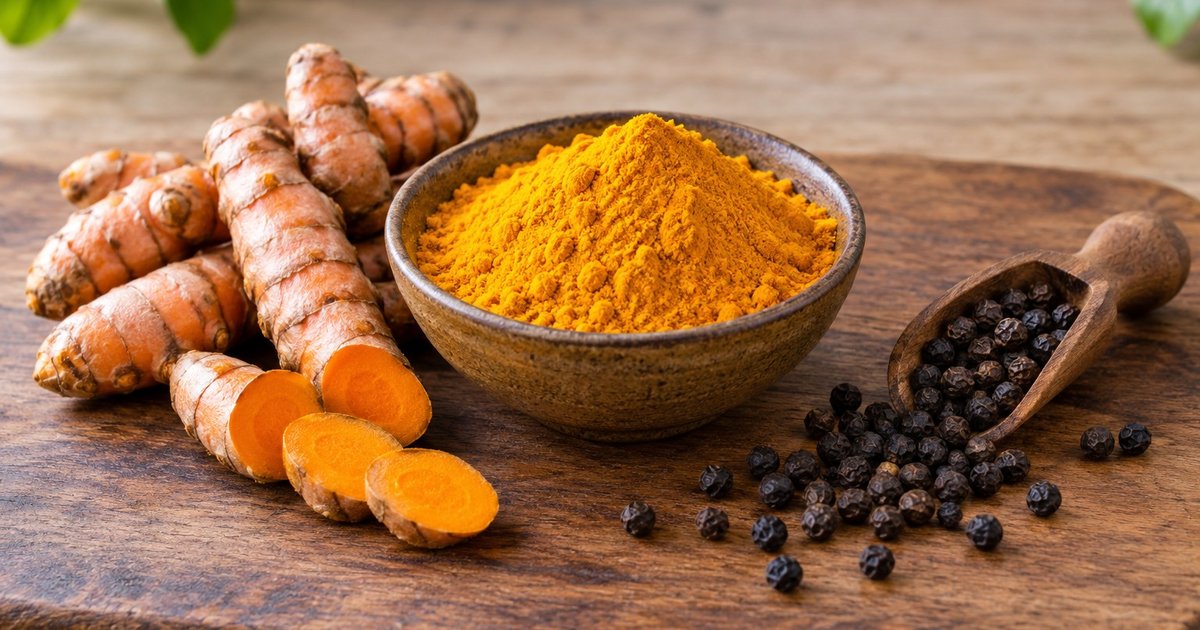
Curcumin, the best-known compound in turmeric, is poorly absorbed when swallowed, so many supplements add piperine from black pepper or use special formulations to raise the amount that reaches the blood. Some studies report that piperine increases blood curcumin levels, but the UK’s Committee on Toxicity has described that evidence as limited and mixed. Regulators including Australia’s TGA have also flagged rare reports of liver injury with turmeric and curcumin products, so absorption is not only a question of value but of safety.
This guide includes a few product links near the end. As an Amazon Associate, michelle.net.au earns from qualifying purchases, at no extra cost to you.
This guide explains the difference between turmeric, curcumin and curcuminoids, how the common absorption approaches compare, what the safety warnings actually say in different countries, and how to read a label before you buy. It is educational only. If you take any medicine, or have a liver, gallbladder or bleeding condition, talk to your doctor or pharmacist first.
At a glance
- Turmeric is not the same as curcumin. Curcumin makes up only a small share of turmeric root by weight, so the label needs to say how much curcumin or curcuminoids you are getting.
- Piperine is the most common absorption aid, but the human studies are small and do not all agree.
- Higher absorption may carry higher risk. NCCIH warns that highly bioavailable curcumin formulations may harm the liver.
- Rare liver injury has been reported worldwide, and regulators in Australia, Canada, Italy and elsewhere have issued advice or label warnings.
- Blood thinners and other medicines are a reason to check with your doctor or pharmacist before you start.
Turmeric, curcumin and curcuminoids: what the words mean
Turmeric is the dried root (rhizome) of Curcuma longa, the yellow spice used in cooking. Curcuminoids are a group of related yellow compounds in turmeric, and curcumin is the main one. According to the US National Institutes of Health LiverTox database, curcumin makes up between about 1% and 6% of the dry weight of whole turmeric, and commercial products vary widely in their curcuminoid content.
That variation is why a label that simply says “turmeric 500 mg” tells you little. A capsule of ground turmeric root and a capsule of concentrated extract can carry very different amounts of curcuminoids. Look for a statement of the extract, its standardisation (for example, a stated percentage of curcuminoids) and the amount of curcuminoids per serving.
Why absorption is the big question
Curcumin has low oral bioavailability. The UK Committee on Toxicity of Chemicals in Food, Consumer Products and the Environment (COT), which advises the Food Standards Agency, notes that much of an oral dose passes through unabsorbed and that curcumin is extensively broken down by the body. Manufacturers have responded with a range of approaches designed to raise blood levels.
| Approach | How it is meant to work | How it may appear on the label | What to keep in mind |
|---|---|---|---|
| Plain turmeric powder | Whole ground root, no enhancer | “Turmeric root powder” or “Curcuma longa rhizome” | Low curcuminoid content; liver injury has still been reported rarely, including with powder and turmeric tea, according to LiverTox |
| Standardised extract | Concentrated curcuminoids | A stated percentage of curcuminoids and mg per serving | Much higher curcuminoid amount than the spice; check the total per day |
| Extract with piperine | Piperine, from black pepper, is thought to slow the breakdown and removal of curcumin | “Piperine”, “black pepper extract” or “Piper nigrum fruit extract” | Human evidence is small and mixed; tell your pharmacist about it alongside your medicines |
| Lipid, liposomal, micelle or nanoparticle forms | Packages curcumin with fats or carriers to help uptake | Terms such as “liposomal”, “micellar”, “phytosome” or a branded ingredient name | NCCIH warns that highly bioavailable formulations may harm the liver |
| Turmeric in food | Small culinary amounts, often cooked with fat and pepper | Not a supplement | Very different exposure from concentrated supplements |
What the piperine research found
The claim that black pepper multiplies curcumin absorption traces largely back to a 1998 study. The UK COT reviewed it in its statement on turmeric and curcumin supplements and pointed out its limits: it had only eight participants, took blood samples for six hours and measured curcumin alone. A 2021 study of 30 participants, which measured total curcuminoids and their breakdown products over 24 hours, found no significant difference with piperine. Two more recent studies reported improvements, but the COT noted that one was a three-person pilot and the other was run by authors who worked for nutraceutical companies.
The COT’s overall view was that taking curcuminoids with piperine as a supplement could produce quite different body levels from eating turmeric as a spice, but that it is unclear how large the difference is for consumers. In plain terms: piperine may raise blood levels, the size of that effect is uncertain, and “more absorbed” is not automatically “better”.
Safety: what regulators have said
Turmeric in food has a long history of use. Concentrated supplements are a different exposure, and several regulators have acted on reports of liver injury. The warnings are about rare events, but they are serious enough to know about before you buy.
Australia (TGA)
In August 2023 the Therapeutic Goods Administration issued a safety advisory after receiving 18 reports of liver injury in people taking products containing Curcuma longa (turmeric) and/or curcumin, one of which was fatal. The advisory covered medicines containing turmeric species or curcumin, and health professionals were advised that people with existing or previous liver disease should avoid these products.
United States (NIH)
The NCCIH fact sheet on turmeric (last updated April 2025) states that highly bioavailable formulations of curcumin may harm the liver. LiverTox, also from the NIH, describes clinically apparent liver injury from turmeric as rare, estimated at roughly 1 in 10,000 to 1 in 100,000 people exposed, and notes it typically appeared one to four months after starting. Most cases resolved after the product was stopped, but some were severe, and continuing to take the product after symptoms began made severe outcomes more likely.
Canada, Italy, France and the UK
- Canada: in late 2025 Health Canada announced that turmeric and curcumin natural health products must carry label warnings about liver risk, including warning signs and advice to consult a health professional if you have a liver disorder or take medicines.
- Italy: after a cluster of hepatitis cases, the Ministry of Health introduced a required label warning for turmeric supplements, applying from the end of 2022, covering liver, bile duct and gallstone conditions, pregnancy, breastfeeding and medicine use.
- France: the food safety agency ANSES advised people with bile duct conditions against turmeric supplements and highlighted possible interactions with anticoagulant medicines.
- United Kingdom: in December 2024 the COT published a statement concluding there was reasonable evidence that high-dose turmeric and curcumin supplements can exceed safe intake levels.
Warning signs to know
NCCIH lists symptoms of possible liver injury as tiredness, nausea, poor appetite, dark urine or yellowing of the skin or eyes (jaundice). If any of these appear while you are taking a turmeric or curcumin product, stop taking it and contact a health professional promptly. Yellowing of the skin or eyes needs urgent medical attention.
Medicines and other cautions
- Blood thinners: Australian pharmacist guidance after the TGA advisory reminded pharmacists to warn people taking anticoagulants or antiplatelet medicines about bleeding risk, and ANSES has flagged anticoagulant interactions. If you take warfarin, a newer anticoagulant, aspirin or clopidogrel, talk to your doctor or pharmacist before using turmeric supplements.
- Other medicines: NCCIH advises anyone taking medicines to talk with a health professional before using herbal products, as some combinations interact.
- Liver and gallbladder conditions: the TGA and Italian advice both single out existing liver problems, and Italy and France also mention bile duct or gallstone conditions.
- Pregnancy: NCCIH states that turmeric supplements during pregnancy may be unsafe. Little is known about high amounts during breastfeeding.
- Before surgery or procedures: tell your doctor, surgeon or dentist about every supplement you take.
How to read a turmeric or curcumin label
For general panel-reading skills, start with how to read a supplement label. Then use this checklist for turmeric specifically.
- Find the licence or listing number for your country. In Australia, an AUST L number on the ARTG. In Canada, an NPN. In the US, a Supplement Facts panel (the FDA does not approve supplements before sale). In the EU and UK, the product is a food supplement under food law.
- Identify the ingredient. Is it turmeric root powder, a turmeric extract, or curcumin/curcuminoids? Is the botanical name Curcuma longa or another Curcuma species?
- Find the curcuminoid amount per serving, not just the turmeric weight. Multiply by the number of servings per day on the directions.
- Check for an absorption enhancer: piperine, black pepper extract, or a liposomal, micelle, phytosome or nanoparticle form. These are the products NCCIH singles out for liver caution.
- Read the warnings section. Depending on where you live, it may now include liver warnings. Read them even if you have used turmeric before.
- Scan the other actives. Combination products may add ginger, boswellia, or other herbs. Australian pharmacist guidance notes that some other herbs, such as ashwagandha, boswellia and black cohosh, have also been linked to liver injury.
- Look for independent quality testing. A seal from a testing body speaks to content and contamination, not benefits. See supplement certification seals explained.
- Check you are not doubling up. Turmeric turns up in blends, teas, shots and gummies. Add up every source.
Worked example: two labels side by side
Product A says “Turmeric 500 mg” per capsule and lists only turmeric root powder. With curcumin making up only a small share of turmeric by weight, the curcumin content is low and not stated. Product B says “Turmeric extract equivalent to 10 g dry rhizome, standardised to contain curcuminoids 400 mg” with piperine added, two capsules twice a day. Product B delivers far more curcuminoids per day, plus an absorption enhancer. That does not make it “better”; it makes it a much more concentrated product, and precisely the kind of product where the liver warnings and medicine checks matter most. (These are illustrative labels, not real products.)
What studies have tested
Turmeric and curcumin have been studied in many settings. NCCIH describes the evidence as not definitive for any health use, noting initial positive findings in some areas such as knee osteoarthritis and calling for more high-quality research. Many trials are small, short, use different formulations and doses, and measure different outcomes, which makes them hard to compare. For a framework on judging supplement evidence, see the supplements evidence and label guide, and for the food side of the story, the truth behind “anti-inflammatory” foods.
Who should talk to a health professional first
| Situation | Why it matters |
|---|---|
| Any current or past liver condition, including fatty liver or hepatitis | The TGA advised that people with existing or previous liver disease avoid these products |
| Regular alcohol use | Australian pharmacist guidance lists alcohol use disorder among reasons to avoid pharmaceutical turmeric products |
| Gallstones or bile duct conditions | Italian and French advice specifically mention these |
| Taking blood thinners or antiplatelet medicines | Possible bleeding risk and interactions |
| Taking several medicines | NCCIH notes that some herbs and medicines interact in harmful ways |
| Pregnant or breastfeeding | NCCIH states supplements in pregnancy may be unsafe |
| Upcoming surgery | Your team needs a full list of supplements |
Common mistakes to avoid
- Reading “turmeric mg” as “curcumin mg”. They are very different numbers.
- Assuming more absorption is always better. Higher bioavailability is exactly what NCCIH flags for liver caution.
- Thinking natural means harmless. Rare but serious liver injury has been reported with turmeric products.
- Ignoring early symptoms. Tiredness, nausea, dark urine or yellowing skin are reasons to stop and seek medical advice.
- Not mentioning it to your pharmacist, especially if you take a blood thinner.
- Stacking products. A capsule, a turmeric shot and a golden latte blend can add up.
- Buying overseas without checking the rules. Labelling and warnings differ by country. See buying supplements internationally.
Sources this guide draws on: the Therapeutic Goods Administration (TGA) 2023 safety advisory on medicines containing turmeric or curcumin, as reported by Australian Pharmacist and Medicine Today; the NCCIH fact sheet on turmeric; the NIH LiverTox database entry on turmeric; the UK Committee on Toxicity statement on turmeric and curcumin supplements; Health Canada’s 2025 safety review and label update; and published summaries of Italian Ministry of Health and French ANSES advice.
Handy kit for this guide
These are practical tools, not supplements or medicines. As an Amazon Associate, michelle.net.au earns from qualifying purchases, at no extra cost to you. Prices and availability are set by Amazon and may vary by country.
- Ezy Dose Weekly AM/PM Pill Organiser (X-Large)
Seven days with separate morning and evening compartments, so you can see at a glance what has already been taken.
View on Amazon - Vaydeer Metal 7-Day Travel Pill Case
Slim metal case with a built-in desiccant, for keeping a week of tablets dry in a bag or suitcase.
View on Amazon - Bambaw Insulated Stainless Steel Water Bottle (32 oz)
Plastic-free and keeps water cold all day, useful when a label says to take a product with a full glass of water.
View on Amazon
Frequently asked questions
Does black pepper really help turmeric absorption?
Piperine from black pepper is the most common absorption aid, and some studies report higher blood curcumin levels with it. However, the UK COT noted the key human studies are small and do not all agree, and a 2021 study measuring all curcuminoids over 24 hours found no significant difference. The effect is uncertain.
Can turmeric supplements damage the liver?
Rarely, yes. The TGA received 18 reports of liver injury, one fatal, by 2023, and NIH sources describe turmeric as a recognised, though rare, cause of herbal-related liver injury. If you notice tiredness, nausea, dark urine or yellowing of the skin or eyes, stop the product and seek medical advice.
Is it safe to take turmeric with blood thinners?
Not without advice. Australian pharmacist guidance and France’s ANSES have both flagged bleeding or interaction concerns with anticoagulants. Talk to your doctor or pharmacist before combining turmeric supplements with warfarin, other anticoagulants, aspirin or antiplatelet medicines.
What is the difference between turmeric and curcumin supplements?
Turmeric supplements may contain ground root with a small amount of curcumin, while curcumin supplements contain concentrated curcuminoids. The label should state the curcuminoid amount per serving so you can tell how concentrated the product is.
Is cooking with turmeric the same as taking a supplement?
No. Culinary turmeric delivers small amounts of curcuminoids as part of a meal. Concentrated extracts, especially those with absorption enhancers, are a very different exposure, which is why regulators focus on supplements.
How long does it take for liver problems to show?
LiverTox notes that reported liver injury typically appeared around one to four months after starting, though timing varied. Problems can occur at any point, so watch for warning signs for as long as you take the product.
Turmeric labels can look simple, but the details on the back matter: the amount of curcuminoids, whether an absorption enhancer is added, and the warnings for your country. If you are weighing up a curcumin product, take the label and your medicines list to your pharmacist first. For more on why “better absorbed” claims need careful reading, see the guide to supplement bioavailability.