
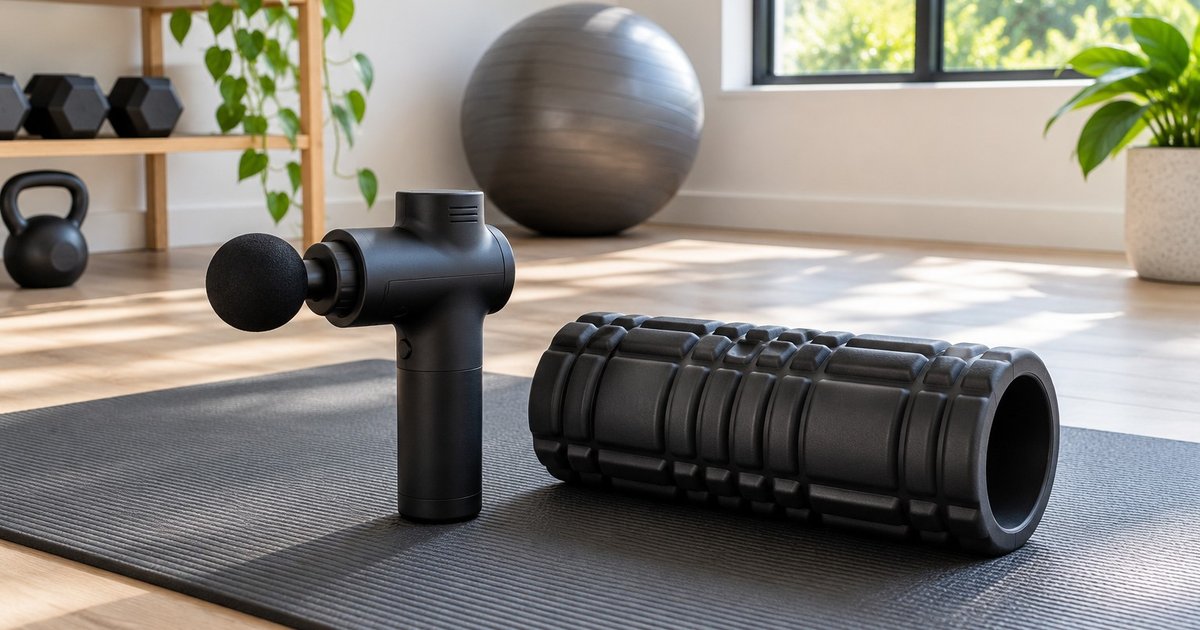
A massage gun delivers rapid, targeted pulses to one spot at a time, while a foam roller uses your own body weight to apply broad, rolling pressure along a whole muscle. Research on both has mostly measured short-term effects, such as a small, temporary gain in range of motion and lower ratings of perceived muscle soreness, rather than lasting change. For most people, the right choice comes down to budget, mobility, how easily you can get down to the floor, and which areas you want to reach.
This guide includes a few product links near the end. As an Amazon Associate, michelle.net.au earns from qualifying purchases, at no extra cost to you.
This guide explains how each tool works, what the studies actually tested, who should be cautious or skip them altogether, the features worth comparing before you buy, and a simple routine for using either one sensibly.
- Different jobs: foam rollers cover large areas such as thighs, calves and upper back; massage guns focus on smaller, specific spots and need no floor work.
- Modest, short-term findings: studies mostly report small, temporary changes in flexibility and perceived soreness, not long-term performance or structural change.
- Cost and simplicity: a foam roller is usually the cheaper, simpler starting point; a massage gun suits people who struggle with floor exercises or want portability.
- Safety first: avoid bones, joints, injuries and the front of the neck, and talk to your doctor or physiotherapist first if you take blood thinners, have a history of blood clots, are pregnant, or have osteoporosis or a joint replacement.
How each tool works
Foam rollers
A foam roller is a cylinder, usually made of foam, that you lie or sit on and roll back and forth. Your body weight provides the pressure, and you control intensity by shifting weight onto or off the roller. Rollers come in different densities (soft, medium and firm), lengths and surface textures, from smooth to ridged or knobbly. Some are solid foam; others have a hollow plastic core wrapped in foam, which tends to feel firmer and hold its shape longer.
Because rolling covers a long stretch of muscle in one pass, foam rollers are well suited to large areas such as the quadriceps, hamstrings, calves, glutes and the muscles either side of the upper spine. The trade-off is that you generally need to get down onto the floor and support yourself with your arms, which is not comfortable or practical for everyone.
Massage guns
A massage gun, also called a percussive therapy device, is a handheld, battery-powered tool with a head that moves rapidly back and forth. You hold it against a muscle and it delivers repeated short strikes. Most models have several speed settings and come with interchangeable heads: a flat or round head for general use, a smaller bullet-shaped head for precise spots, and a forked head designed to sit either side of a structure rather than on top of it.
Massage guns can be used sitting or standing, reach some areas without floor work, and are easy to pack in a gym bag. The trade-offs are cost, noise, the need to charge a battery, and the fact that they work on a small area at a time, so covering a whole leg takes longer than a few passes on a roller. Reaching your own back can also be awkward unless the model has a long or angled handle.
What the research actually measured
It is easy to find bold marketing claims for both tools. The published research is far more modest, and it is worth knowing what was tested before you buy.
Foam rolling
A frequently cited meta-analysis by Wiewelhove and colleagues, published in Frontiers in Physiology in 2019, pooled 21 studies. When foam rolling was used before exercise, the studies found a small improvement in flexibility and a very slight improvement in sprint times, with negligible effects on strength. When it was used after exercise, participants reported slightly lower perceived muscle pain. The authors described the overall effects as rather minor and partly negligible, and suggested foam rolling may be most useful as part of a warm-up.
A separate 2021 systematic review and meta-analysis led by Konrad, in the Journal of Sports Science and Medicine, looked at foam rolling combined with stretching. The combination improved range of motion compared with doing nothing, but it was no better than stretching alone. In other words, rolling did not add a measurable extra benefit on top of a stretching routine in those studies.
Massage guns
The research on massage guns is newer and smaller. A 2023 systematic review by Ferreira and colleagues in the Journal of Functional Morphology and Kinesiology included 11 studies. It concluded that massage guns may help improve range of motion and flexibility in the short term, but found no improvement, and in some cases a decrease, in strength, balance, agility and explosive performance when used just beforehand. The authors recommended against using them to try to improve those performance measures.
That review also pointed out important limitations: the studies were mostly short-term, most participants were young and male, device settings such as speed and pressure were often poorly reported, and the studies were of moderate quality. That means the findings may not apply to older adults, people with injuries or anyone looking for long-term change.
What this means in practice
Taken together, the research suggests that either tool may produce small, temporary changes in how flexible or sore a muscle feels. Neither has strong evidence for long-term changes in muscle, tendon or joint health, and neither replaces regular movement, sleep, sensible training loads and hydration, which this site covers in guides on active recovery techniques and how sleep supports recovery after exercise. If a hands-on approach appeals, a qualified practitioner is a separate option, explained in the guide to choosing a deep tissue massage practitioner.
Massage gun vs foam roller at a glance
| Factor | Foam roller | Massage gun |
|---|---|---|
| How pressure is applied | Your body weight, rolling along the muscle | Motorised pulses from a handheld head |
| Best suited to | Large areas: thighs, calves, glutes, upper back | Smaller, specific areas; shoulders, forearms, calves |
| Floor work needed | Usually yes (wall rolling is an alternative for some areas) | No; can be used seated or standing |
| Typical cost | Generally low | Generally higher; varies widely by brand and features |
| Power and upkeep | None; wipe clean | Rechargeable battery; motor and battery wear over time |
| Noise | Silent | Varies from quiet to noticeably loud |
| Portability | Bulky, though short travel versions exist | Compact; many come with a carry case |
| Learning curve | Takes some balance and arm strength | Easy to start, but easy to overdo intensity |
| Research base | Larger, still modest and short-term | Smaller and newer, mostly young adults |
Who each option suits (and who it doesn’t)
A foam roller may suit you if
- You are comfortable getting down to and up from the floor.
- You want a low-cost tool to add to a warm-up or stretching routine.
- You mainly want to work on large muscle groups in the legs and upper back.
- You prefer something silent that never needs charging.
A massage gun may suit you if
- Floor exercises are difficult because of balance, knee or wrist issues.
- You want something portable for travel or the gym.
- You want to focus on smaller areas such as the forearms or the tops of the shoulders.
- You are comfortable with the higher cost and battery upkeep.
Neither may be the right first step if
- You have an undiagnosed or ongoing pain, swelling, numbness or tingling: get it assessed first.
- You have a medical condition listed in the safety section below and have not yet checked with your doctor or physiotherapist.
- You are hoping for a quick fix to an injury. Neither tool is a substitute for professional assessment.
Safety: when to be cautious or avoid them
Both tools apply pressure to soft tissue, and some people need to be more careful than others. As a general guide, physiotherapists and health services commonly advise the following.
- Avoid bones and joints: keep both tools on muscle, not directly over the spine, kneecaps, elbows, shins, collarbones or any bony area.
- Keep away from sensitive areas: do not use a massage gun on the front or sides of the neck, the head, or the abdomen, and avoid areas with major blood vessels close to the surface, such as the back of the knee and inner thigh.
- Skip injuries and damaged skin: do not use either tool over fresh injuries, bruises, open wounds, rashes, swollen areas, varicose veins or recent surgery sites.
- Blood clots: if you have, or might have, a blood clot such as a deep vein thrombosis (warning signs can include one-sided calf pain, swelling, warmth or redness), do not massage the area and seek medical advice promptly.
- Blood thinners: people taking anticoagulant or antiplatelet medicines may bruise more easily. Talk to your doctor or pharmacist before using either tool.
- Pregnancy: talk to your doctor, midwife or a physiotherapist experienced in pregnancy care before using a massage gun or foam roller.
- Bone and joint conditions: osteoporosis, inflammatory arthritis and joint replacements are all reasons to get personalised advice first.
- Other conditions: people with nerve conditions, reduced sensation (for example from diabetes), bleeding disorders, implanted devices or cancer should check with their doctor or specialist before use.
If anything causes sharp pain, numbness, tingling, dizziness or bruising, stop. Discomfort should stay at a mild, tolerable level, never painful.
Features to compare before you buy
Foam roller checklist
- Density: beginners and older adults usually find a soft or medium roller more comfortable; firm rollers feel more intense.
- Surface: smooth surfaces spread pressure evenly; ridged or knobbly surfaces concentrate it and can feel harsh.
- Length: longer rollers (around the length of your forearm to shoulder or more) are more stable and suit upper-back work; shorter ones travel better.
- Diameter: a larger diameter sits higher off the floor, which some people find easier to get onto.
- Durability: cheaper foams can flatten over time; hollow-core rollers tend to keep their shape longer.
- Cleaning: a closed-cell surface is easier to wipe down, which matters if you share it.
Massage gun checklist
- Speed range: look for a genuinely low setting, so you can start gently.
- Weight and grip: heavier units can tire your hands and wrists; try holding one at arm’s length if you can.
- Handle shape: an angled or longer handle makes it easier to reach your own back and shoulders.
- Noise level: check independent reviews rather than relying only on the box.
- Attachments: a soft, broad head is the most useful for beginners; more heads are not necessarily better.
- Battery and charging: check run time, charging method and whether the battery can be replaced.
- Auto shut-off: a timer that stops the device after a set period can help you avoid overuse.
- Warranty and safety marks: buy from a seller that offers a clear warranty and look for the electrical safety markings required where you live, as these differ by country.
Prices for both tools vary widely by brand, size and features, and prices change, so compare the features above rather than assuming the most expensive option is best.
A simple, gentle routine
If you have checked the safety points and want to try either tool, a cautious starting routine looks like this.
- Warm up first: walk or march on the spot for a few minutes.
- Start light: use a soft roller or the lowest massage gun setting with a broad head.
- Keep it short: spend roughly 30 seconds to a minute per muscle group, and no more than a couple of minutes on any one area.
- Keep moving: roll slowly or glide the massage gun along the muscle; do not hold it on one spot.
- Breathe normally: if you find yourself holding your breath or tensing, ease off.
- Follow with movement: gentle stretching or your planned activity helps you notice how the area feels.
- Review next day: if you feel bruised or sore, take a few days off and return at a lower intensity.
Always follow the manufacturer’s instructions for your device, as recommended use times can differ between models.
Common mistakes to avoid
- Going too hard: more pressure is not better. Pain, bruising or tingling means you have overdone it.
- Staying on one spot: holding a massage gun in one place for long periods increases the risk of bruising and irritation.
- Rolling over joints or the lower spine: keep to muscle, and avoid rolling directly on the lower back unless a physiotherapist has shown you how.
- Using it instead of getting advice: ongoing pain, swelling or numbness needs assessment, not more rolling.
- Expecting dramatic results: the research describes small, short-term changes, so it is worth judging the tool on whether it feels helpful and fits your routine.
- Paying for features you will not use: many people only ever use one head and one or two speeds.
- Sharing without cleaning: wipe tools down between users.
Questions to ask before buying
- Can I comfortably get down to and up from the floor, or would a handheld option be safer?
- Which areas do I actually want to work on: large leg muscles or smaller spots?
- Have I checked with my doctor or physiotherapist about any medicines or conditions that affect me?
- Does the massage gun have a gentle enough lowest setting, and is it light enough for me to hold?
- What is the warranty and return policy if it is uncomfortable to use?
Rolling and percussion tools work best as small additions to a broader routine. The guides to everyday movement and strength training and bone density cover the habits that matter more over time.
Sources this guide draws on: Wiewelhove and colleagues, “A Meta-Analysis of the Effects of Foam Rolling on Performance and Recovery”, Frontiers in Physiology (2019); Konrad and colleagues, systematic review and meta-analysis of foam rolling combined with stretching, Journal of Sports Science and Medicine (2021); Ferreira and colleagues, “The Effects of Massage Guns on Performance and Recovery: A Systematic Review”, Journal of Functional Morphology and Kinesiology (2023); and general safety guidance on massage guns published by hospital physiotherapy services.
Handy kit for this guide
These are practical everyday products, not supplements or medicines. As an Amazon Associate, michelle.net.au earns from qualifying purchases, at no extra cost to you. Prices and availability are set by Amazon and may vary by country.
- The Blue Zones Kitchen by Dan Buettner
100 everyday recipes built around beans, greens and whole grains.
View on Amazon - Bambaw Insulated Stainless Steel Water Bottle (32 oz)
Plastic-free and keeps water cold all day, at home, on walks or at the gym.
View on Amazon - Gaiam Premium 5 mm Yoga Mat
Non-slip mat for yoga, Pilates, tai chi warm-ups and floor exercises.
View on Amazon
Frequently asked questions
Is a massage gun better than a foam roller?
Not in any clear way. The research on both mostly shows small, short-term changes in flexibility and perceived soreness, and there are few head-to-head studies. The better choice is the one that suits your body, budget and routine, and that you can use safely.
Can older adults use a massage gun or foam roller?
Many can, but older adults are more likely to take medicines or have conditions, such as osteoporosis or a joint replacement, that call for caution. Talk to your doctor or physiotherapist first, start with the gentlest setting or softest roller, and consider a massage gun or wall rolling if getting onto the floor is difficult.
How long should you use a massage gun on one muscle?
General guidance from physiotherapists is short sessions, roughly 30 seconds to two minutes per muscle group, keeping the device moving. Check your device’s instructions and reduce the time or intensity if you notice bruising or tenderness.
Should I foam roll before or after exercise?
Studies have tested both. The 2019 meta-analysis found that rolling before exercise was linked to small, short-term flexibility gains, while rolling afterwards was linked to slightly lower perceived soreness. Many people simply include it in their warm-up.
Is it safe to use a massage gun if I take blood thinners?
Blood-thinning medicines can make bruising more likely, so talk to your doctor or pharmacist before using one. If you are given the go-ahead, use the lowest setting and a soft head, and stop if any bruising appears.
Where should you never use a massage gun?
Avoid the head, the front and sides of the neck, the abdomen, bones and joints, and any area with an injury, bruise, wound, swelling or varicose veins. Never use one over a suspected blood clot.
Both tools are optional extras rather than essentials. Start with the simplest option that fits your body and budget, keep sessions short and gentle, and check with your doctor or physiotherapist if anything in the safety list applies to you.