
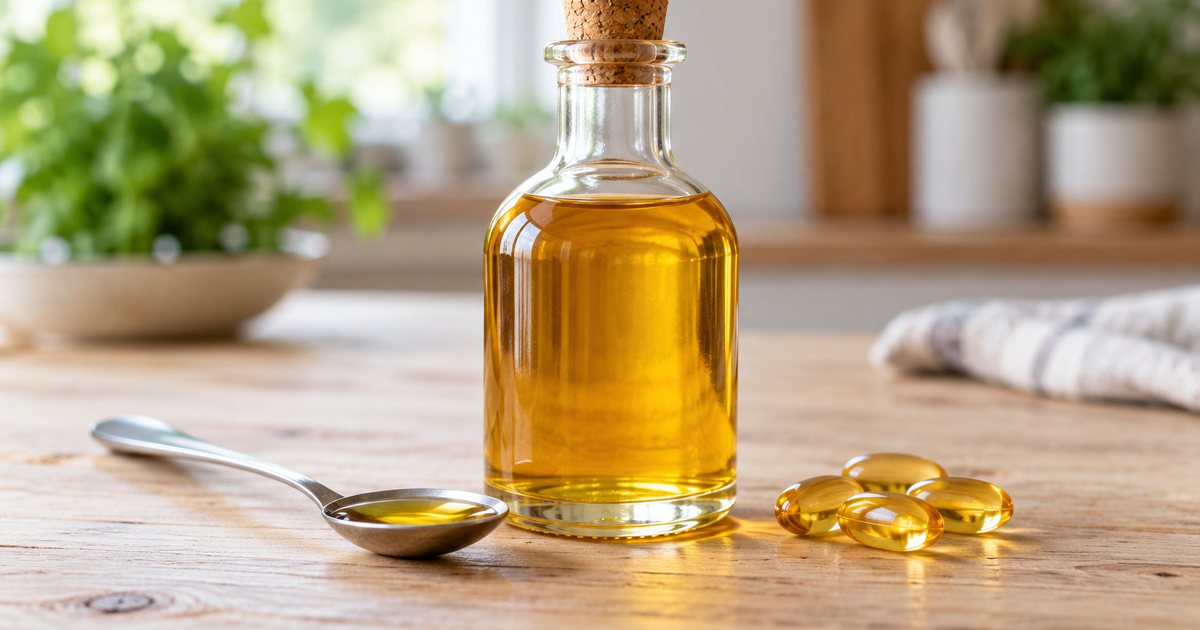
The main difference between cod liver oil and fish oil is vitamin A. Cod liver oil comes from the liver of the cod and naturally carries large amounts of preformed vitamin A (retinol) and vitamin D alongside its omega-3 fats, while ordinary fish oil is pressed from the body of oily fish and usually contains little of either vitamin. That means a cod liver oil serve can take a real bite out of the safe upper limit for vitamin A, which matters most in pregnancy and for anyone already taking other vitamin A sources.
This guide includes a few product links near the end. As an Amazon Associate, michelle.net.au earns from qualifying purchases, at no extra cost to you.
This guide compares the two side by side using label numbers, shows how a typical serve stacks up against published upper limits, explains capsules, tablets and fermented cod liver oil, and gives you a simple checklist to use before you buy.
At a glance
- Fish oil is mainly a source of the omega-3 fats EPA and DHA. Cod liver oil supplies EPA and DHA plus vitamin A and vitamin D.
- Generic cod liver oil in the USDA nutrient database contains about 1,350 micrograms of vitamin A per teaspoon, and about three times that per tablespoon.
- The adult upper level for preformed vitamin A is 3,000 micrograms a day in Australia and New Zealand, the United States and the European Union.
- The NHS advises keeping total vitamin A from food and supplements to no more than 1.5 mg (1,500 micrograms) a day, partly because of bone concerns later in life.
- Pregnant readers, people taking multivitamins or acne medicines related to vitamin A, and people who eat liver should check labels with a doctor or pharmacist first.
Cod liver oil vs fish oil: what each one is
Fish oil is extracted from the flesh of oily fish such as anchovies, sardines, mackerel and salmon. Its selling point is the long-chain omega-3 fats EPA and DHA. Most fish oil capsules contain little or no vitamin A or D unless the vitamins have been added.
Cod liver oil is extracted from cod livers. The liver is where fish store fat-soluble vitamins, so the oil naturally contains vitamin A and vitamin D as well as EPA and DHA. Many brands refine the oil and then adjust the vitamin content to a set level, so two cod liver oil products can carry very different amounts. Always go by the label in your hand.
If you are also weighing up krill or algae oil, this site’s fish oil vs krill oil vs algae oil comparison covers those sources. This article focuses on the cod liver oil question.
Side-by-side: what is in a typical serve
The figures below for generic cod liver oil come from the USDA National Nutrient Database (Standard Reference), which lists 30,000 micrograms of vitamin A (as retinol activity equivalents) and 250 micrograms (10,000 IU) of vitamin D per 100 g. The teaspoon (about 4.5 g) and tablespoon (about 13.6 g) amounts are calculated from those values. Commercial products are often standardised to lower or different levels, so read this as an illustration of why the label matters, not a description of any brand.
| Per serve | Generic cod liver oil, 1 teaspoon (about 4.5 g) | Generic cod liver oil, 1 tablespoon (about 13.6 g) | Typical fish oil capsule |
|---|---|---|---|
| Vitamin A (retinol) | About 1,350 micrograms | About 4,080 micrograms | Usually none or very little unless added |
| Vitamin D | About 11 micrograms (450 IU) | About 34 micrograms (1,360 IU) | Usually none unless added |
| EPA | About 310 mg | About 940 mg | Varies widely; check the label |
| DHA | About 490 mg | About 1,490 mg | Varies widely; check the label |
The striking number is the tablespoon of vitamin A: on the USDA figures it exceeds the 3,000 microgram adult upper level on its own. That is why the serving size printed on a liquid cod liver oil bottle deserves close attention.
How cod liver oil stacks up against upper limits
An upper level (UL) is the highest average daily intake that is unlikely to cause harm for most healthy people. It is not a target. Here is how the published adult limits compare.
| Authority | Preformed vitamin A upper level (adults) | Other guidance relevant to cod liver oil |
|---|---|---|
| NHMRC Nutrient Reference Values (Australia and New Zealand) | 3,000 micrograms a day | Applies to preformed vitamin A (retinol), not beta-carotene from plants |
| NIH Office of Dietary Supplements (United States) | 3,000 micrograms RAE a day | Vitamin D upper limit for adults is 100 micrograms (4,000 IU) a day |
| European Food Safety Authority (2024 opinion) | 3,000 micrograms RE a day, kept after a 2024 review | Advises women who are pregnant or planning pregnancy to avoid liver products |
| NHS (United Kingdom) | Advises total intake from food and supplements not above 1.5 mg (1,500 micrograms) a day | Notes fish liver oils are high in vitamin A; links long-term high intake with bones more likely to fracture in older age |
EFSA based its limit mainly on the risk of harm to an unborn baby, which is why pregnancy is the group most often warned about. The NHS bone advice is aimed especially at older women, who already face higher osteoporosis risk. Vitamin D limits differ between countries, so check your local guidance; this site’s guide to reading a vitamin D label explains converting IU to micrograms.
A worked example of adding it all up
Imagine someone takes a multivitamin with 750 micrograms of vitamin A as retinol, a cod liver oil that provides 1,000 micrograms per serve, and eats pâté on toast a few times a week. On days with the pâté, their total could pass the NHS 1.5 mg figure and approach or exceed the 3,000 microgram UL, without any single product looking alarming on its own. The numbers here are hypothetical, but the pattern is common: vitamin A is easy to double up on. The multivitamins after 50 guide shows where to find retinol on a multivitamin label.
Who should check with a health professional first
- Pregnant women and those planning pregnancy. Too much preformed vitamin A can harm an unborn baby. The NHS advises avoiding liver and liver products in pregnancy and lists fish liver oils among high vitamin A sources. Ask your doctor, midwife or pharmacist before taking any supplement that contains retinol.
- People taking other vitamin A sources. This includes multivitamins, “eye health” formulas and skin supplements that list retinol or retinyl esters.
- People on retinoid medicines. Some acne and skin medicines are related to vitamin A; a pharmacist can tell you whether combining them with cod liver oil is appropriate.
- Older adults, especially women, concerned about bone health. The NHS bone advice applies here.
- People with liver disease or who drink heavily. Vitamin A is stored in the liver.
- Anyone on blood-thinning medicines. Omega-3 supplements are commonly flagged for a pharmacist check alongside these medicines.
Capsules, tablets and liquid: what changes
Cod liver oil capsules and cod liver oil tablets (usually soft gels or chewables) make serving sizes predictable and hide the fishy taste. The trade-off is that one capsule often contains a small amount of oil, so the omega-3 content per capsule can be modest. Liquid oil delivers more per spoonful, which is exactly why the vitamin A per spoon needs checking.
When comparing, convert everything to the same unit: vitamin A in micrograms per daily serve, vitamin D in micrograms per daily serve, and EPA plus DHA in milligrams per daily serve. The omega-3 label guide shows how to find the EPA and DHA lines, which are often hidden behind a larger “fish oil” figure.
What about fermented cod liver oil?
Fermented cod liver oil is made by letting cod livers break down before the oil is collected, rather than using heat. It is marketed as more traditional or “whole food”. This guide could not find published controlled trials comparing fermented and standard cod liver oil on any health measure, so there is no evidence-based reason to pay more for it. Vitamin A and D content still varies between batches and brands, and labels on some fermented products give fewer details. The same label rules apply.
Before you buy: a seven-step checklist
- Decide what you are after. If it is omega-3, plain fish oil or algae oil avoids the extra vitamin A. If you have been advised to get vitamin D, a dedicated vitamin D product lets you control the amount separately.
- Find vitamin A per daily serve, in micrograms. If it is listed only in IU, ask a pharmacist to convert it; conversion depends on the form.
- Add up your other vitamin A sources: multivitamins, other supplements, and how often you eat liver or pâté.
- Find vitamin D per daily serve and add it to any other vitamin D you take.
- Find EPA and DHA per daily serve, not just total oil.
- Look for quality signs such as batch testing or a third-party seal; see how to read supplement seals.
- Check with your doctor or pharmacist if you are pregnant, planning pregnancy, older and concerned about bones, or take regular medicines.
Common mistakes
- Assuming cod liver oil and fish oil are interchangeable. They are not; the vitamin content is the key difference.
- Going by the spoon in the drawer. A heaped tablespoon is very different from a level teaspoon, and the label serve is based on a measured amount.
- Doubling up with a multivitamin. Retinol from several products adds up quickly.
- Forgetting food sources. Liver and liver products are very high in vitamin A.
- Assuming “natural” means low risk. The vitamin A in cod liver oil is the preformed kind that the upper limits are set for.
- Ignoring IU versus microgram labels. Converting to the same unit is the only way to compare.
For more on how to judge whether any supplement is worth taking, see how to read a supplement label.
Sources this guide draws on: USDA National Nutrient Database for Standard Reference (fish oil, cod liver); NHMRC and New Zealand Ministry of Health, Nutrient Reference Values for Australia and New Zealand (vitamin A); NIH Office of Dietary Supplements, Vitamin A and Vitamin D Fact Sheets; European Food Safety Authority, Scientific opinion on the tolerable upper intake level for preformed vitamin A and beta-carotene (2024); NHS, Vitamin A.
Handy kit for this guide
These are practical tools, not supplements or medicines. As an Amazon Associate, michelle.net.au earns from qualifying purchases, at no extra cost to you. Prices and availability are set by Amazon and may vary by country.
- Ezy Dose Weekly AM/PM Pill Organiser (X-Large)
Seven days with separate morning and evening compartments, so you can see at a glance what has already been taken.
View on Amazon - The Complete Mediterranean Cookbook (America’s Test Kitchen)
500 kitchen-tested recipes with plenty of fish, legumes and vegetables.
View on Amazon - Vaydeer Metal 7-Day Travel Pill Case
Slim metal case with a built-in desiccant, for keeping a week of tablets dry in a bag or suitcase.
View on Amazon
FAQ
Is cod liver oil better than fish oil?
Neither is simply better. Cod liver oil adds vitamins A and D to the omega-3 fats, which can be useful or can be a problem depending on what else you take. Fish oil lets you get EPA and DHA without the extra vitamin A.
Can I take cod liver oil and fish oil together?
Some people do, but it increases omega-3 intake and, from the cod liver oil, vitamin A and D. Add up the label amounts and check with a pharmacist, especially if you take any other supplements or medicines.
Is cod liver oil safe in pregnancy?
High intakes of preformed vitamin A can harm an unborn baby, and health authorities advise pregnant women to avoid liver products. Speak with your doctor, midwife or pharmacist before taking cod liver oil or any supplement containing retinol.
Are cod liver oil capsules weaker than the liquid?
Usually each capsule holds less oil than a spoonful of liquid, so it provides less of everything per unit. Compare the vitamin A, vitamin D and EPA plus DHA per daily serve rather than per capsule.
Does fermented cod liver oil have more vitamins?
Not reliably. Content varies by brand and batch, and this guide could not find controlled trials showing an advantage for fermented oil.
The cod liver oil vs fish oil choice comes down to vitamin A. Read the label in micrograms, add up every source, and bring the total to your doctor or pharmacist if you are pregnant, older or on regular medicines.