
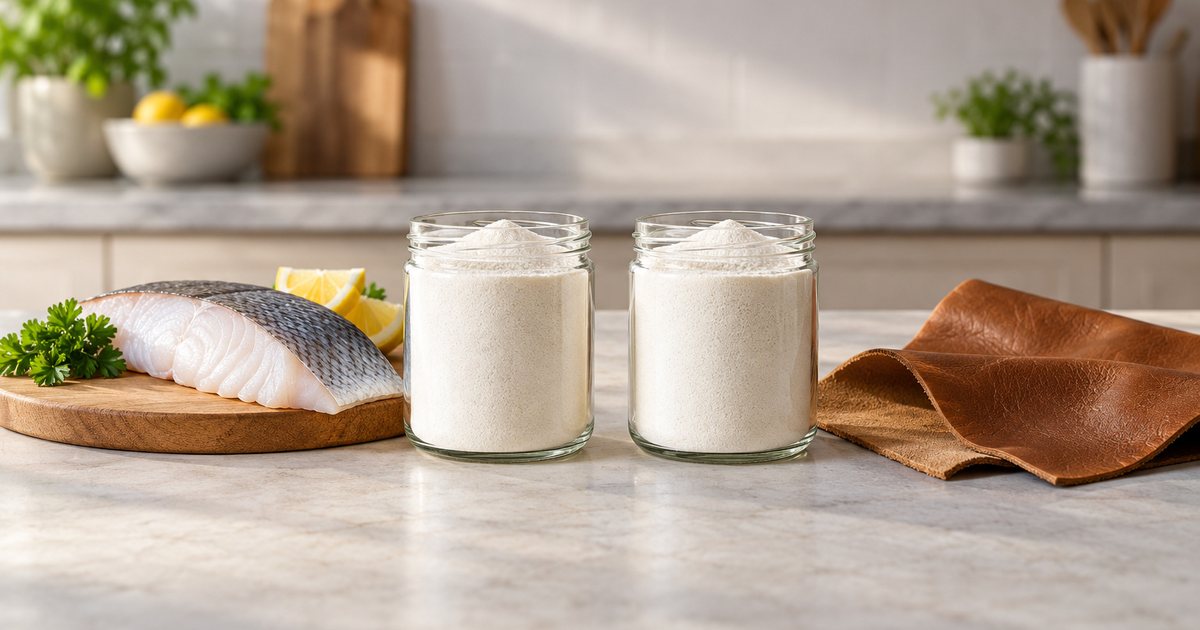
Bovine collagen comes from cattle, usually the hides and bones, while marine collagen comes from fish, usually the skin and scales. Both are mostly sold as hydrolysed collagen peptides, and both are made mainly of type I collagen, with bovine products often listing type III as well. The real differences for a buyer are the source animal, allergen and dietary suitability, sourcing and price per gram, rather than any proven difference in results.
This guide includes a few product links near the end. As an Amazon Associate, michelle.net.au earns from qualifying purchases, at no extra cost to you.
This guide compares marine vs bovine collagen side by side: what each is made from, what the collagen types on the label mean, what “low molecular weight” peptide claims do and do not tell you, allergen and dietary considerations, sustainability questions, and how to work out the real cost per 10 g serve. It does not make skin or joint claims, because the evidence does not support confident promises for either source.
At a glance
- What is bovine collagen? Collagen extracted from cattle by-products such as hides and bones, then usually broken down (hydrolysed) into peptides.
- What is marine collagen? Collagen extracted from fish by-products such as skin and scales, also usually sold as hydrolysed peptides.
- Both are mainly type I collagen. Type II, found in cartilage, is a different product usually made from chicken cartilage.
- Marine collagen contains fish, a declared food allergen in many countries. Neither marine nor bovine collagen is vegetarian or vegan.
- Trials of oral collagen have mixed results, and a 2025 meta-analysis found no clear benefit for skin in higher-quality or independently funded trials.
What is bovine collagen?
Bovine collagen is made from the connective tissue of cattle, mainly hides and bones, which are by-products of the meat industry. The collagen is extracted, often turned into gelatin, and then broken down further with enzymes into smaller pieces called hydrolysed collagen or collagen peptides. These dissolve in hot or cold liquids, which is why they are sold as unflavoured powders, capsules and ready-to-drink products.
According to a 2019 review of hydrolysed collagen sources in the journal Molecules, bovine collagen has long been the main commercial source because of its availability. The same review notes that bovine and pig sources have faced concerns in recent decades, including bovine spongiform encephalopathy (BSE), as well as religious considerations. Reputable manufacturers address BSE risk through sourcing controls, and food regulators in many countries set rules for bovine-derived ingredients.
What is marine collagen?
Marine collagen is extracted mainly from fish skin and scales, and sometimes bones. The Molecules review lists research on collagen from a wide range of species, including cod, Alaska pollock, tuna skin and tilapia scales, and notes that using fish by-products can reduce waste. Labels may name the species, say “wild-caught” or “farmed”, or simply say “fish”. Most marine collagen powders are hydrolysed peptides, like bovine products.
Marine collagen powder vs marine collagen supplements in capsules
Powders usually supply several grams per scoop. Capsules hold much less per capsule, so you may need many capsules to match one scoop of powder. Always compare the grams of collagen per serve, not the number of capsules or the price per tub.
Marine vs bovine collagen compared
| Factor | Bovine collagen | Marine collagen |
|---|---|---|
| Source animal | Cattle | Fish (sometimes other marine animals) |
| Typical raw material | Hides and bones | Skin, scales and sometimes bones |
| Collagen types usually listed | Type I, often with type III | Mainly type I |
| Usual form | Hydrolysed peptides or gelatin | Hydrolysed peptides |
| Allergen labelling | Not a listed major allergen in most countries | Fish is a declared allergen in many countries |
| Suits pescatarians? | No | Usually yes |
| Suits vegetarians or vegans? | No | No |
| Halal or kosher | Only if certified; depends on slaughter and processing | Often more widely acceptable, but check for certification |
| Taste and smell | Usually neutral | Usually neutral, sometimes a faint fishy note |
| Price per gram | Often lower | Often higher |
The price row is a general pattern only; individual products vary, and prices change. Work out the cost per 10 g yourself using the method below.
Collagen types on the label: I, II and III
There are many types of collagen in the body. The three you will see most on supplement labels are:
- Type I: the most common type in the body, found in skin, bone, tendons, ligaments and teeth.
- Type II: the main type in cartilage. Supplements listing type II are usually made from chicken cartilage, and some are “undenatured”, which is a different product from hydrolysed peptides.
- Type III: found alongside type I in skin, muscle and blood vessels.
When you eat hydrolysed collagen, it is digested into amino acids and small peptides, so the “type” on the label describes where it came from rather than where it ends up. Our guide to collagen peptide myths explains why eaten collagen does not travel directly to your skin or joints. Be wary of “multi-collagen” products that list five or more types: they often blend several sources, and the label rarely shows how much of each is present.
Peptide size and “better absorbed” claims
Marine collagen is often marketed as having “smaller peptides” or “better absorption” than bovine collagen. Some points to keep in mind:
- Peptide size depends on how the collagen is hydrolysed, not only on the animal. The Molecules review gives a general range of around 3 to 6 kilodaltons for hydrolysed collagen, but the examples it cites range from under 600 daltons to over 10 kilodaltons depending on source and process.
- Both marine and bovine products can be made with small or large average peptide sizes.
- Most marine-specific claims come from laboratory or early-stage studies, and the review found little direct human comparison of marine and bovine collagen.
- If a label states a molecular weight (for example “average 2,000 Da”), that is a product specification. It is not evidence of a better outcome.
What the research shows, and why it is uncertain
People search for “marine collagen benefits”, but most trials of oral collagen do not separate marine and bovine sources in a way that lets you compare them. The overall evidence on oral collagen is mixed:
- A 2021 systematic review and meta-analysis by de Miranda and colleagues in the International Journal of Dermatology reported improvements in skin hydration and elasticity measures with hydrolysed collagen.
- A 2025 meta-analysis by Myung and Park in The American Journal of Medicine, covering 23 randomised controlled trials and 1,474 participants, found that the apparent effects disappeared when the analysis was limited to higher-quality trials or to trials without supplement-industry funding.
- Industry groups have disputed the 2025 findings, which shows the question is not settled.
For joints, the evidence is reviewed separately in our guide to collagen and joint comfort research. The honest summary is that neither marine nor bovine collagen has been shown to be reliably superior, and you should be cautious of any brand that says otherwise. If you have a health condition, are pregnant or breastfeeding, or take medicines, talk to your doctor or pharmacist before adding collagen.
Allergen and dietary considerations
Fish allergy
Marine collagen is made from fish, so it is not suitable for people with fish allergy unless a doctor advises otherwise. In Australia and New Zealand, Plain English Allergen Labelling rules from Food Standards Australia New Zealand require food produced from 25 February 2024 to show fish, crustacean and mollusc in bold in the ingredient list and in a summary statement starting “Contains”. Collagen sold as a listed medicine rather than as a food follows different labelling rules, and other countries have their own allergen laws, so read the full label wherever you live.
Shellfish
Most marine collagen comes from fish, but some products may use other marine sources or be made in facilities that process shellfish. If you have a shellfish allergy, check the label and ask the manufacturer.
Pescatarian, halal, kosher and vegetarian diets
- Pescatarians usually choose marine collagen because it comes from fish.
- Halal and kosher suitability depends on the source and processing, so look for a recognised certification mark rather than assuming.
- No collagen is vegetarian or vegan. “Vegan collagen” products contain plant ingredients, not collagen.
Sustainability and sourcing
Both bovine and marine collagen are commonly made from by-products: hides and bones from meat processing, and skin and scales from fish processing. That can reduce waste, but it does not tell you everything about environmental impact. If sourcing matters to you, look for:
- The country of origin of the raw material.
- For marine collagen, the species, whether it is wild-caught or farmed, and any recognised fisheries or aquaculture certification.
- For bovine collagen, statements about the source country and how animals were raised, such as grass-fed, with evidence rather than vague wording.
- Independent testing for contaminants. Our guide to supplement certification seals explains what common seals mean.
How to work out the price per 10 g
Price per tub is misleading because tub sizes and serve sizes differ. Use this simple method:
- Find the net weight of collagen in the container (for example, 300 g). If the product contains added ingredients, use the collagen amount per serve instead.
- Divide the price by the number of grams of collagen to get the cost per gram.
- Multiply by 10 to get the cost per 10 g.
Worked example with round figures (not real prices): a 300 g tub of pure collagen peptides priced at 45 dollars costs 45 divided by 300, or 0.15 dollars per gram, which is 1.50 dollars per 10 g. A 200 g tub at 40 dollars costs 0.20 dollars per gram, or 2.00 dollars per 10 g. The larger, cheaper-looking tub is better value per gram even though the price tag is higher. Our guide on how to compare collagen brands walks through the other label checks.
Checklist: choosing between marine and bovine collagen
- Do you have a fish or shellfish allergy? If so, avoid marine collagen and check bovine labels for cross-contact statements.
- Do you follow a pescatarian, halal or kosher diet? Choose the source and certification that fits.
- Is the product hydrolysed collagen peptides, gelatin or undenatured type II? Compare like with like.
- How many grams of collagen are in one serve, and what else is in it?
- What is the cost per 10 g of collagen?
- Does the label name the source species or country of origin?
- Is there independent testing for contaminants and heavy metals?
- Are the claims cautious and specific, or do they promise dramatic results?
Common mistakes
- Believing marine is “stronger” or “better absorbed” by default. Peptide size depends on processing, and human comparisons are limited.
- Comparing price per tub instead of price per 10 g. Always work it out per gram of collagen.
- Missing the fish allergen. Marine collagen is a fish product even when it tastes neutral.
- Assuming “multi-collagen” is better. More types on the label does not mean more benefit.
- Counting collagen as complete protein. Collagen lacks the amino acid tryptophan, so it does not replace other protein; see protein powder types compared.
- Trusting before-and-after marketing. Look for clear labelling and independent testing instead.
Related guide: Is Vegan Collagen Real? The Smart Label Check to Save Money.
Sources this guide draws on: León-López and colleagues, Hydrolyzed Collagen: Sources and Applications (Molecules, 2019); de Miranda and colleagues, systematic review and meta-analysis of hydrolysed collagen and skin (International Journal of Dermatology, 2021); Myung and Park, meta-analysis of collagen supplements and skin ageing (The American Journal of Medicine, 2025); Food Standards Australia New Zealand Plain English Allergen Labelling requirements, as summarised by Safe Food Production Queensland.
Handy kit for this guide
These are practical everyday products, not supplements or medicines. As an Amazon Associate, michelle.net.au earns from qualifying purchases, at no extra cost to you. Prices and availability are set by Amazon and may vary by country.
- Etekcity Digital Kitchen Scale
Reads in grams, handy for portions, recipes and checking a scoop against a label.
View on Amazon - Stainless Steel Measuring Spoon Set (6 pieces)
Plastic-free spoons for level, repeatable measures.
View on Amazon - BlenderBottle Classic V2 Shaker (20 oz)
The wire whisk ball mixes powders into water or milk without lumps.
View on Amazon
Frequently asked questions
Is marine collagen better than bovine collagen?
Not in any proven way. Both are mainly type I collagen sold as hydrolysed peptides, and few human studies compare them directly. The better choice depends on your allergies, diet, budget and sourcing preferences.
What is bovine collagen made from?
Bovine collagen is made from cattle hides and bones, which are by-products of meat processing. It is extracted and usually broken down into collagen peptides that dissolve in liquids.
Is marine collagen safe if I am allergic to fish?
Marine collagen is made from fish, so people with fish allergy should avoid it unless their doctor advises otherwise. Check labels carefully and talk to your doctor or an allergy specialist if you are unsure.
Can vegetarians take marine or bovine collagen?
No. Both are animal products. Marine collagen usually suits pescatarians, but products labelled “vegan collagen” contain plant ingredients rather than collagen.
Why is marine collagen usually more expensive?
Prices reflect raw material supply, processing and marketing. Marine collagen often costs more per gram, but this varies by product, so compare the cost per 10 g of collagen.
Can I take marine and bovine collagen together?
Some products combine them, and there is no clear evidence that combining sources adds benefit. If you have health conditions or take medicines, ask your doctor or pharmacist before using collagen supplements.
Marine and bovine collagen are more alike than the marketing suggests. Choose the source that fits your allergies, diet and values, compare the cost per 10 g of collagen, and keep expectations modest while the research continues.