
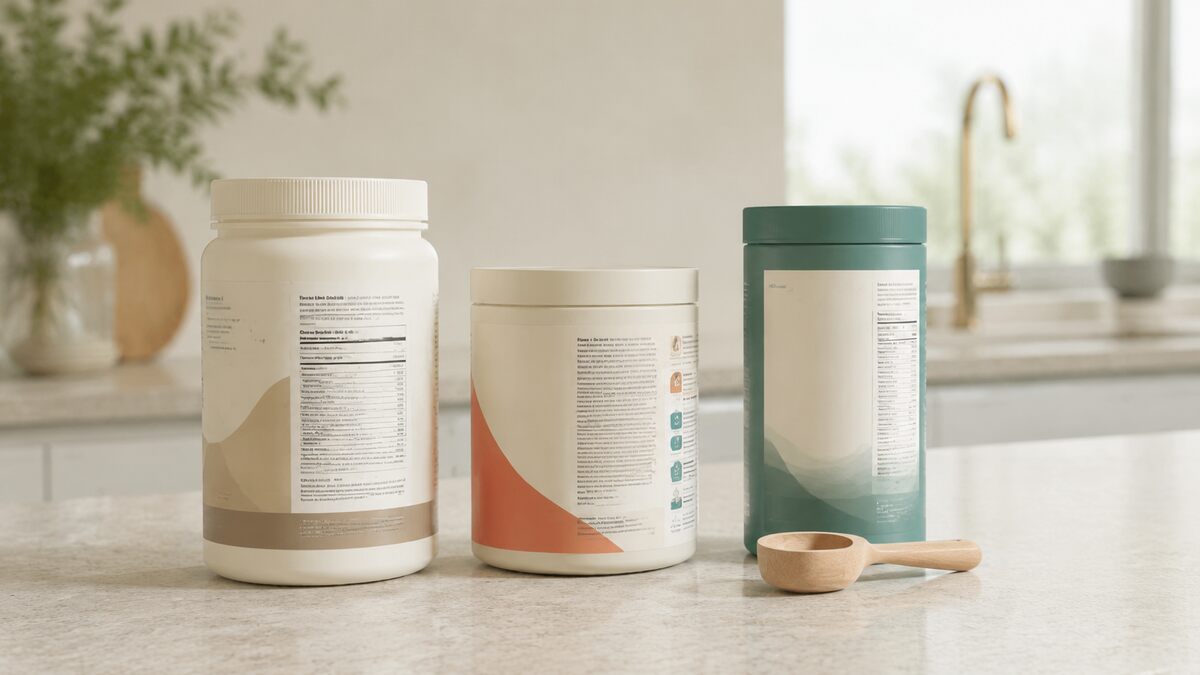
To compare collagen brands fairly, ignore the front-of-pack promises and check six things on the label: the form of collagen (hydrolysed peptides, gelatin or undenatured type II), the grams per serving, the animal source, any independent testing, the added ingredients, and the cost per gram of collagen. Those details let you compare any two products like for like, whatever the marketing says.
This guide includes a few product links near the end. As an Amazon Associate, michelle.net.au earns from qualifying purchases, at no extra cost to you.
This guide walks through each check, explains why it matters, shows how to work out the real cost per serving, and lists the questions worth asking a brand or pharmacist. It does not rank or recommend brands, and it does not suggest any collagen product will change your skin, joints or health. It is about reading a label honestly.
At a glance
- Form decides the dose: hydrolysed collagen peptides are studied in grams; undenatured type II collagen is studied in milligrams. They are not interchangeable.
- Grams per serving is the key number: “contains collagen” tells you nothing about how much.
- Source matters for allergies and diet: bovine, porcine, marine and chicken collagen are all common, and none is suitable for vegans.
- Seals check quality, not effect: third-party testing confirms content and contaminants, not that a product works.
- Talk to your doctor or pharmacist before starting collagen if you have allergies, kidney disease, are pregnant or take regular medicines.
What the research does and does not tell a buyer
Collagen is a structural protein found in skin, tendons, cartilage and bone. When you swallow collagen it is digested into amino acids and short peptides like any other protein. Trials have tested collagen supplements against placebo using a range of measurements, and reviews describe the evidence as mixed, short-term and often industry-funded. The Harvard T.H. Chan School of Public Health’s Nutrition Source notes that much of the collagen research is funded, at least in part, by related industries.
For a buyer, the practical point is narrower: if you decide to try a collagen product, the label should let you see whether it matches the form and amount that researchers actually tested. For what specific trials measured, see what the research says about collagen and joint comfort, and for the claims that do not hold up, collagen peptide myths.
The six label checks, compared
| Check | Where to find it | What a clear label shows | Red flag |
|---|---|---|---|
| Form | Ingredient list | “Hydrolysed collagen”, “collagen peptides”, “gelatin” or “undenatured type II collagen” | Just “collagen” or a trademarked blend name with no form stated |
| Amount per serving | Nutrition or active ingredient panel | Grams (or milligrams for type II) of collagen per serving | Collagen inside a “proprietary blend” with only a total weight |
| Source | Ingredient list or allergen statement | Bovine, porcine, marine (fish) or chicken stated plainly | No source given, which matters for allergies and dietary rules |
| Testing | Seal on pack or brand’s quality page | Named independent tester, ideally with batch results available | Vague “lab tested” or “pharmaceutical grade” with no detail |
| Added ingredients | Full ingredient list | Each extra listed with its amount | Long lists of extras in tiny or unstated amounts |
| Cost per gram | Your own calculation | Price divided by total grams of collagen in the pack | Only “price per tub” or “per serving” with small servings |
Check 1: The form of collagen
Hydrolysed collagen peptides
Most collagen powders are hydrolysed: the protein has been broken into smaller peptides so it dissolves easily in drinks. This is the form used in most trials, typically at around 2.5 to 10 g a day. A 2023 systematic review in Nutrients by Pu and colleagues, covering 26 randomised trials, found doses across the literature ranging from 0.6 g to 12 g a day over 2 to 12 weeks, and its authors noted biases in the trials and called for larger studies. So “the studied dose” is a range rather than a single benchmark.
Gelatin
Gelatin is partially broken-down collagen that gels when cooled. It provides the same amino acids but is less convenient in cold drinks. It is usually cheaper per gram.
Undenatured type II collagen
Undenatured type II collagen, usually from chicken cartilage, is a different product. It is studied at very small doses, around 40 mg a day, as in a 2016 trial by Lugo and colleagues in Nutrition Journal. A brand citing gram-dose peptide research while selling a milligram-dose type II product, or the reverse, is not making a like-for-like comparison.
Labels sometimes list “types I, II, III, V and X”. Types describe where collagen is found in the body; once a protein is hydrolysed, the type label tells you more about its source tissue than about what it will do.
Check 2: Grams per serving
This is the single most useful comparison point. Some products provide around 10 g of collagen per serving; others, especially capsules, gummies and “beauty” drinks, provide a gram or less. Capsules often need several a day to reach even a few grams.
Look for the amount of collagen itself, not the total serving weight, which may include flavours, sweeteners and fillers. If collagen sits inside a “proprietary blend” with only the blend’s total weight shown, you cannot tell how much you are getting.
Check 3: Source and dietary needs
- Bovine (cow): common and often the cheapest per gram.
- Porcine (pig): common in gelatin; not suitable for halal or kosher diets unless certified.
- Marine (fish skin or scales): avoid if you have a fish allergy; usually priced higher.
- Chicken: the usual source of type II collagen.
- “Vegan collagen”: plant products cannot contain animal collagen. They usually contain vitamin C, amino acids or plant extracts, or in some cases lab-produced proteins, so read what is actually in them.
If you follow religious dietary rules, look for a recognised halal or kosher certification mark rather than relying on wording alone.
Check 4: Independent testing
Because collagen is made from animal tissue, contamination with heavy metals is a reasonable question; the Harvard Nutrition Source lists it among the concerns with collagen supplements. A named third-party testing programme gives some assurance about what is in the pack. The NIH Office of Dietary Supplements notes that seals from bodies such as USP, NSF International and ConsumerLab confirm proper manufacturing, accurate labelling and absence of harmful levels of contaminants, but do not guarantee a product is safe or effective for you. The guide to supplement certification seals explains what each one checks.
Check 5: Added ingredients
Many products add extras. Judge each on its own merits rather than assuming more ingredients means a better product.
- Vitamin C: the NIH Office of Dietary Supplements notes vitamin C is needed for the body to make collagen. Its recommended dietary allowance is 90 mg a day for adult men and 75 mg for adult women, amounts many people already get from food. See the vitamin C supplements guide.
- Biotin: the NIH Office of Dietary Supplements sets an adequate intake of 30 mcg a day for adults and describes evidence for hair, skin and nail claims as limited. The US Food and Drug Administration has warned that high-dose biotin can interfere with some laboratory tests, including certain thyroid and heart tests. If a product contains milligram amounts of biotin, tell your doctor before any blood test.
- Hyaluronic acid, plant extracts, probiotics: often present in small amounts; check the quantity and whether it matches anything studied.
- Sweeteners and flavours: worth checking if you are watching sugar or have sensitivities.
Check 6: Work out the real cost per gram
Price per tub hides big differences. Here is a worked example with made-up numbers to show the method (not real products or prices):
| Product A (powder) | Product B (capsules) | |
|---|---|---|
| Pack price | $40 | $30 |
| Collagen per serving | 10 g | 1.5 g (3 capsules) |
| Servings per pack | 30 | 30 |
| Total collagen in pack | 300 g | 45 g |
| Cost per gram of collagen | About 13 cents | About 67 cents |
The “cheaper” pack costs about five times more per gram of collagen. Real prices vary widely by country and retailer, and prices change, so do the sum yourself with prices at the time you buy.
How regulations differ by country
What a label is allowed to say depends on where it is sold, so label language is a poor guide to evidence.
- Australia: collagen products may be sold as foods (many powders) or as listed complementary medicines with an AUST L number. Listed medicines may only use permitted indications, and the Therapeutic Goods Administration does not evaluate their effectiveness before listing.
- United States: supplements do not need FDA approval before sale; companies are responsible for safety and truthful labelling, and structure or function statements must carry a disclaimer that the FDA has not evaluated them.
- European Union: health claims must be authorised. In 2011 the European Food Safety Authority assessed a joint-maintenance claim for collagen hydrolysate and concluded a cause and effect relationship had not been established.
If you buy online from overseas, the product may not meet the rules where you live; see how to buy supplements internationally.
Your comparison checklist
- Write down the form of collagen for each product (peptides, gelatin, or undenatured type II).
- Only compare products of the same form with each other.
- Record collagen per serving in grams (or mg for type II), not total serving weight.
- Check the source against any allergy, vegetarian, halal or kosher needs.
- Look for a named independent testing seal or published batch testing.
- List every added ingredient and its amount; cross out extras you already get from food.
- Calculate cost per gram of collagen using today’s price.
- Ask your doctor or pharmacist whether it suits you, especially if you take medicines or have a health condition.
Common mistakes
- Comparing grams with milligrams: type II and peptide products are different things.
- Trusting “clinically studied”: this often means an ingredient was tested somewhere, not that this product, at this dose, was.
- Buying on price per tub: small servings make products look cheaper than they are.
- Ignoring the source: marine collagen and fish allergies do not mix.
- Mistaking seals for proof it works: testing confirms content and purity only.
- Overlooking biotin: high doses can distort blood test results.
Questions to ask a brand or pharmacist
- How many grams of collagen are in one serving, and from which animal source?
- Is the product tested by an independent laboratory, and can I see results for my batch?
- Is this sold as a food or a listed medicine where I live?
- Does anything in it interact with my medicines or affect blood tests?
The wider method for judging any product is in the supplements evidence and label guide, and the basics of reading a panel are in how to read a supplement label.
Related guide: Bovine vs Marine Collagen: How to Pick the Right One Safely.
Related guide: Is Colostrum Worth It? The Smart Evidence and Label Check.
Sources this guide draws on: Harvard T.H. Chan School of Public Health Nutrition Source (collagen); NIH Office of Dietary Supplements fact sheets on vitamin C and biotin and its guidance on supplement quality seals; US Food and Drug Administration safety communication on biotin and laboratory tests; European Food Safety Authority NDA Panel opinion on collagen hydrolysate (2011); Therapeutic Goods Administration guidance on listed medicines; Pu and colleagues, Nutrients (2023); Lugo and colleagues, Nutrition Journal (2016).
Handy kit for this guide
These are practical everyday products, not supplements or medicines. As an Amazon Associate, michelle.net.au earns from qualifying purchases, at no extra cost to you. Prices and availability are set by Amazon and may vary by country.
- Etekcity Digital Kitchen Scale
Reads in grams, handy for portions, recipes and checking a scoop against a label.
View on Amazon - Stainless Steel Measuring Spoon Set (6 pieces)
Plastic-free spoons for level, repeatable measures.
View on Amazon - BlenderBottle Classic V2 Shaker (20 oz)
The wire whisk ball mixes powders into water or milk without lumps.
View on Amazon
FAQ
What is the best type of collagen to buy?
There is no single best type for everyone. Hydrolysed peptides are the most common and easiest to use; undenatured type II is a separate, low-dose product. Decide what you are comparing, then use the six checks above, and ask your doctor or pharmacist whether any collagen product suits you.
Is marine collagen better than bovine collagen?
There is no strong evidence that one source is better than the other for health outcomes. The practical differences are price, allergies (fish) and dietary preferences. Marine collagen usually costs more per gram.
How many grams of collagen should a serving contain?
Trials of hydrolysed collagen have used a wide range, from under a gram to around 12 g a day, with many using 2.5 to 10 g. Labels that give only a fraction of a gram are well below most of that research. This is a description of what was tested, not a recommended dose for you.
Are collagen gummies and capsules worth it?
They often provide much less collagen per serving than powders and usually cost more per gram. If you choose them, check the collagen amount per serving and the sugar content.
Does a third-party seal mean a collagen product works?
No. Seals from testers such as USP or NSF confirm manufacturing quality, label accuracy and contaminant limits. They say nothing about whether a product has any effect.
Comparing collagen brands comes down to reading the label carefully and doing one simple sum. Check the form, grams, source, testing, extras and cost per gram, compare only like with like, and talk to your doctor or pharmacist before adding any supplement.
This guide is general education only. It does not endorse any brand and is not medical advice. Talk to your doctor or pharmacist before starting any supplement.