
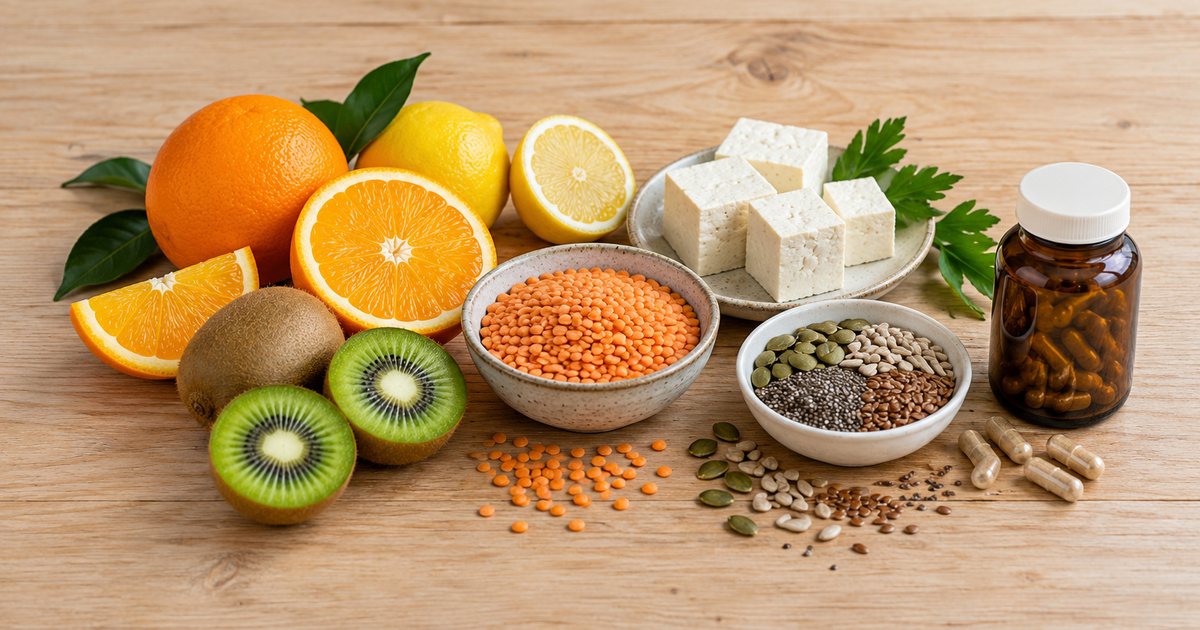
Vegan collagen, in the strict sense, does not exist on supplement shelves: collagen is an animal protein, and plants do not make it. Products sold as “vegan collagen” are almost always “collagen builders”, blends of vitamin C, amino acids, minerals and plant extracts that supply some of the raw materials and helpers the body uses when it makes its own collagen. A genuinely animal-free collagen made by fermentation is being developed, but it is still rare and mostly used outside supplements.
This guide includes a few product links near the end. As an Amazon Associate, michelle.net.au earns from qualifying purchases, at no extra cost to you.
This guide explains where collagen comes from, what is really inside a vegan or vegetarian collagen product, how to read the label line by line, and how to decide whether one is worth your money compared with simply eating well.
At a glance
- Collagen is made only by animals. A “vegan collagen” supplement usually contains no collagen at all.
- Most products are collagen builders: vitamin C plus amino acids such as glycine, proline and lysine, sometimes with zinc, copper, silica or plant extracts.
- Vitamin C is the best-documented ingredient. The NIH Office of Dietary Supplements notes that the body needs it to make collagen.
- Recombinant (fermentation-made) collagen exists in research and some ingredient supply, but it is not the same thing as a collagen builder and is uncommon in consumer supplements.
- Judge a product by its full ingredient list and amounts per serve, not the front-of-pack wording.
Why plants cannot give you collagen
Collagen is the main structural protein in animal connective tissue: skin, tendons, ligaments, cartilage and bone. Its building block is a long chain with a repeating pattern in which glycine appears at almost every third position, with proline and hydroxyproline packed in between. Three of these chains twist together into a tight triple helix.
Plants build their structure differently, mainly from cellulose and other carbohydrates in their cell walls. They make plenty of protein, but not collagen. That is why every standard collagen supplement, whether bovine, porcine, marine or chicken, comes from animal skin, bone, scales or cartilage. If you are weighing those animal sources, the guide to bovine vs marine collagen compares them.
So when a vegetarian or vegan product says “collagen” on the front, it is describing what the product is meant to support, not what is inside the tub.
The three things sold as “vegan collagen”
Products in this space fall into three quite different groups. Knowing which one you are looking at is the single most useful label skill.
| Type | What it actually contains | Does it contain collagen? | How common |
|---|---|---|---|
| Collagen builder (also called collagen support or pro-collagen) | Vitamin C, amino acids (often glycine, proline, lysine), sometimes zinc, copper, silica and plant extracts | No | By far the most common |
| Plant protein blend marketed for skin or hair | Pea, rice or soy protein with added vitamins | No | Common |
| Recombinant or “animal-free” collagen | Collagen or collagen-like protein made by genetically engineered yeast or bacteria | Yes, or a close fragment of it | Rare; mostly skincare, research and medical uses |
Collagen builders
A collagen builder supplies nutrients involved in the body’s own collagen production. The logic is simple: your body makes collagen from amino acids it gets from dietary protein, and it relies on vitamin C and certain minerals to do so. The product puts some of those ingredients in one capsule or scoop.
What a builder cannot do is deliver the collagen peptides that animal collagen supplements contain. Whether taking a builder makes any measurable difference for someone who already eats enough protein and vitamin C has not been well studied, and experts quoted in mainstream health coverage generally say the evidence is thin.
Recombinant collagen
Researchers have inserted human collagen genes into microorganisms such as the yeast Pichia pastoris and certain bacteria, which then produce collagen or “human-like” collagen fragments by fermentation. Peer-reviewed studies published in 2024 describe this kind of production and its potential uses in medicine and cosmetics. Because no animal is involved, some people regard it as vegan, although opinions differ on how to classify genetically engineered ingredients.
The practical point for shoppers: recombinant collagen is expensive and made in relatively small volumes. If a product genuinely contains it, the ingredient list should name it clearly (for example “recombinant human collagen” or a named fermentation-derived collagen ingredient). If you see only vitamins, amino acids and herbs, it is a builder.
What the common ingredients do (and what is not known)
Here is what each frequent ingredient is and the most that can honestly be said about it. None of this means a product will change your skin, joints or hair.
| Ingredient on the label | Why it is included | What is well established |
|---|---|---|
| Vitamin C (ascorbic acid, sodium ascorbate, acerola, camu camu) | A cofactor in collagen production | The NIH Office of Dietary Supplements states vitamin C is required for collagen biosynthesis, and that severe deficiency (scurvy) impairs collagen and weakens connective tissue. Most people who eat fruit and vegetables get enough from food. |
| Glycine, L-proline, L-lysine | Amino acids that are abundant in collagen, or needed to form it | They are normal parts of dietary protein. A few hundred milligrams in a capsule is small compared with what a protein-rich meal provides. |
| Zinc and copper | Minerals used by enzymes involved in building and cross-linking connective tissue | Both are essential nutrients. Both also have upper limits, so totals across all your supplements matter. |
| Silica (bamboo extract, horsetail) | Marketed for skin, hair and nails | Human evidence for supplemental silica on collagen is limited. Read claims cautiously. |
| Plant extracts (gotu kola, sea buckthorn, green tea, berries) | Antioxidant or traditional-use ingredients | Evidence varies by extract and is often from lab or small studies. Quantities are frequently too small to judge. |
| Biotin, hyaluronic acid (fermentation-made), ceramides | Added for a “beauty” positioning | These are not collagen and do not become collagen. Hyaluronic acid used in vegan products is usually made by bacterial fermentation. |
Vitamin C deserves a closer look because it carries most of the scientific weight. The guide to vitamin C supplements covers forms and how much is in common products, and why more is not automatically better.
How to read a vegan collagen label: step by step
Use this sequence in the shop or on a product page. It takes about two minutes and works in any country.
- Find the word “collagen” in the ingredient list, not just on the front. If it is missing, you are looking at a builder. That is fine, as long as the price reflects it.
- Check whether it is actually vegan. Look for a vegan certification mark and read the full list. Some “collagen support” products contain animal-derived ingredients such as marine collagen, gelatin capsules, lanolin-sourced vitamin D3 or beeswax.
- Write down the amount of each active ingredient per daily serve. Labels that hide amounts inside a “proprietary blend” make it impossible to compare products.
- Add up vitamin C, zinc and copper across everything you take. Many people already take a multivitamin. Upper limits exist for these nutrients, and a pharmacist can check your total.
- Look at the serving size. A product that needs four capsules a day to deliver its listed amounts costs twice as much as one that needs two.
- Check the regulatory number or quality seal for your country. In Australia, a supplement regulated as a listed complementary medicine shows an AUST L number. Elsewhere, look for the relevant local registration or independent testing seal. The guide to supplement certification seals explains what the main ones mean.
- Work out the cost per day. Divide the price by the number of daily serves. Then compare it with what the same money buys in food.
For a broader walk-through of any supplement panel, see how to read a supplement label.
Food first: what a vegan diet already provides
The body makes collagen from amino acids it gets from all dietary protein, along with vitamin C, zinc and copper. A varied vegan or vegetarian diet can supply all of these without a special product.
- Protein for amino acids: legumes, tofu, tempeh, soy milk, seitan, nuts and seeds. Combining sources across the day covers the full range of amino acids.
- Vitamin C: citrus, kiwifruit, capsicum, berries, broccoli, tomatoes and leafy greens.
- Zinc: legumes, whole grains, nuts and seeds. Soaking or sprouting legumes and grains is often suggested because it reduces phytate, which can reduce zinc absorption.
- Copper: nuts, seeds, legumes, whole grains and cocoa.
Getting enough total protein matters more as we age. The guide to protein after 40 explains why and lists practical plant sources.
Vegan collagen builder or animal collagen: how they compare
If you are not strictly vegan, you may be deciding between a builder and an animal collagen supplement. This table sets out the practical differences without making claims about results.
| Question | Vegan collagen builder | Animal collagen peptides |
|---|---|---|
| Contains collagen? | No (unless it names a recombinant ingredient) | Yes, as hydrolysed peptides |
| Suitable for vegans? | Usually, if certified | No |
| Typical format | Capsules, tablets or small scoops of powder | Larger scoops of powder, gummies, drinks |
| Research base | Strong for vitamin C’s role in collagen production; weak for builder blends as products | More studies, though many are small or industry-funded and results are mixed |
| Main label risk | Hidden amounts in blends; doubling up on vitamin C, zinc or copper | Unclear source; overstated claims |
Before buying either, read common myths about collagen peptides, which explains why swallowed collagen is digested into amino acids and what that means for marketing claims. If you do go the animal route, how to compare collagen brands sets out a fair comparison method.
Who a collagen builder may suit, and who should skip it
It may suit you if
- You are vegan or vegetarian and want a convenient product containing vitamin C and amino acids, and the price is reasonable to you.
- Your diet is often low in fruit and vegetables, and you prefer a single capsule (although improving your diet is the stronger option).
- You understand it contains no collagen and you are paying for convenience, not a special effect.
Consider skipping it if
- You already eat a varied diet with plenty of protein, fruit and vegetables.
- You already take a multivitamin with vitamin C and zinc. Doubling up adds cost and pushes totals higher.
- You take prescription medicines, are pregnant or breastfeeding, have kidney problems or a history of kidney stones, or have a condition affecting iron or copper levels. Talk to your doctor or pharmacist first.
- The product hides amounts in a blend or makes dramatic before-and-after claims.
Common mistakes
- Assuming “vegan collagen” means collagen. In almost every case it means a blend of nutrients, not the protein itself.
- Paying a premium for vitamin C. Many builders are mostly vitamin C plus small amounts of amino acids. Compare the price with a plain vitamin C product if that is what you are actually getting.
- Ignoring totals. Vitamin C, zinc and copper each appear in many multivitamins, hair-skin-nails products and fortified drinks.
- Trusting a “vegan” claim without checking. Capsule shells, coatings and vitamin D3 sources can be animal-derived.
- Mistaking marketing language for evidence. Words like “plant collagen”, “phyto-collagen” or “collagen from plants” describe a product idea, not a protein that plants make.
- Expecting the amino acids to do the work of a meal. A few hundred milligrams of glycine or lysine is a tiny fraction of the protein in a serve of lentils or tofu.
A quick decision checklist
- Does the ingredient list contain collagen, or only nutrients?
- Is it certified vegan, and are the capsule and coatings plant-based?
- Are all amounts per serve listed, with no proprietary blend?
- Will my total vitamin C, zinc and copper stay sensible with my other supplements?
- Does it carry a local registration number or independent quality seal?
- Is the cost per day better spent on protein-rich food, fruit and vegetables?
- Have I asked my pharmacist if I take medicines or have a health condition?
Sources this guide draws on: NIH Office of Dietary Supplements Vitamin C fact sheet for health professionals; peer-reviewed studies on recombinant human-like collagen expressed in Pichia pastoris (2024); Medical News Today and Live Science explainers on vegan collagen, used for context only; WebMD and Holland and Barrett consumer pages reviewed as search context only.
Handy kit for this guide
These are practical everyday products, not supplements or medicines. As an Amazon Associate, michelle.net.au earns from qualifying purchases, at no extra cost to you. Prices and availability are set by Amazon and may vary by country.
- Etekcity Digital Kitchen Scale
Reads in grams, handy for portions, recipes and checking a scoop against a label.
View on Amazon - Stainless Steel Measuring Spoon Set (6 pieces)
Plastic-free spoons for level, repeatable measures.
View on Amazon - BlenderBottle Classic V2 Shaker (20 oz)
The wire whisk ball mixes powders into water or milk without lumps.
View on Amazon
Frequently asked questions
Is there such a thing as vegan collagen?
Not in the usual sense. Collagen comes only from animals, so most “vegan collagen” products are collagen builders made of vitamins, minerals and amino acids. Collagen produced by engineered yeast or bacteria does exist, but it is rare in consumer supplements and should be named clearly on the label if present.
What is the difference between vegan and vegetarian collagen?
There is no true vegetarian collagen either, because collagen comes from animal tissue such as skin, bones and scales. “Vegetarian collagen” is usually another name for a collagen builder. Check whether the product is certified vegan, as some vegetarian-labelled products use ingredients such as beeswax or lanolin-derived vitamin D3.
Do vegan collagen builders work?
Vitamin C is required for the body to make collagen, which is well established. Whether a builder product changes anything for someone who already eats enough protein and vitamin C has not been shown in good-quality studies. Think of them as a convenience product, not a proven solution.
Is vegan collagen better than marine or bovine collagen?
They are different products, so “better” depends on what you value. A builder contains no collagen but suits vegans; marine and bovine products contain collagen peptides but come from animals. Neither should be bought on the expectation of a guaranteed result, and the research on both is limited.
Can I get what a collagen builder contains from food?
Yes. Legumes, soy foods, nuts, seeds and whole grains provide the amino acids, zinc and copper, while fruit and vegetables provide vitamin C. A varied plant-based diet covers the same nutrients, usually for less money.
Are vegan collagen supplements safe to take?
Many are made from common nutrients, but safety depends on the amounts, your total intake from other products, your medicines and your health. Vitamin C, zinc and copper all have upper limits. Talk to your doctor or pharmacist before starting one, especially if you take prescription medicines or are pregnant.
Vegan collagen is a label idea more than an ingredient. Read past the front of the pack, check what is really inside and in what amounts, and compare the cost with a good plate of beans, greens and fruit. If a product still earns its place after that, you will at least know exactly what you are paying for.