
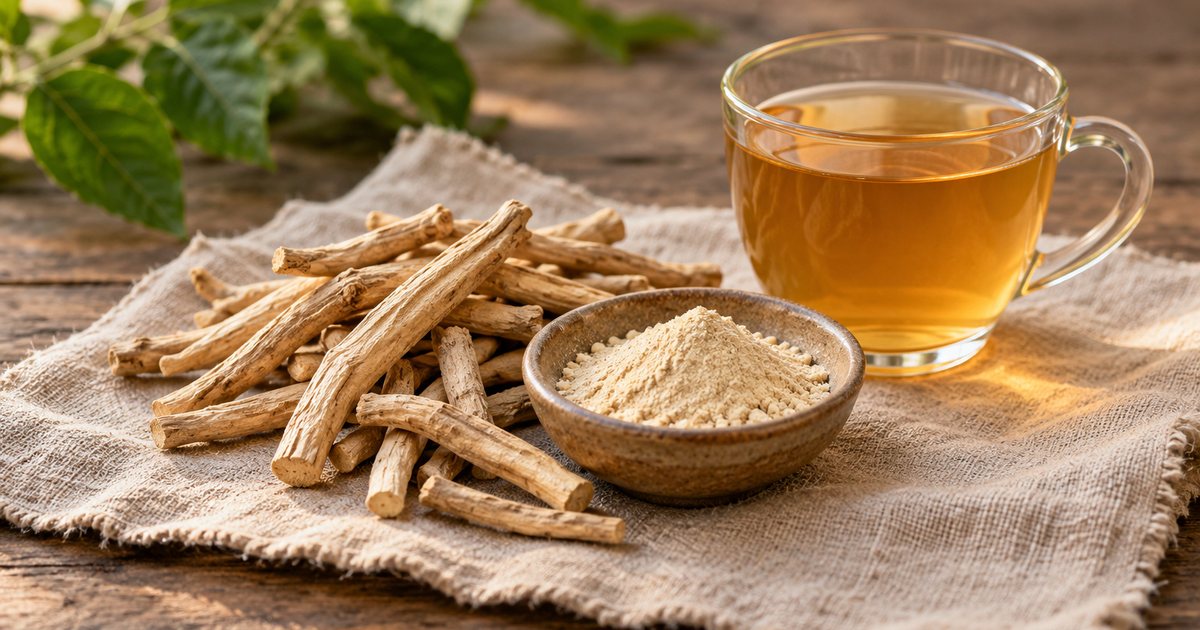
There is no single answer to how long ashwagandha takes to work, but the clinical trials give a useful frame: most ran for about 30 days to 12 weeks, and they measured changes in things like self-rated stress scores, sleep questionnaires and cortisol levels at the end of that period. Results were mixed, and the NIH Office of Dietary Supplements describes the trials as small and short, using many different extracts and amounts. That makes it impossible to promise any personal timeline.
This guide includes a few product links near the end. As an Amazon Associate, michelle.net.au earns from qualifying purchases, at no extra cost to you.
This guide sets out what the randomised trials actually measured and over what period, explains what “when people take it” looks like in research rather than in marketing, covers how long ashwagandha stays in your system and whether tea is the same as an extract, and gives a clear safety box based on the Australian Therapeutic Goods Administration’s liver warnings.
At a glance
- Stress trials summarised by the NIH Office of Dietary Supplements ran for 30 to 90 days; sleep trials ran for 6 to 12 weeks.
- Outcomes were mostly questionnaire scores (stress, anxiety, sleep quality), sometimes with cortisol or wrist-worn sleep tracking.
- Some trials reported differences from placebo, at least one larger 12-week trial found no change in perceived stress, and the evidence is described as limited.
- Long-term safety beyond about three months is not known.
- Australia’s TGA has warned about a rare risk of liver injury; talk to your doctor or pharmacist before using ashwagandha, especially if you take medicines or have liver or thyroid conditions.
What ashwagandha is
Ashwagandha (Withania somnifera, sometimes called withania) is a plant used in Ayurvedic traditional medicine in India. Supplements are usually made from the root, or from root and leaf, and are often sold as branded, standardised extracts. Different extracts are made in different ways, which is one reason trial results do not transfer neatly from one product to another.
In Australia, many ashwagandha products are listed on the Australian Register of Therapeutic Goods. Listing means a product meets certain quality and safety requirements, but listed medicines are not assessed by the TGA for whether they work.
What the trials measured, and for how long
The table below summarises randomised, placebo-controlled trials described in the NIH Office of Dietary Supplements ashwagandha fact sheet. Amounts are shown only to describe what was tested; they are not a recommendation.
| Trial (as listed by NIH ODS) | Who took part | Length | What was measured | What was reported |
|---|---|---|---|---|
| Remenapp and colleagues (United States) | 60 stressed adults, average age 34 | 30 days | Stress, anxiety and mood rating scales; saliva cortisol | Better ratings than placebo at both amounts tested; lower saliva cortisol at one amount |
| Baker and colleagues (United States) | 60 college students | 30 days | Interviews and focus groups about stress | Users more often described stress as manageable; other descriptions were similar between groups |
| Majeed and colleagues (India, 2023) | 54 adults with mild to moderate stress and anxiety | 60 days | Stress and anxiety scales; quality of life | Lower stress and anxiety scores than placebo |
| Gopukumar and colleagues (India) | 130 adults with self-reported stress | 90 days | Stress and sleep quality scales; blood cortisol | Better stress and sleep scores and lower cortisol than placebo |
| Smith and colleagues (2023) | 120 adults in their mid-50s with low energy | 12 weeks | Perceived stress; fatigue | No reduction in perceived stress; lower fatigue scores |
| Deshpande and colleagues (India, 2020) | 150 adults with self-reported sleep problems | 6 weeks | Sleep rating scale; wrist-worn sleep tracking (actigraphy) | More people in the ashwagandha group reported better sleep quality; actigraphy measures also differed |
| Langade and colleagues (India, 2021) | 80 adults, half with insomnia | 8 weeks | Actigraphy; sleep and anxiety scales | Differences on several sleep measures, mainly in the insomnia group |
What the reviews concluded
The NIH fact sheet also describes two pooled analyses. A 2021 systematic review of seven trials (491 adults, all in India, lasting 6 to 8 weeks) reported reductions in stress and anxiety scores and serum cortisol. A 2021 meta-analysis of five sleep trials (372 adults, 6 to 12 weeks) reported a small overall effect on sleep scores, which was larger in trials lasting 8 weeks or more and in people with insomnia.
The fact sheet’s overall view is cautious: the trials are small and short, used varied preparations and amounts, and many were run within a traditional medicine setting, so it is hard to say which extract, if any, produces which effect.
So how long does ashwagandha take to work?
What the research can honestly say is this: the trials that reported differences measured them after roughly one to three months, and the sleep analysis found larger differences in studies lasting at least eight weeks. Trials generally did not track week-by-week changes in a way that tells you when a difference first appeared. Individual responses, health conditions and products differ, so these timeframes describe study designs, not what any one person will notice.
Best time to take ashwagandha: morning or night?
“Best time to take ashwagandha” and “do I take ashwagandha in the morning or night” are among the most searched questions on this topic. Trials set a timing schedule as part of each protocol, and those schedules differed between studies. This guide could not find a trial that directly compared morning with evening use, so there is no evidence-based answer to which is better.
Because drowsiness is one of the reported side effects, and because ashwagandha may interact with sedative medicines, timing is a reasonable question to put to your pharmacist, who can consider your other medicines and health. For broader, well-supported sleep habits, see sleep and healthy ageing and how sleep changes as you age.
How long does ashwagandha stay in your system?
This is a common question, but reliable human data are scarce. The NIH Office of Dietary Supplements fact sheet does not give a half-life or elimination time, and ashwagandha extracts contain many different compounds that may behave differently in the body. This guide could not verify any single figure, so it does not give one. If you need to know for a medical reason, such as before surgery or a new prescription, tell your doctor or pharmacist what you have been taking and when you stopped.
Ashwagandha tea vs extracts
Ashwagandha tea is popular, but it is not what the trials tested. The trials in the table used capsules or tablets of specific root or root-and-leaf extracts, often standardised to a stated level of plant compounds called withanolides. A tea made from dried root or a blend will contain different, usually unknown, amounts. That does not make tea unsafe or useless, but trial results cannot be applied to it.
| Feature | Branded standardised extract | Generic root powder | Ashwagandha tea |
|---|---|---|---|
| Used in the trials described above | Yes, in most | Rarely | No |
| Amount per serve stated | Usually, as extract weight and sometimes withanolide content | Powder weight only | Often not stated |
| Comparable to trial results | Only if it is the same extract and amount | No | No |
| Liver safety warning applies | Yes | Yes | Yes, as it contains the same plant |
Safety box: what the TGA and NIH say
In 2024 Australia’s TGA issued a safety advisory about possible liver injury linked to products containing Withania somnifera, and in July 2026 it published a further medicine safety update describing a very rare risk of liver injury, with four new Australian reports received since the 2024 advisory. The TGA advises people to:
- be aware of possible stomach and bowel side effects and the rare risk of liver injury;
- stop the product and seek medical advice straight away if they notice yellowing of the skin or eyes, dark urine, nausea, vomiting, unusual tiredness or weakness, abdominal pain or loss of appetite;
- avoid these products if they have, or have had, liver problems;
- report suspected side effects to the TGA or a health professional.
The NIH Office of Dietary Supplements adds that ashwagandha appears well tolerated for up to about three months, but long-term safety is not known. It lists possible effects on thyroid hormone levels, notes that some experts advise against use in pregnancy (Denmark banned ashwagandha products in 2023 and France’s food safety agency advised against use in pregnancy and breastfeeding in 2024), and flags possible interactions with thyroid, diabetes, blood pressure, immunosuppressant and sedative medicines.
If any of this applies to you, or you take regular medicines, talk to your doctor or pharmacist before using ashwagandha. If stress or worry is affecting your daily life, is my anxiety normal? explains when it is worth speaking to a GP.
A checklist before you buy
- Ask your doctor or pharmacist whether ashwagandha is suitable, particularly if you take medicines, are pregnant or breastfeeding, or have liver, thyroid or autoimmune conditions.
- Check for an AUST L or AUST R number if you are in Australia; the TGA has warned against buying supplements online from sources that are not regulated here. See buying supplements overseas.
- Read the label for the plant part (root, leaf or both), extract name and amount per serve; how to read a supplement label shows where to look.
- Look for combination products and check every ingredient; the TGA noted other ingredients may have contributed in some liver cases.
- Look for third-party testing; see how to read supplement seals.
- Write down when you started, so you can tell your doctor if anything changes.
- Know the liver warning signs listed above and act on them.
Common mistakes
- Expecting a set timeline. Trial lengths describe study designs, not personal results.
- Assuming tea equals an extract. The trials did not test tea.
- Applying one brand’s trial to another product. Extracts differ in how they are made.
- Using it long term without review. Safety beyond about three months is not established.
- Ignoring early warning signs. Yellow skin or eyes, dark urine or unusual tiredness need prompt medical advice.
- Not telling your doctor or pharmacist. Herbal products can interact with prescribed medicines.
For a wider framework on judging supplements, see supplements: how to choose the right ones.
Sources this guide draws on: NIH Office of Dietary Supplements, Ashwagandha Fact Sheet for Health Professionals (including the trials and reviews it summarises); Therapeutic Goods Administration, safety advisory on Withania somnifera and liver injury (2024) and medicine safety update (July 2026); Danish Veterinary and Food Administration and ANSES, as reported in the NIH fact sheet.
Handy kit for this guide
These are practical tools, not supplements or medicines. As an Amazon Associate, michelle.net.au earns from qualifying purchases, at no extra cost to you. Prices and availability are set by Amazon and may vary by country.
- Ezy Dose Weekly AM/PM Pill Organiser (X-Large)
Seven days with separate morning and evening compartments, so you can see at a glance what has already been taken.
View on Amazon - Vaydeer Metal 7-Day Travel Pill Case
Slim metal case with a built-in desiccant, for keeping a week of tablets dry in a bag or suitcase.
View on Amazon - Bambaw Insulated Stainless Steel Water Bottle (32 oz)
Plastic-free and keeps water cold all day, useful when a label says to take a product with a full glass of water.
View on Amazon
FAQ
How long does it take for ashwagandha to start working?
Trials typically measured outcomes after about 30 days to 12 weeks, and the sleep analysis found larger differences in studies lasting eight weeks or more. These are study timeframes, not a personal promise, and some trials found no difference on their main measure.
Should I take ashwagandha in the morning or at night?
No trial this guide found compared the two directly. Because drowsiness is a reported side effect and interactions with sedatives are possible, ask your pharmacist about timing.
How long does ashwagandha stay in your system?
Reliable human data on elimination are limited, and this guide could not verify a figure. Tell your doctor or pharmacist what you have taken if it matters for surgery or new medicines.
Is ashwagandha tea as effective as capsules?
The trials used specific extracts in capsules or tablets, not tea. Tea contains different and usually unknown amounts, so trial results do not apply to it.
Is ashwagandha safe for long-term use?
The NIH Office of Dietary Supplements says it appears well tolerated for up to about three months but long-term safety is unknown. The TGA has also warned about a rare risk of liver injury.
Ashwagandha research measured results over weeks to months, with mixed findings and real safety questions. Use the trial timeframes as context, not a promise, and check with your doctor or pharmacist before you start.