
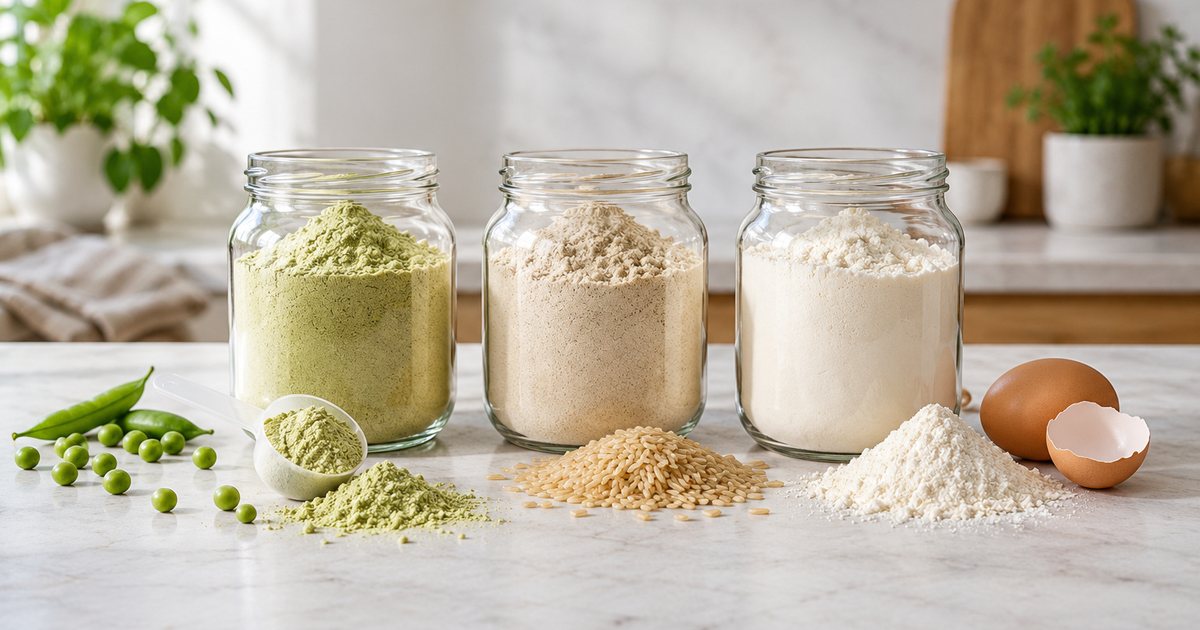
A lactose free protein powder is not always dairy-free. Whey isolate is still made from milk and usually carries a milk allergen warning, even when the lactose has been reduced or removed, while truly dairy-free powders use pea, rice, soy, egg white, beef or blended plant proteins. The right choice depends on whether you are avoiding lactose (the milk sugar) or milk protein itself, and the label tells you which one you are buying.
This guide includes a few product links near the end. As an Amazon Associate, michelle.net.au earns from qualifying purchases, at no extra cost to you.
This guide explains the difference, compares the main lactose-free and dairy-free protein sources on completeness, allergens and taste, and gives you a label checklist to use in the shop. It is label education, not a tested “best” list.
At a glance
- Lactose-free and dairy-free are different claims. Lactose-free whey still contains milk protein; dairy-free powders contain no milk at all.
- The allergen statement is your fastest check. In Australia and New Zealand, milk must be named in bold in the ingredients and in a “Contains” statement; the US and other regions have their own milk-labelling rules.
- Egg white, beef and soy are complete proteins on standard scoring. Pea and rice score lower on their own, which is why many plant powders blend them.
- Check the protein per serve, not the front-of-pack number. Scoop sizes differ, so compare grams of protein per 100 g of powder.
- Ask a health professional if you have a diagnosed milk allergy or a medical condition, because “free from” claims and “may contain” warnings work differently.
Lactose-free vs dairy-free: what the words actually mean
Lactose is the natural sugar in milk. People who are lactose intolerant may get digestive symptoms from it, but they can often handle milk protein. Milk allergy is an immune reaction to milk proteins such as casein and whey, and it can be serious. That is why the two labels matter so much: a lactose-free milk powder may suit someone avoiding lactose and still be completely unsuitable for someone with a milk allergy.
Lactose-free (but still dairy)
These powders start with milk. Common versions are:
- Whey protein isolate: filtered further than whey concentrate, so it is higher in protein and much lower in lactose and fat. Lower is not the same as none. Unless the pack says “lactose free”, assume some lactose remains.
- Lactase-processed milk or whey protein: the lactase enzyme is used to break lactose down, which is how “lactose-free” dairy products are usually made.
- Hydrolysed whey: the protein is partly broken down. This changes taste and price, but it is still a milk product.
In Australia and New Zealand, the Food Standards Code sets conditions that a product must meet before it can make a “lactose free” or “low lactose” claim, so the exact words on the pack matter. Other countries use their own rules, so read what the label actually claims rather than assuming.
Dairy-free
These powders contain no milk ingredients. The main sources are pea, brown rice, soy, egg white, beef and blends such as pea with rice or pea with pumpkin seed. “Vegan” or “plant-based” usually also means dairy-free, but egg and beef powders are dairy-free without being vegan. If you also need to avoid other allergens, read the whole ingredient list: soy, egg and some tree nuts are allergens in their own right.
For a wider comparison that includes whey concentrate, casein and hydrolysate, see the guide to choosing the right type of protein powder.
Dairy-free and lactose-free protein powders compared
The table below compares the main sources. The protein quality column uses DIAAS (Digestible Indispensable Amino Acid Score), the method the Food and Agriculture Organization of the United Nations recommended in its 2013 expert consultation report. A score of 1.0 or above means a protein met the reference amino acid pattern in testing. Published values vary between studies and between products, so read them as a guide to the raw ingredient, not a rating of any brand.
| Protein source | Contains milk? | Protein quality (published DIAAS, approximate) | Allergens to check | Label notes |
|---|---|---|---|---|
| Whey protein isolate | Yes | Above 1.0 | Milk | Low lactose, not lactose-free unless the pack says so |
| Lactase-processed whey or milk protein | Yes | Above 1.0 | Milk | Look for an explicit “lactose free” claim |
| Egg white protein | No | Around 1.0 or above | Egg | Dairy-free but not vegan; mild flavour, can foam when shaken |
| Beef protein | No | Beef muscle scores above 1.0 | Usually none of the major allergens | Check the source and amino acid panel; collagen-heavy blends differ (see below) |
| Soy protein isolate | No | Around 0.9 | Soy | Smooth texture, high protein percentage |
| Pea protein | No | Around 0.8; lowest in methionine and cysteine | Usually none of the major allergens | Earthy taste; often blended with rice |
| Brown rice protein | No | Well below 1.0; lowest in lysine | Usually none of the major allergens | Gritty texture on its own; often blended with pea |
| Pea and rice blend | No | Higher than either alone, because each covers the other’s weaker amino acid | Check for soy or nuts in flavourings | The most common dairy-free blend |
Why do blends matter? Pea protein is relatively rich in lysine but lower in the sulphur amino acids methionine and cysteine. Rice is the other way around. Mixing them gives a more complete amino acid profile than either on its own, which is the main reason plant powders so often combine two or three sources.
The labelling rules that protect you
Australia and New Zealand
Food Standards Australia New Zealand (FSANZ) brought in Plain English Allergen Labelling on 25 February 2024, with a transition period for older stock that ended on 25 February 2026. Under these rules, milk is one of the mandatory allergens. It must be declared by its required name, in bold, within the ingredient list (for example, “whey protein (milk)”), and the label must carry a separate bold summary statement starting with “Contains”, such as “Contains milk“.
FSANZ also notes that precautionary statements such as “may contain milk” are voluntary and are not regulated by the Food Standards Code. A product without a “may contain” line is not guaranteed to be free of trace contact, and a product with one is not necessarily contaminated. If trace amounts matter for you, contact the manufacturer and speak with your doctor or an allergy specialist.
United States and elsewhere
In the US, milk is one of the major food allergens that the Food and Drug Administration (FDA) requires to be declared on packaged foods, either within the ingredient list or in a “Contains” statement. Many protein powders in the US are sold as dietary supplements, which carry their own labelling format, but the milk declaration still applies. The UK, EU and Canada also require milk to be highlighted or declared, though the exact format varies, so check the rules where you live if you buy from overseas sites.
For more on decoding a supplement panel, including serve sizes and percentage daily values, see how to read a supplement label.
A closer look at each dairy-free option
Egg white protein
Egg white protein is made from dried egg whites. It is dairy-free, generally low in fat and carbohydrate, and on standard protein-scoring methods egg is among the reference-quality proteins. The trade-offs: it is an allergen for people with egg allergy, it is not suitable for vegans, and some people find it foams or thickens when shaken. “Egg protein powder” can also mean whole-egg powder, which contains the yolk and therefore more fat, so check which one you are looking at.
Beef protein
Beef protein powders are dairy-free and usually free from the major allergens, which is why they appeal to people avoiding both milk and soy. The catch is that “beef protein” covers very different raw materials. Some products are made mostly from hydrolysed collagen-rich tissue rather than muscle meat. Collagen contains almost no tryptophan, one of the nine essential amino acids, so a collagen-heavy powder will not have the same amino acid profile as beef muscle. Look for a stated source and a full amino acid panel. The site’s guide to collagen peptide myths explains why collagen is counted differently.
Pea protein
Pea protein, usually from yellow split peas, is the most common base for dairy-free powders. It mixes reasonably well and is not one of the mandatory allergens in Australia and New Zealand, though people with legume sensitivities should take care. Taste is the most common complaint, which is why many products add flavourings and sweeteners. When comparing the “best pea protein powder”, ignore marketing language and compare protein per 100 g, the ingredient list length and whether it has been independently tested.
Rice protein
Brown rice protein is low-allergen and mild but has a slightly gritty texture and a lower score on its own, mainly because of lysine. It works best in blends, and as with any powder, an independent testing seal adds confidence that the contents match the label.
Soy protein isolate
Soy protein isolate is dairy-free, high in protein and among the more complete plant proteins in published scoring. Soy is itself a mandatory allergen, so it suits people avoiding milk but not those avoiding soy.
Whey vs plant protein: does the difference matter?
On paper, whey and egg score highest on amino acid completeness, and plant proteins tend to score lower unless blended. In everyday terms, the total amount of protein you eat across the day and the variety of protein foods usually matter more than one scoop. The guide to protein needs after 40 looks at what research has examined for older adults. How much protein is right for you depends on your health, kidney function, activity and diet, so talk to your doctor, pharmacist or an accredited dietitian rather than following a number on a tub.
How to choose a lactose-free or dairy-free protein powder: step by step
- Decide what you are avoiding. Lactose only, all milk protein, or milk plus other allergens such as soy or egg.
- Read the “Contains” statement first. If it says milk and you need dairy-free, put it back, whatever the front of the pack says.
- Check the exact claim. “Lactose free”, “low lactose”, “dairy free” and “vegan” mean different things. Rely on the words printed, not on colours or images.
- Look at the protein source list. Single source or blend? For plant powders, a pea and rice blend usually gives a more complete amino acid profile than rice alone.
- Compare protein per 100 g. Scoop sizes vary a lot between products, so per-serve numbers can mislead. Per 100 g lets you compare like with like.
- Check for an amino acid panel. This matters most for beef and blended products, and it also helps you spot “amino spiking”, where cheap added amino acids inflate the protein figure.
- Scan the rest of the ingredients. Sweeteners, gums, flavours and added vitamins or herbs. Herbal extracts can interact with medicines, so ask your pharmacist.
- Look for independent testing. Third-party seals show a product was checked for what it claims and for certain contaminants. See what supplement seals mean.
- Work out cost per 100 g of protein. Divide the price by the total grams of protein in the tub. This is often where dairy-free powders differ most.
Who each option tends to suit
| Your situation | Options people often consider | Watch out for |
|---|---|---|
| Lactose intolerant, no milk allergy | Whey isolate labelled lactose free, lactase-processed milk protein, or any dairy-free powder | Whey concentrate, which contains more lactose |
| Diagnosed milk allergy | Dairy-free powders only, after checking with your doctor or allergy specialist | “Lactose free” whey; voluntary “may contain milk” warnings |
| Vegan or plant-based | Pea, rice, soy or plant blends | Single-source rice powders with a lower amino acid score |
| Avoiding milk and soy | Pea, rice, pea-rice blends, egg white or beef | Soy lecithin or soy protein hidden in blends |
| Avoiding milk and egg | Pea, rice, soy, beef | Egg-based “paleo” blends |
Common mistakes
- Confusing “lactose free” with “dairy free”.
- Trusting the front of the pack. Words like “clean”, “pure” or “gentle” have no fixed meaning. The ingredient list and allergen statement do.
- Comparing per scoop instead of per 100 g. A bigger scoop can make a lower-protein powder look better.
- Assuming every beef protein is like steak. Collagen-heavy powders have a different amino acid profile.
- Ignoring the other allergens. Many dairy-free blends contain soy, and egg protein is an allergen for some people.
- Buying overseas without checking local rules. Labels made for another country may use different terms. The guide to buying supplements overseas covers what to check.
- Adding a powder without asking about medicines or kidney health. A pharmacist or doctor can tell you whether extra protein or added ingredients suit you.
Quick label checklist
- Allergen “Contains” statement read and understood
- Exact claim noted: lactose free, low lactose, dairy free or vegan
- Protein source(s) listed by name
- Protein per 100 g recorded for comparison
- Amino acid panel present (especially for beef and blends)
- Added herbs, stimulants or high-dose vitamins noted for your pharmacist
- Independent testing seal checked
- Cost per 100 g of protein worked out
If you are comparing high-protein snacks too, the same checks apply; see how to choose a protein bar.
Sources this guide draws on: Food Standards Australia New Zealand allergen labelling guidance (Plain English Allergen Labelling); the Australia New Zealand Food Standards Code; US Food and Drug Administration food allergen labelling requirements; the FAO 2013 expert consultation report on dietary protein quality evaluation; published DIAAS and PDCAAS studies of whey, egg, beef, soy, pea and rice proteins.
Handy kit for this guide
These are practical tools, not supplements or medicines. As an Amazon Associate, michelle.net.au earns from qualifying purchases, at no extra cost to you. Prices and availability are set by Amazon and may vary by country.
- BlenderBottle Classic V2 Shaker (20 oz)
The wire whisk ball mixes powders into water or milk without lumps.
View on Amazon - Etekcity Digital Kitchen Scale
Reads in grams, handy for checking a scoop against the serving size printed on the label.
View on Amazon - Stainless Steel Measuring Spoon Set (6 pieces)
Plastic-free spoons for level, repeatable measures of powders.
View on Amazon
Frequently asked questions
Is whey isolate lactose free?
Not necessarily. Whey isolate is filtered to remove most of the lactose, so it is much lower in lactose than whey concentrate, but small amounts can remain. Only rely on it as lactose free if the pack makes that claim, and remember it is still a milk product.
What is the difference between lactose-free and dairy-free protein powder?
Lactose-free means the milk sugar has been removed or broken down, but the powder can still be made from milk. Dairy-free means there are no milk ingredients at all. People with a milk allergy need dairy-free, and should confirm suitability with their doctor.
Is egg white protein powder dairy free?
Yes. Egg white protein is made from dried egg whites and contains no milk, though it is an allergen for people with egg allergy and is not vegan. Check the label in case the product also contains milk-based ingredients or flavours.
Is pea protein a complete protein?
Pea protein contains all nine essential amino acids, but it is lower in methionine and cysteine, so it scores below whey or egg on standard methods. Blending pea with rice, as many products do, gives a more complete profile.
Is beef protein powder dairy free?
Beef protein powders do not contain milk unless milk ingredients are added, so check the allergen statement. Also check the amino acid panel, because some products are made largely from collagen-rich tissue, which has a different profile from beef muscle.
Can I use a lactose-free protein powder if I have a milk allergy?
Usually not, because lactose-free powders made from whey or milk still contain milk protein, which is what triggers an allergy. Choose a dairy-free product and speak with your doctor or allergy specialist about what is safe for you.
The quickest way to the right tub is to decide what you are avoiding, read the allergen statement before anything else, and compare protein per 100 g. Do that, and the marketing on the front of the pack stops mattering.