
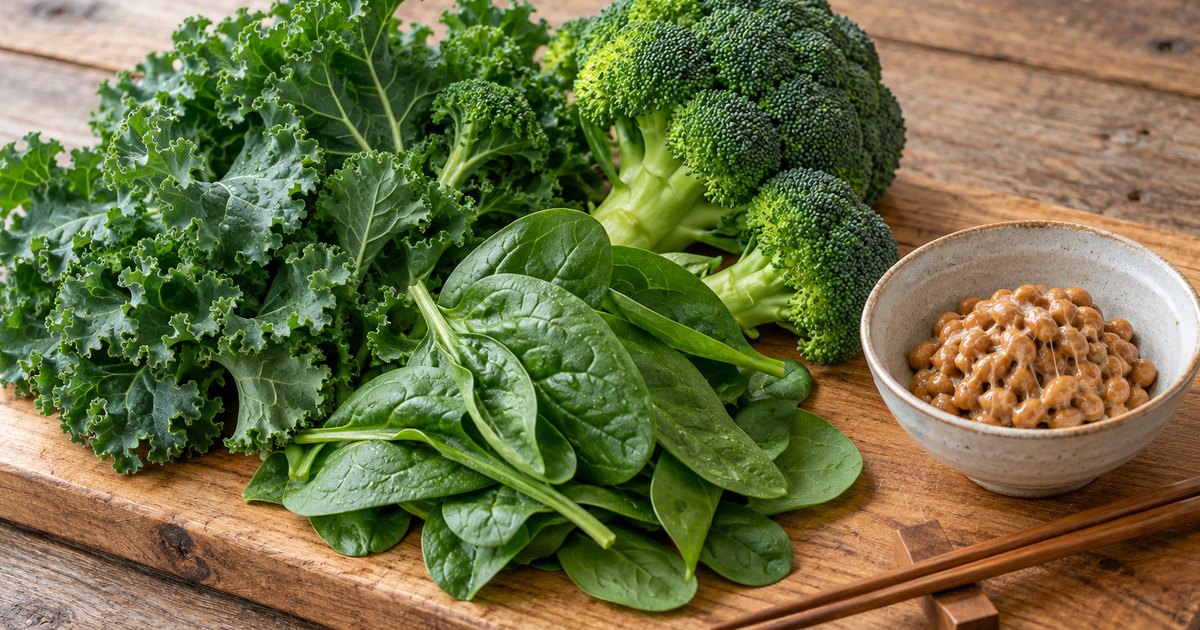
Vitamin K is a family of fat-soluble vitamins the body needs to make proteins involved in blood clotting and bone metabolism. Vitamin K1 (phylloquinone) comes mainly from green leafy vegetables, while vitamin K2 (menaquinones such as MK-4 and MK-7) comes from fermented foods like natto, some cheeses, and smaller amounts in meat and eggs. If you take warfarin, keep your vitamin K intake steady and talk to your doctor before changing your diet or starting any supplement.
This guide includes a few product links near the end. As an Amazon Associate, michelle.net.au earns from qualifying purchases, at no extra cost to you.
This guide explains what vitamin K does, how K1 and K2 differ, which foods supply them, what intakes health authorities set in different countries, what the bone and heart research has and has not shown, and how to read a vitamin K label. It is general education, not personal medical advice.
At a glance
- K1 is mostly in green leafy vegetables and some plant oils. K2 is in natto, some cheeses and other fermented foods, and in smaller amounts in meat, eggs and dairy.
- Adequate intakes differ by country: for adults, 60 to 70 micrograms a day in Australia and New Zealand, 90 to 120 micrograms in the US, and 70 micrograms in the EU.
- Warfarin users need consistent vitamin K intake, not zero vitamin K, and should talk to their doctor before any supplement.
- Research on K2 and bones or arteries is mixed and mostly small or observational, so it has not shown that supplements make a difference.
- Vitamin K is not potassium. The letter K means something different in each case.
What does vitamin K do?
According to the US National Institutes of Health Office of Dietary Supplements (NIH ODS) fact sheet, vitamin K works as a coenzyme for an enzyme that activates proteins involved in blood clotting and in bone metabolism. Without enough vitamin K, those proteins cannot work properly, which is why the classic sign of severe deficiency is bleeding.
Clinically significant deficiency is rare in healthy adults. The NIH ODS notes it mainly occurs in people with conditions that affect fat absorption or who take medicines that interfere with vitamin K. Newborn babies are a special case: the NIH ODS notes that babies not given vitamin K at birth are at risk of bleeding from deficiency, which is why it is routinely offered at birth in many countries. If you have questions about that, ask your midwife or doctor.
For how vitamin K fits among the other vitamins, see the vitamins and minerals starter guide.
K1 vs K2 (MK-4 and MK-7): what’s the difference?
All forms of vitamin K share the same core chemical structure but differ in their side chains, which affects where they come from and how long they stay in the body.
| Form | Also called | Main food sources | Seen on labels as | What research has mostly studied | Note |
|---|---|---|---|---|---|
| K1 | Phylloquinone; phytonadione (synthetic) | Green leafy vegetables, broccoli, soybean and canola oils | Vitamin K1, phylloquinone, phytonadione | Dietary intake, clotting, bone studies | The main dietary form; absorbed much less well from vegetables than from a tablet |
| K2 as MK-4 | Menatetrenone | Meat, eggs, dairy (modest amounts) | Vitamin K2 (MK-4) | High-amount bone studies in Japan | The body can make MK-4 from K1 |
| K2 as MK-7 | Menaquinone-7 | Natto (fermented soybeans); some cheeses | Vitamin K2 (MK-7), often “from natto” | Smaller bone and blood-vessel studies | Stays in the blood longer than other forms |
| K3 | Menadione (synthetic) | Not a food form | Not used in human supplements | Older laboratory studies showed liver-cell damage | No longer used in supplements or fortified foods; still used in some animal feed |
The NIH ODS notes that menaquinones range from MK-4 to MK-13 and are mostly made by bacteria, including bacteria in the human gut. MK-4, MK-7 and MK-9 are the most studied.
Food sources of vitamin K1 and K2
These figures are from the NIH ODS fact sheet, which uses US food composition data and US serving measures; metric equivalents are rounded. Amounts in your country’s food database may differ.
| Food | Serve | Vitamin K type | Amount per serve (micrograms) | Source |
|---|---|---|---|---|
| Natto | 3 oz (about 85 g) | K2 (MK-7) | 850 | NIH ODS / USDA data |
| Collard greens, frozen, boiled | Half a cup | K1 | 530 | NIH ODS / USDA data |
| Turnip greens, frozen, boiled | Half a cup | K1 | 426 | NIH ODS / USDA data |
| Spinach, raw | 1 cup | K1 | 145 | NIH ODS / USDA data |
| Kale, raw | 1 cup | K1 | 113 | NIH ODS / USDA data |
| Broccoli, boiled | Half a cup | K1 | 110 | NIH ODS / USDA data |
| Soybean oil | 1 tablespoon | K1 | 25 | NIH ODS / USDA data |
| Chicken breast, rotisserie | 3 oz (about 85 g) | K2 (MK-4) | 13 | NIH ODS / USDA data |
| Egg, hard-boiled | 1 large | K2 (MK-4) | 4 | NIH ODS / USDA data |
Fermented foods and K2
Natto stands out because the bacteria used to ferment it produce large amounts of MK-7. Cheese and other fermented foods also contain menaquinones, but the NIH ODS notes the amounts vary widely with the bacterial strains and fermentation conditions, so there is no reliable single figure for “cheese”. Most other fermented foods have not been well measured for K2.
The Australian Government’s Nutrient Reference Values also list cabbage, Brussels sprouts, salad greens, canola and soybean oils, and the margarines and dressings made from them as sources.
How much vitamin K do adults need?
No country has enough evidence to set a precise requirement, so authorities set an adequate intake (AI) instead, based on what healthy people typically eat. That is why the numbers differ.
| Authority | Adult men | Adult women | Basis |
|---|---|---|---|
| NHMRC (Australia and New Zealand) | 70 micrograms a day | 60 micrograms a day (also in pregnancy and breastfeeding) | Adequate intake; no upper level set |
| US National Academies | 120 micrograms a day | 90 micrograms a day (also in pregnancy and breastfeeding) | Adequate intake; no upper level set |
| EFSA (European Union) | 70 micrograms a day | 70 micrograms a day | 1 microgram of K1 per kilogram of body weight; set for K1 only (2017) |
| UK (NHS) | About 1 microgram per kilogram of body weight | About 1 microgram per kilogram of body weight | For example, about 65 micrograms for a 65 kg adult |
EFSA set its value for K1 only, because it judged the evidence on menaquinones’ absorption and function too limited. Neither Australia nor the US has set an upper level, because no adverse effects have been linked to vitamin K from food or supplements. The NHS advises that up to 1 mg (1,000 micrograms) a day from supplements is unlikely to cause harm, while noting there is not enough evidence on higher daily amounts. These are reference values, not targets.
Vitamin K and blood thinners: the essential safety check
This is the most important section of this guide.
- Warfarin works against vitamin K. The NIH ODS describes the interaction as potentially serious: sudden changes in vitamin K intake can make warfarin work more or less strongly.
- The goal is consistency, not avoidance. Clinicians generally advise warfarin users to keep vitamin K intake steady from week to week, rather than cutting out green vegetables. Penn Medicine’s dietitians sum it up as consistency rather than avoidance.
- Newer anticoagulants are different. Penn Medicine notes that medicines such as apixaban, rivaroxaban and dabigatran do not interact with vitamin K the way warfarin does. Ask your doctor or pharmacist which type you take.
- Never start, stop or change a vitamin K supplement, or a product containing it, without talking to your doctor or pharmacist first. That includes multivitamins, bone formulas and vitamin D3 and K2 combinations.
The NIH ODS also lists other medicines that affect vitamin K: long courses of some antibiotics, bile acid sequestrants used for cholesterol, and the weight-loss medicine orlistat, which reduces fat (and vitamin K) absorption. Tell your doctor and pharmacist about every product you take.
What the bone and heart research has (and hasn’t) shown
Bones
Some observational studies have linked higher vitamin K intake with better bone density or lower hip fracture rates, but the NIH ODS describes the results as mixed. A 2006 analysis of trials found fewer fractures with MK-4 at 45 mg a day, an amount far above food levels that is used as a prescription medicine in Japan. Later trials using lower amounts found no effect on bone density in older adults. Whether supplements make a difference for people without a deficiency remains unclear. Strength training and calcium intake are covered in strength training for bone health and choosing a calcium form.
Heart and blood vessels
One vitamin K-dependent protein is thought to help limit calcium build-up in blood vessel walls, which is why K2 is marketed for arteries. The NIH ODS calls the evidence preliminary. Dutch observational studies linked higher dietary menaquinone intake with less calcification in arteries, but observational studies cannot show cause and effect, and one trial of K1 supplements found no overall difference in coronary artery calcification. The authors made no clinical recommendations.
Reading a vitamin K label
- Check the form. K1 (phylloquinone or phytonadione), MK-4 or MK-7. The amounts are not interchangeable, so compare like with like.
- Check the unit. Vitamin K is listed in micrograms (µg or mcg). See reading micrograms on vitamin labels for unit tips.
- “From natto” usually means MK-7 produced by fermentation. People with soy allergies should check the allergen statement.
- Combination products. Vitamin D3 and K2 combinations are common; see the D3 and K2 combination guide. The NIH ODS notes that multivitamins usually contain modest amounts, but standalone or combination products can contain much more.
- Testing and registration. Look for an independent testing seal. In Australia, look for an AUST L number on listed medicines.
Before you take a vitamin K supplement: a six-step check
- Do you take warfarin or another blood thinner? Talk to your doctor before anything else.
- Look at your current food sources: leafy greens, oils, natto, cheese and eggs.
- Read the form (K1, MK-4 or MK-7) and the micrograms per daily dose.
- Check every product you take, including multivitamins, bone formulas and D3 and K2 combinations, so you do not double up. The guide to checking vitamin K in your multivitamin shows where to look.
- Look for a testing seal or, in Australia, the AUST L number. The general steps in reading a supplement label apply.
- Tell your doctor and pharmacist about any change, especially before surgery or if you start a new medicine.
Vitamin K2 side effects: what’s reported
The NIH ODS states that no adverse effects linked to vitamin K from food or supplements have been reported in humans or animals, which is why no upper level has been set in the US or Australia. The main risk is not toxicity but interaction: vitamin K can reduce the effect of warfarin and similar medicines. Synthetic K3 (menadione) is the exception on safety grounds, and it is no longer used in human supplements.
Is vitamin K potassium?
No. The confusion comes from the letter K. On the periodic table, K is the chemical symbol for potassium, from its Latin name, kalium. Vitamin K got its letter separately: Danish biochemist Henrik Dam, who later shared the 1943 Nobel Prize for the work, named it after the German word for clotting, as the “Koagulations-Vitamin”. So “is K2 potassium?” has the same answer: no, K2 is a form of vitamin K and contains no potassium.
Common mistakes
- Changing vitamin K intake suddenly while on warfarin. Big swings, up or down, can affect how the medicine works.
- Cutting out greens entirely because of warfarin. Current advice focuses on keeping intake consistent, guided by your doctor.
- Confusing vitamin K with potassium. They are unrelated nutrients.
- Assuming K2 supplements are proven for bones or arteries. The research is mixed and mostly small or observational.
- Doubling up. A D3 and K2 product plus a multivitamin plus a bone formula can add up.
- Comparing MK-4 and MK-7 amounts directly. They behave differently in the body, so a microgram of one is not the same as a microgram of the other.
Sources this guide draws on: the NIH Office of Dietary Supplements Vitamin K fact sheet for health professionals; the NHMRC Nutrient Reference Values for Australia and New Zealand (vitamin K); the European Food Safety Authority’s 2017 scientific opinion on dietary reference values for vitamin K; the NHS vitamin K guidance; Penn Medicine’s guidance on blood thinners and vitamin K; and Encyclopaedia Britannica on the discovery of vitamin K.
Handy kit for this guide
These are practical everyday products, not supplements or medicines. As an Amazon Associate, michelle.net.au earns from qualifying purchases, at no extra cost to you. Prices and availability are set by Amazon and may vary by country.
- The Blue Zones Kitchen by Dan Buettner
100 everyday recipes built around beans, greens and whole grains.
View on Amazon - The Complete Mediterranean Cookbook (America’s Test Kitchen)
500 kitchen-tested recipes with plenty of fish, legumes and vegetables.
View on Amazon - Etekcity Digital Kitchen Scale
Reads in grams, handy for portions, recipes and checking a scoop against a label.
View on Amazon
Frequently asked questions
What is the difference between vitamin K1 and K2?
K1 (phylloquinone) comes mainly from green leafy vegetables and plant oils and is the main form in most diets. K2 (menaquinones, such as MK-4 and MK-7) comes from fermented foods such as natto, some cheeses and smaller amounts in animal foods, and is also made by gut bacteria.
Is vitamin K the same as potassium?
No. K is the chemical symbol for potassium, but vitamin K was named after the German word for clotting. They are completely different nutrients.
Which fermented foods contain vitamin K2?
Natto is by far the richest known source, with about 850 micrograms of MK-7 in a 3 oz serve according to the NIH ODS. Some cheeses also contain K2, but amounts vary a lot with the bacteria and fermentation method.
Are there side effects of vitamin K2?
The NIH ODS reports no known adverse effects from vitamin K in food or supplements. The important issue is interaction with warfarin and similar medicines, so talk to your doctor or pharmacist before taking it if you use any blood thinner.
Can I take vitamin K if I’m on blood thinners?
Only with your doctor’s advice. Warfarin users need steady vitamin K intake, and a new supplement can change how the medicine works. Newer blood thinners interact differently, so ask which type you take.
Why do some vitamin D supplements include K2?
Because both are linked to bone metabolism, manufacturers often combine them. Whether the combination adds anything for people without a deficiency is not settled; the site’s D3 and K2 guide covers the evidence and safety checks.
Most people can get the vitamin K they need from vegetables, plant oils and fermented foods. Anyone on a blood thinner should start with their doctor before changing their diet or adding a supplement.