
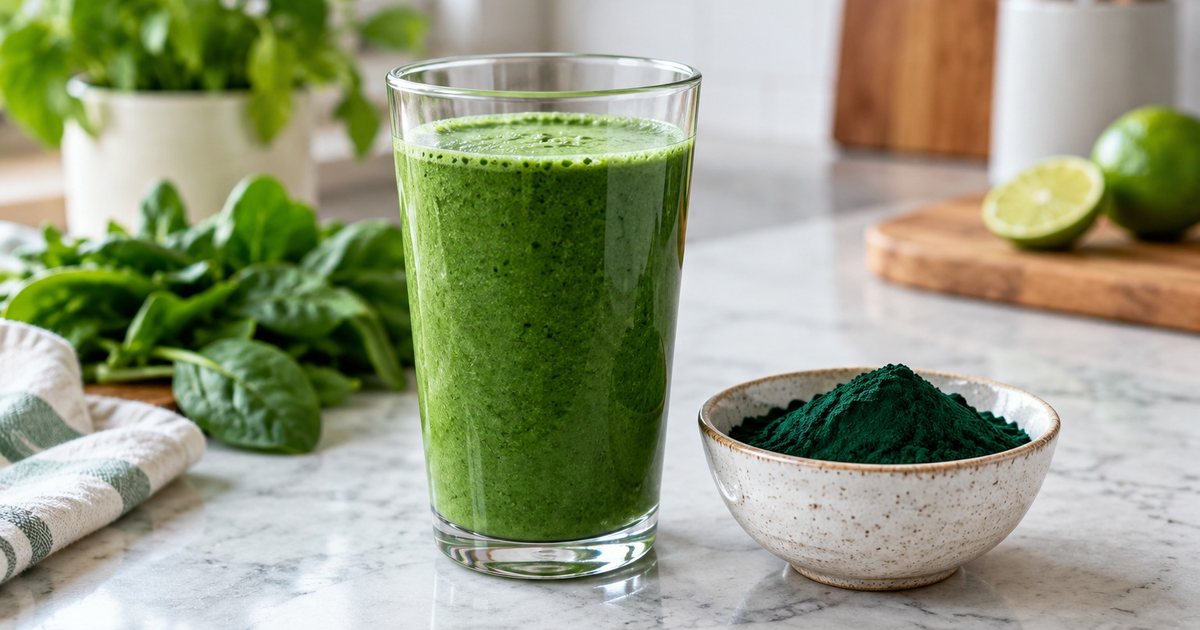
Spirulina is a dried cyanobacterium, sold as a powder or tablets, that is high in protein and iron per 100 grams. Its health claims run well ahead of the human evidence. Two points are well established: it is not a reliable source of vitamin B12, and with this category of product, contamination and quality testing matter more than anything on the front of the pack. A typical daily serving supplies only modest amounts of nutrients, so whether it is worth the money depends on what you expect from it.
This guide includes a few product links near the end. As an Amazon Associate, michelle.net.au earns from qualifying purchases, at no extra cost to you.
This guide covers what spirulina is, what is actually in a typical serving, what research has and has not shown, the B12 question, safety and who should check with a doctor first, and a step-by-step way to judge a product before you buy.
- Nutrient-dense per 100 grams, modest per serving: a few grams a day supplies only small amounts of protein and iron.
- Not a B12 source: most of the B12-like compound in spirulina is a form considered inactive in humans. Major health bodies point to fortified foods or supplements instead.
- Quality is the main safety issue: blue-green algae products can be contaminated with toxins called microcystins, so independent testing matters.
- Human trials are mostly small and short, and lab or animal findings do not tell you what a spoonful does for a person.
- Talk to your doctor or pharmacist first if you are pregnant, have an autoimmune condition or phenylketonuria, or take immune-suppressing or blood-thinning medicines.
At a glance
- Spirulina is a dried cyanobacterium whose health claims run well ahead of the human evidence.
- It is high in protein and iron per 100 grams, but a 3 g serving gives only about 1.7 g of protein and 0.9 mg of iron.
- It is not a reliable source of vitamin B12, so get B12 from fortified foods or supplements instead.
- Contamination is the main safety concern, so choose a product independently tested for microcystins and heavy metals.
- A common mistake is reading per-100-gram figures as per-serving amounts.
- Talk to your doctor or pharmacist first if you are pregnant, have an autoimmune condition or phenylketonuria, or take regular medicines.
What spirulina actually is
Spirulina is not a plant, and not an alga in the everyday sense. It is a cyanobacterium, a microscopic organism (mainly the species now called Limnospira or Arthrospira) that grows in water and is dried into a deep green powder. It is often grouped with other “blue-green algae” products such as AFA (Aphanizomenon flos-aquae) and with chlorella, which is a true green alga and a different organism.
Because these organisms are grown in ponds, tanks or wild lakes, what ends up in the tub depends heavily on the water, the growing conditions, the processing and the testing. That point comes up again in the safety section.
What is in a typical serving
Spirulina’s reputation comes from its composition per 100 grams of dried powder. USDA FoodData Central lists dried spirulina at about 57 grams of protein and about 28 milligrams of iron per 100 grams. Those figures are real, but nobody eats 100 grams. Product labels usually suggest a few grams a day.
| Nutrient | Per 100 g dried | Per 3 g serving (approx.) | What that means in practice |
|---|---|---|---|
| Protein | about 57 g | about 1.7 g | Less than a third of the protein in one egg |
| Iron | about 28 mg | about 0.9 mg | A small share of daily needs, which vary by age, sex and country |
| Energy | about 290 kcal | about 9 kcal | Negligible |
| Vitamin B12 (active) | Not a reliable source | Not a reliable source | Do not count it towards B12 needs |
Per-serving figures are calculated from the USDA per-100-gram values and will differ between products. Always check the nutrition panel on the pack you are considering, and compare the serving size with the figures being quoted in the marketing. “Complete protein” and “rich in iron” are statements about the dried powder, not about a teaspoon of it. If protein is your main goal, our guide to protein powder types compares cheaper, more concentrated options.
The vitamin B12 claim: the one that matters most
Spirulina is often promoted as a plant-based source of vitamin B12. This is the claim most worth questioning, because a shortfall in B12 builds quietly over years.
When researchers have analysed spirulina tablets, they found B12-like compounds, but most of it was pseudovitamin B12. A 2007 review by Fumio Watanabe in Experimental Biology and Medicine reported that pseudovitamin B12 made up the large majority of the B12-like compounds in commercial spirulina tablets. This form binds poorly to the protein the gut uses to absorb B12 and is considered inactive in humans. The review concluded that edible cyanobacteria including spirulina are not suitable as a B12 source for groups at risk of low B12, such as vegans and older adults. It also helps explain why USDA FoodData Central lists no active B12 for dried spirulina.
Major health references agree. The NIH Office of Dietary Supplements’ vitamin B12 fact sheet notes that plant foods do not naturally contain B12 and points to fortified breakfast cereals and fortified nutritional yeasts for people who avoid animal foods. The UK’s NHS guidance on vegan diets lists B12-fortified foods and supplements. Neither lists spirulina. The NIH gives the recommended intake for adults as 2.4 micrograms a day; other countries set similar figures.
B12 absorption also tends to fall with age, and some common medicines, such as metformin and acid-reducing medicines, are linked to lower B12 levels. If you are relying on a green powder for B12, that is the assumption to check with your doctor or pharmacist. Our vitamin B12 supplements guide explains the forms and how B12 is tested.
What research has and has not shown
Spirulina has been studied in the laboratory, in animals and in small human trials. Lab and animal studies have looked at antioxidant and immune-related activity, and human trials have measured things such as blood lipids, blood pressure and blood glucose. Results have been mixed, and most trials were small, short and varied in dose and product. That is not enough to say what spirulina does for a healthy person over years.
Health references that summarise the evidence describe its benefits for any condition as not well established and its effects in people as not well understood. Lab findings in particular do not transfer neatly to people, because the amount of a compound that reaches the bloodstream after eating can be very different from what is applied to cells in a dish. Our guide to supplement bioavailability explains why.
The fair summary: spirulina is a nutrient-dense food ingredient, and it is reasonable to enjoy it in a smoothie if you like it. It is not an evidence-backed shortcut for energy, immunity or any health condition, and claims that it is go beyond what the research shows.
Safety: contamination is the main concern
The clearest documented risk with blue-green algae products is not the organism itself but what can grow alongside it. The US Food and Drug Administration’s page on blue-green algae products and microcystins explains that microcystins are toxins made by certain cyanobacteria, that they cannot be seen, smelled or tasted, and that high exposure can cause liver and kidney damage. It notes recalls of products containing wild-harvested AFA from Upper Klamath Lake in Oregon. The FDA page focuses on AFA rather than spirulina, but it shows why testing matters for the whole category. Heavy metals are another quality issue that responsible manufacturers test for.
The FDA’s practical advice is to check for recalls, read labels for algae ingredients, keep to the serving size on the pack, talk to a healthcare provider before use, especially if pregnant, breastfeeding or living with a chronic condition, and check with a doctor before giving supplements to children.
Who should talk to a doctor or pharmacist first
- People who are pregnant, planning pregnancy or breastfeeding, because safety has not been established and contamination is a concern.
- People with autoimmune conditions, such as lupus, rheumatoid arthritis or multiple sclerosis, because health references caution that blue-green algae may stimulate the immune system.
- People taking immune-suppressing medicines, blood thinners or diabetes medicines, where interactions have been raised as a possibility.
- People with phenylketonuria, because spirulina is high in protein and contains phenylalanine.
- Anyone buying for a child.
Reported side effects include stomach upset, nausea, diarrhoea and, rarely, allergic reactions. Stop and seek advice if you notice a reaction.
What regulation does and does not guarantee
It is easy to assume that a supplement on a shelf has been checked for effectiveness. Rules differ between countries:
- United States: under the Dietary Supplement Health and Education Act of 1994, manufacturers are responsible for the safety and labelling of their own products before sale. There is no pre-market approval; the FDA acts afterwards against unsafe or misbranded products.
- Australia: supplements sold as complementary medicines show an AUST L or AUST R number. Most are AUST L (listed) products, which the TGA does not evaluate for effectiveness before they go on sale. Spirulina may also be sold as a food, under food standards instead.
- Elsewhere: many countries regulate supplements as foods, with limited pre-market checks. Our guide to buying supplements internationally covers what changes when you order from overseas.
In every system, a confident label is not the same as a verified one, which is why independent testing seals are worth understanding. See what USP, NSF and Informed Sport seals mean.
How to judge a spirulina product: step by step
- Decide why you want it. If it is for protein, iron or B12, there are cheaper and more reliable options; check with your doctor or pharmacist if you suspect a deficiency.
- Check the species and the form. Spirulina, AFA and chlorella are different organisms; know which you are buying.
- Look for independent third-party testing, and for what was tested: microcystins and heavy metals, not just potency.
- Check where and how it was grown. Controlled cultivation is generally easier to monitor than wild harvesting.
- Read the serving size and work out what you actually get per serving, not per 100 grams.
- Be wary of big promises. Claims about fixing illness, cleansing the body or strengthening immunity are a red flag.
- Check for recalls with your country’s regulator before buying.
- Keep to the serving on the pack and do not scale up.
- Tell your doctor or pharmacist what you take, especially if you take regular medicines.
For a wider method that works for any product, see our supplements evidence and label guide and how to read a supplement label.
Common mistakes
- Counting spirulina as your B12. It is not a reliable source.
- Reading per-100-gram figures as per-serving. A daily serving is a small fraction of that.
- Using it as an iron fix. If you think your iron is low, get tested first; our iron supplements guide explains why.
- Buying on price alone. Testing costs money, and this is a category where testing matters.
- Reading lab studies as proof. Results in cells or animals do not show what happens in people.
- Taking more than the label suggests. More is not better, and it raises exposure to any contaminants.
Sources this guide draws on: USDA FoodData Central entry for dried spirulina; Watanabe, Vitamin B12 Sources and Bioavailability, Experimental Biology and Medicine (2007); NIH Office of Dietary Supplements vitamin B12 fact sheet; NHS guidance on the vegan diet; US Food and Drug Administration information on blue-green algae products and microcystins and on dietary supplement regulation; Therapeutic Goods Administration information on listed complementary medicines.
Handy kit for this guide
These are practical tools, not supplements or medicines. As an Amazon Associate, michelle.net.au earns from qualifying purchases, at no extra cost to you. Prices and availability are set by Amazon and may vary by country.
- Ezy Dose Weekly AM/PM Pill Organiser (X-Large)
Seven days with separate morning and evening compartments, so you can see at a glance what has already been taken.
View on Amazon - Vaydeer Metal 7-Day Travel Pill Case
Slim metal case with a built-in desiccant, for keeping a week of tablets dry in a bag or suitcase.
View on Amazon - Bambaw Insulated Stainless Steel Water Bottle (32 oz)
Plastic-free and keeps water cold all day, useful when a label says to take a product with a full glass of water.
View on Amazon
Frequently asked questions
Is spirulina a good source of vitamin B12?
No. Most of the B12-like compound in spirulina is pseudovitamin B12, which is considered inactive in humans. Health bodies such as the NIH and NHS point to B12-fortified foods or supplements instead. Talk to your doctor or pharmacist if you are unsure about your B12 intake.
Is spirulina safe to take every day?
For many healthy adults, a product that has been independently tested for contaminants and is taken at the serving size on the pack is generally well tolerated. The main risk with blue-green algae products is contamination. People who are pregnant, have autoimmune conditions or phenylketonuria, or take regular medicines should check with a doctor or pharmacist first.
Is spirulina worth the money?
If you enjoy it as a food ingredient, it adds small amounts of protein and iron. As a health supplement, the human evidence is limited, and a typical serving supplies modest amounts of nutrients that are cheaper to get from everyday foods. Quality testing, not price, should guide any purchase.
What is the difference between spirulina and chlorella?
Spirulina is a cyanobacterium; chlorella is a single-celled green alga. They have different compositions and are not interchangeable. Neither is a reliable B12 source without fortification, so check the label and ask your pharmacist if B12 is your reason for buying.
Who should not take spirulina?
Health references advise caution for people who are pregnant or breastfeeding, have autoimmune conditions or phenylketonuria, or take immune-suppressing, blood-thinning or diabetes medicines. Children should only be given it with a doctor’s advice. If any of these apply, talk to your doctor or pharmacist first.
Spirulina is a nutrient-dense food with a marketing story that has run well ahead of the evidence. If you buy it, buy it for what it is, choose a tested product, and get your B12 from somewhere reliable.
This guide is general education, not medical advice. Talk to your doctor or pharmacist before starting any supplement, especially if you are pregnant, have a health condition or take regular medicines.