
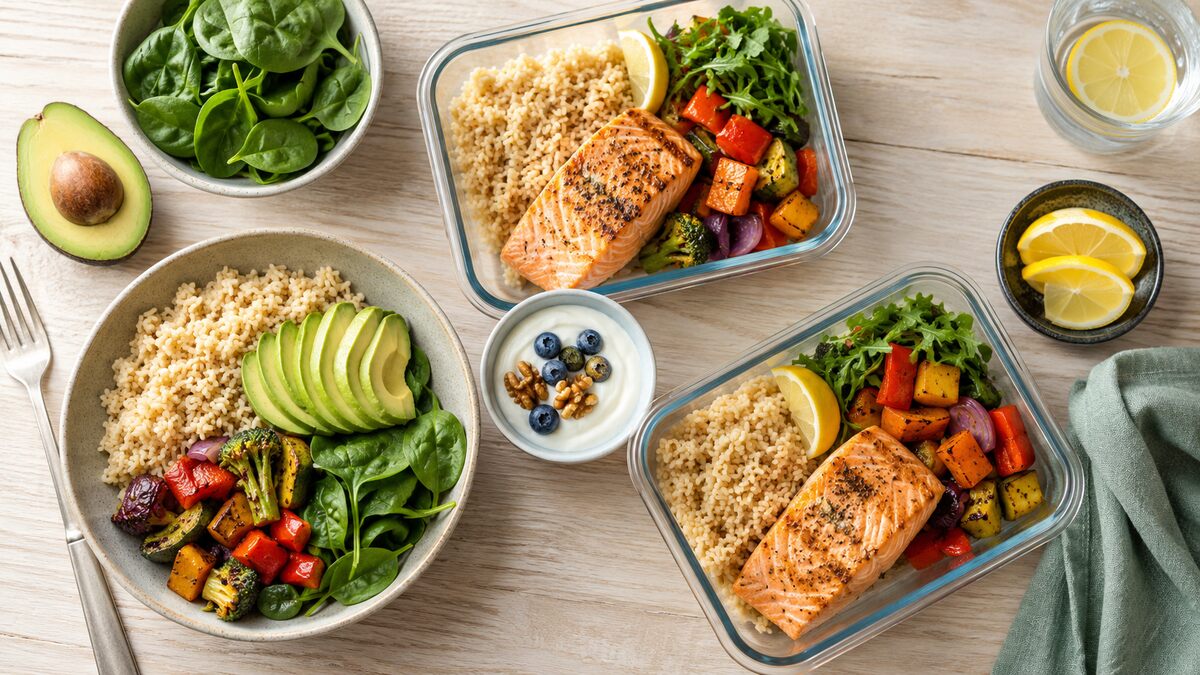
Being “active” covers a lot of ground — gym sessions, weekend hikes, recreational sport, physical jobs. The nutrition advice aimed at elite athletes doesn’t always translate well to that. Here’s what tends to matter most for everyday active adults.
Eat enough, not just “clean”
Under-eating relative to activity level is one of the most common issues in active adults, especially when “eating healthy” gets equated with eating very little. If energy is consistently low, recovery is slow, or performance is sliding, total intake is worth checking before anything more specific.
The International Society of Sports Nutrition’s 2018 review update makes much the same point from the research side, observing that many people who train regularly focus heavily on supplementation while neglecting the basics. That review states plainly that an energy-deficient diet may lead to loss of muscle mass, strength and bone mineral density — roughly the opposite of what most people are training for.
Protein spread across the day
Rather than one large protein-heavy meal, spreading protein across three or four meals tends to support recovery and muscle maintenance better. Good everyday sources include lean meat, fish, eggs, dairy, legumes, and tofu.
The ISSN’s 2017 position stand on protein and exercise describes a daily range of 1.4–2.0 g of protein per kg of bodyweight as sufficient for most exercising individuals, with individual servings of around 0.25 g/kg — an absolute dose of roughly 20–40 g — ideally spaced every three to four hours across the day. Those are population-level figures from a position paper, not a target set for any particular reader.
Carbohydrates aren’t the enemy
For anyone training regularly, carbohydrates are the main fuel for moderate-to-high intensity effort. Cutting them drastically often shows up as flat, low-energy sessions. Whole-food sources — grains, fruit, starchy vegetables — work well for most people.
The 2018 ISSN review scales carbohydrate intake to training volume rather than treating it as one fixed number: roughly 3–5 g/kg/day for someone on a general fitness programme, rising to around 5–8 g/kg/day for people doing two to three hours of intense exercise five or six times a week. Most recreationally active adults sit near the lower end of that spread, which is worth knowing before adopting figures written for people training twice a day.
Hydration is easy to underrate
Even mild dehydration can affect concentration and perceived effort. Water is enough for most everyday activity; longer or hotter sessions may call for electrolytes as well.
A 2018 meta-analysis in Medicine & Science in Sports & Exercise pooled 33 studies covering 413 participants and reported that water losses beyond about 2% of body mass were associated with measurable decrements in attention, executive function and motor coordination. The same analysis found no significant effect on information processing, memory or simple reaction time — so the familiar claim that dehydration “makes you foggy” is both narrower and better defined than the marketing version.
Recovery meals matter more than supplement timing
A balanced meal with protein and carbohydrates within a few hours of activity does more heavy lifting than the minute-by-minute “anabolic window” timing that’s often marketed. Consistency across the week matters more than precision on any one day.
Aragon and Schoenfeld examined this directly in a 2013 review in the Journal of the International Society of Sports Nutrition and concluded that the available data “lack any consistent indication of an ideal post-exercise timing scheme for maximizing MPS”. On the common instruction to eat the moment a session ends, they were blunter: evidence-based support for that practice, they wrote, is currently lacking. The ISSN’s 2017 position stand takes a similar line, describing the anabolic effect of exercise as long-lasting — at least 24 hours — while diminishing as time since training increases.
What the research actually measured
Much of the protein-distribution research rests on small, short, tightly controlled feeding studies, and it is worth knowing what they put on the scales. The study most often cited for spreading protein out — Mamerow and colleagues, published in the Journal of Nutrition in 2014 — was a seven-day crossover trial in eight healthy adults averaging 37 years of age.
Participants ate the same total protein, about 90 g a day, either evenly across three meals or skewed towards dinner. The even pattern produced roughly 25% higher 24-hour muscle protein synthesis. That is a genuine result, but note the outcome measured: a synthesis rate over a single day, in eight people, under laboratory feeding conditions. It was not muscle gained or strength added.
Where the evidence is weak
When longer trials have measured the outcomes people actually care about, the distribution effect has been harder to find. A randomised controlled trial by Kim and colleagues, published in Clinical Nutrition in 2017, gave 14 adults aged 51 to 69 the same 1.1 g/kg/day of protein in either an even pattern or one heavily weighted towards dinner, for eight weeks. It found no significant differences in lean body mass, muscle strength or the other functional outcomes assessed.
Fourteen participants is a small trial, and a null result in a small trial is not evidence of no effect. The honest summary is that the short-term laboratory signal is fairly consistent while the longer-term functional evidence remains thin. Spreading protein across the day is a low-cost habit with a plausible rationale, not a settled finding.
It is also worth noticing who this research is usually done on: relatively young, often already-trained participants, in samples of single or low double digits. Carrying those numbers across to a middle-aged adult who walks and lifts twice a week involves extrapolation that rarely gets acknowledged.
What guidelines around the world say
Baseline nutrition guidance and sports-nutrition guidance answer different questions, and the gap between them generates a lot of confusion. The United States Recommended Dietary Allowance, as described by Harvard’s Nutrition Source, is 0.8 g of protein per kg of bodyweight per day, with protein contributing somewhere between 10% and 35% of daily calories. The European Food Safety Authority’s 2012 opinion set a Population Reference Intake of 0.83 g/kg/day, derived from an average requirement of 0.66 g/kg/day based on nitrogen balance data.
Both are minimums intended to cover most healthy adults, not optimums for people training hard, which is why the ISSN’s 1.4–2.0 g/kg/day sits so far above them. EFSA also noted that intakes up to twice its reference value are regularly consumed from mixed diets by physically active adults in Europe and are considered safe. Harvard’s page is candid about the gap, stating that beyond the RDA there is relatively little solid information on the ideal amount of protein in the diet.
On the activity side rather than the food side, the World Health Organization’s 2020 guidelines describe at least 150–300 minutes of moderate-intensity aerobic activity a week for adults aged 18 to 64, plus muscle-strengthening work involving all major muscle groups on two or more days a week.
The takeaway
Most active adults don’t need a complicated plan — they need enough food, enough protein spread across the day, and enough fluids, done consistently. The evidence supports the general shape of that advice considerably more strongly than it supports any of the precise numbers that get attached to it.
This article is general information only and is not medical advice. It does not diagnose, treat, or cure any condition. Speak with a qualified healthcare professional before starting any supplement.