
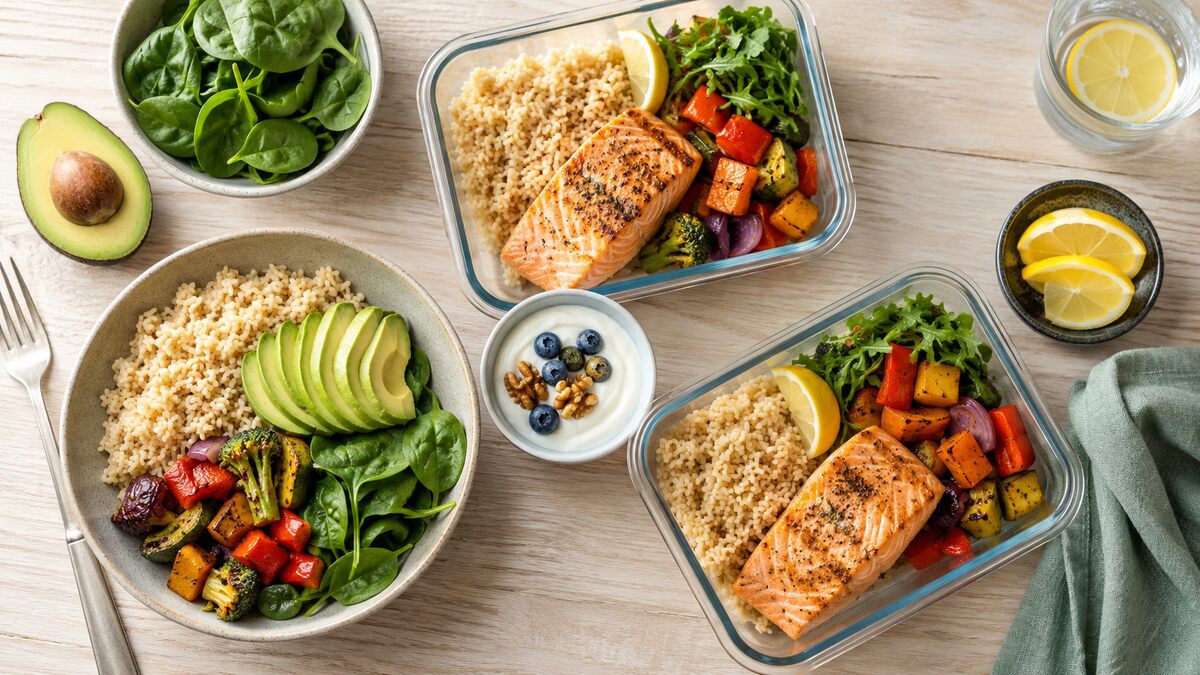
The nutrition habits that matter most for active adults are simple: eat enough total food for the work you do, spread protein across three or four meals, match carbohydrate to how hard and how long you train, and drink enough fluid before, during and after sessions. Get those four right, consistently, and most of the finer details (timing windows, special products, exact gram targets) make little practical difference for people who are not elite athletes.
This guide includes a few product links near the end. As an Amazon Associate, michelle.net.au earns from qualifying purchases, at no extra cost to you.
This guide explains each habit, what the research behind it actually measured, how much the major guidelines suggest, and how to turn that into an ordinary week of eating. It is written for everyday active adults: gym-goers, walkers, weekend sport players, people with physical jobs and anyone staying active into later life.
At a glance
- Enough comes before clean: eating too little for your activity level is a common and underrated problem, and no supplement makes up for it.
- Protein is best spread out: sports nutrition position papers describe 1.4 to 2.0 g per kg of body weight a day for most exercising people, in servings of roughly 20 to 40 g.
- Carbohydrate scales with training: a general fitness routine needs far less than daily hard endurance training.
- Fluid losses above about 2% of body weight have been linked in research with poorer attention and coordination.
- Talk to your doctor or pharmacist before big diet changes if you have kidney disease, diabetes, a heart condition or take regular medicines.
Who this guide suits (and who it does not)
The figures below come from general population guidelines and sports nutrition position statements. They are a sensible starting point for healthy adults who exercise regularly at a recreational level. They are not designed for competitive athletes chasing performance, for people managing a medical condition, or during pregnancy. In those situations an accredited sports dietitian or your doctor can set targets that fit you.
Habit 1: Eat enough, not just “clean”
Under-eating relative to activity is one of the most common nutrition problems in active adults, especially when “eating healthy” quietly turns into eating very little. Typical signs include low energy in sessions, slow recovery, frequent niggles, poor sleep and performance that slides over weeks rather than improving.
The International Society of Sports Nutrition (ISSN), in its 2018 review of exercise and sports nutrition, makes the same point from the research side: many athletes and coaches focus on supplements while neglecting total energy intake. The review notes that an energy-deficient diet may lead to loss of muscle mass, strength and bone mineral density, which is close to the opposite of what most people train for.
In practice, before you look at any product or timing trick, check whether you are eating regular meals, whether those meals contain enough food, and whether your intake rises on heavier training days.
Habit 2: Spread protein across the day
Protein supplies the amino acids the body uses to maintain and repair muscle and other tissues. For active adults the question is less “how much in one go” and more “how much across the day, in how many sittings”.
How much protein active adults need
The ISSN’s 2017 position stand on protein and exercise describes 1.4 to 2.0 g of protein per kg of body weight a day as sufficient for most exercising individuals, with servings of around 0.25 g per kg (roughly 20 to 40 g) spaced every three to four hours. These are population-level figures from a position paper, not a personal prescription.
Baseline guidelines are much lower because they answer a different question: what covers the needs of most healthy adults, not what suits regular training. The table below shows how the main reference values compare.
| Source | Protein figure | What it is for |
|---|---|---|
| US Recommended Dietary Allowance (National Academies) | 0.8 g per kg per day | Minimum to meet the needs of most healthy adults |
| European Food Safety Authority (2012) | 0.83 g per kg per day (Population Reference Intake) | Adequate intake for most healthy adults in Europe |
| Australia and New Zealand Nutrient Reference Values | Around 0.75 g per kg (women) and 0.84 g per kg (men) aged 19 to 70, higher over 70 | Recommended dietary intake for the general population |
| ISSN position stand (2017) | 1.4 to 2.0 g per kg per day | Most people who exercise regularly |
EFSA also noted that intakes up to about twice its reference value are regularly eaten by some active, healthy adults in Europe and are considered safe for them. If you have kidney disease, that is different: talk to your doctor before raising protein.
What the research on spreading protein actually found
The study most often cited for spreading protein out, by Mamerow and colleagues in the Journal of Nutrition (2014), was a seven-day crossover trial in eight healthy adults. When roughly the same daily protein was eaten evenly across three meals rather than mostly at dinner, 24-hour muscle protein synthesis was about 25% higher. That is a genuine finding, but it measured a synthesis rate in eight people under laboratory feeding conditions, not muscle gained or strength added.
Longer trials measuring muscle mass and strength have found the effect harder to show, and those trials have been small. The fair summary is that spreading protein across the day is a low-cost habit with a plausible rationale, not a settled finding. It also happens to be easy: it mostly means adding a protein food to breakfast and lunch rather than saving it all for dinner.
Everyday protein foods
Good sources include eggs, milk, yoghurt and cheese, fish and seafood, poultry, lean meat, tofu and tempeh, legumes such as lentils and chickpeas, and nuts and seeds. For a deeper look at protein targets in midlife and later life, see the guide to protein after forty. If you use a powder for convenience, the guide to comparing protein powder types explains what to look for on the tub.
Habit 3: Match carbohydrate to your training
Carbohydrate is the main fuel for moderate to high-intensity effort. Cutting it hard while training regularly often shows up as flat, low-energy sessions. The useful idea is that the right amount depends on how much you actually train.
The ISSN 2018 review scales intake to training volume: roughly 3 to 5 g per kg per day for someone on a general fitness programme, rising to around 5 to 8 g per kg per day for people doing two to three hours of intense exercise five or six times a week. Most recreationally active adults sit near the lower end, which is worth knowing before copying numbers written for people training twice a day.
| Your typical week | Carbohydrate approach | Practical examples |
|---|---|---|
| Walking, light gym or yoga most days | Normal balanced meals; no special fuelling needed | Wholegrain bread, oats, fruit, potatoes with meals |
| Three to five moderate sessions of up to an hour | Around the lower end of sports ranges; a carbohydrate food before and after harder sessions | Toast or fruit before; rice, pasta or potatoes with protein after |
| Long endurance sessions (over 90 minutes) or daily hard training | Higher intake on big days; consider fuel during long sessions | Larger starchy portions; sports drinks or simple snacks during long efforts |
Whole-food carbohydrates (grains, fruit, starchy vegetables, legumes) also bring fibre, which most adults eat too little of. The guide to dietary fibre sources and labels covers how to lift it without upsetting your stomach.
Habit 4: Take hydration seriously, without overdoing it
A 2018 meta-analysis in Medicine and Science in Sports and Exercise pooled 33 studies covering 413 participants. Water losses beyond about 2% of body mass were associated with measurable declines in attention, executive function and motor coordination, but not in memory or simple reaction time. So the effect is real, but narrower than “dehydration makes you foggy”.
For most everyday activity, water is enough. Longer or hotter sessions, or heavy sweating, may call for electrolytes as well. Drinking far beyond thirst during long events carries its own risk (low blood sodium), so more is not always better. For detail, see the guides to hydrating for recovery after exercise and electrolyte tablets and hydration salts.
Habit 5: Make the recovery meal routine, not the stopwatch
A balanced meal with protein and carbohydrate within a few hours of training does more work than the minute-by-minute “anabolic window” often marketed. In a 2013 review in the Journal of the International Society of Sports Nutrition, Aragon and Schoenfeld concluded that the data did not show any consistent ideal post-exercise timing scheme for muscle protein synthesis, and that evidence for eating the moment a session ends was lacking. The ISSN’s 2017 position stand describes the effect of exercise on muscle as lasting at least 24 hours.
The exception is people who train fasted early in the morning or train twice in one day; for them, eating reasonably soon afterwards makes more practical sense. Sleep is the other half of recovery, covered in the guide to how sleep helps athletic recovery.
Where supplements fit
For most active adults, supplements are optional extras rather than foundations. A few, such as creatine monohydrate and protein powder, have a substantial research base for specific training outcomes; others have very little. Supplements can also interact with medicines, so talk to your doctor or pharmacist before starting any. The supplements evidence and label guide sets out how to judge them, and the creatine monohydrate label guide covers that product in detail.
Your weekly checklist
- Work out a rough protein range: multiply your body weight in kg by 1.4 and by 2.0 (for example, a 70 kg person gets about 98 to 140 g a day).
- Split that across three or four meals, aiming for roughly 20 to 40 g at each.
- Add a protein food to breakfast if it is currently mostly toast or cereal.
- Look at your training week and decide which days are “big” days; add a larger carbohydrate portion to those meals.
- Have a meal containing protein and carbohydrate within a few hours of harder sessions.
- Start sessions well hydrated, drink to thirst during, and weigh yourself before and after a long, hot session once to see how much you lose.
- Fill half the plate with vegetables or fruit at most meals for fibre and micronutrients.
- Check energy, recovery and sleep after two to three weeks; if they are poor, look at total intake first.
Common mistakes
- Eating too little and calling it healthy: restriction while training more is a recipe for slow recovery and lost muscle.
- Copying elite athlete numbers: carbohydrate and fluid targets for people training several hours a day do not suit a few gym sessions a week.
- Saving all the protein for dinner: breakfast and lunch are often light on protein; moving some earlier is easy.
- Chasing the anabolic window: panicking about the 30 minutes after a session matters far less than the whole day and week.
- Reaching for supplements first: products cannot make up for not eating enough, and some interact with medicines.
- Over-drinking on long events: drinking well beyond thirst can dilute blood sodium.
What the evidence does not settle
Much of the precise-sounding advice rests on small, short, tightly controlled studies, often in younger and already-trained people. Carrying those numbers across to a 55-year-old who walks daily and lifts twice a week involves extrapolation. The general shape of the advice (enough food, protein spread out, carbohydrate matched to effort, adequate fluid) is far better supported than any exact gram figure attached to it.
On the activity side, the World Health Organization’s guidelines describe at least 150 to 300 minutes of moderate-intensity aerobic activity a week for adults, plus muscle-strengthening activity on two or more days. Nutrition supports that activity; it does not replace it.
Sources this guide draws on: International Society of Sports Nutrition exercise and sports nutrition review (2018) and position stand on protein and exercise (2017); Mamerow and colleagues, Journal of Nutrition (2014); Aragon and Schoenfeld, Journal of the International Society of Sports Nutrition (2013); Wittbrodt and Millard-Stafford meta-analysis, Medicine and Science in Sports and Exercise (2018); European Food Safety Authority scientific opinion on protein reference values (2012); Harvard T.H. Chan School of Public Health Nutrition Source; Australian and New Zealand Nutrient Reference Values; World Health Organization physical activity guidelines.
Handy kit for this guide
These are practical everyday products, not supplements or medicines. As an Amazon Associate, michelle.net.au earns from qualifying purchases, at no extra cost to you. Prices and availability are set by Amazon and may vary by country.
- The Blue Zones Kitchen by Dan Buettner
100 everyday recipes built around beans, greens and whole grains.
View on Amazon - The Complete Mediterranean Cookbook (America’s Test Kitchen)
500 kitchen-tested recipes with plenty of fish, legumes and vegetables.
View on Amazon - Etekcity Digital Kitchen Scale
Reads in grams, handy for portions, recipes and checking a scoop against a label.
View on Amazon
FAQ
How much protein does an active adult need a day?
Sports nutrition position papers describe 1.4 to 2.0 g per kg of body weight a day as sufficient for most people who exercise regularly, compared with general population figures of around 0.8 g per kg. Lighter activity sits towards the lower end. If you have kidney disease, talk to your doctor before increasing protein.
Should active adults eat before a workout?
It depends on the session and on you. For a short, easy session many people feel fine without eating. For longer or harder sessions, a light meal or snack with some carbohydrate one to three hours beforehand usually helps energy. Test what suits your stomach on training days, not on event days.
Do I need to eat within 30 minutes of exercise?
For most people, no. Reviews have not found a consistent ideal timing window, and the effect of exercise on muscle lasts at least a day. Having a meal with protein and carbohydrate within a few hours is a sensible routine, especially after fasted or back-to-back sessions.
Is water enough, or do I need electrolyte drinks?
Water is enough for most everyday sessions. Electrolytes may be useful during long sessions, in heat or with heavy sweating. People with heart or kidney conditions, or on fluid or salt restrictions, should check with their doctor or pharmacist first.
Are low-carb diets bad for active adults?
Not automatically, but very low carbohydrate intake tends to reduce capacity for repeated hard or high-intensity efforts. If you choose a lower-carbohydrate approach and notice flat sessions or poor recovery, adding carbohydrate around training days is a simple test.
Good nutrition for an active life is mostly unglamorous: enough food, protein at every meal, carbohydrate matched to effort, and steady fluids, repeated week after week. Start with the checklist, adjust after a few weeks, and get personalised advice if you have a medical condition.
This guide is general education based on published research and guidelines. It is not medical advice. Talk to your doctor or pharmacist before making major diet changes or starting supplements.