
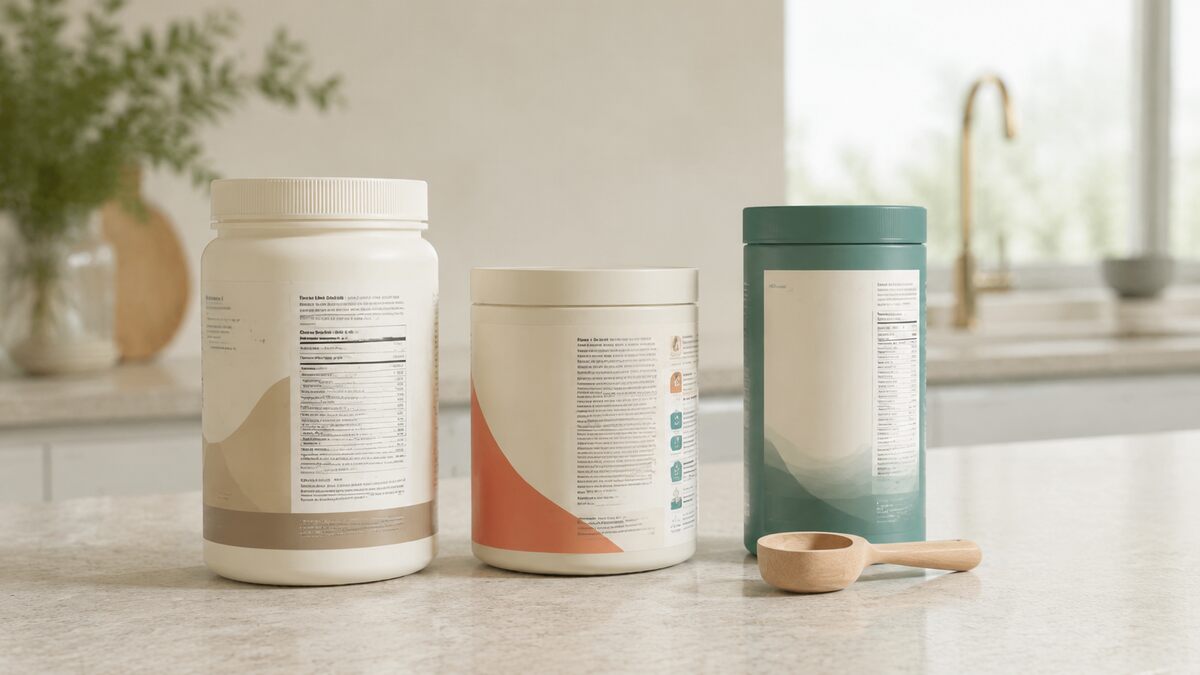
The collagen supplement market is crowded, and most marketing copy looks similar from brand to brand — “clinically studied,” “premium sourced,” “visible results.” Instead of taking any single brand’s word for it, here’s what’s actually worth checking on the label.
Collagen type
Type I and III (often from bovine or marine sources) are the most commonly used for skin, hair, and nail-focused products. Type II (often from chicken cartilage) shows up more in joint-focused products. The type should match what you’re actually looking for.
Type matters more than it might seem, because the research does not transfer between forms. Hydrolysed type I and III peptides have been studied at 5–10 g a day, while undenatured type II has been studied at 40 mg a day — as in a 2016 trial by Lugo and colleagues in Nutrition Journal, which randomised 191 adults over 180 days. A brand citing one body of research while selling the other form is not making a like-for-like argument.
Hydrolysed vs. whole
Most supplement collagen is hydrolysed — broken down into smaller peptides, which is the form almost all research on absorption has used. If a product doesn’t specify hydrolysation, that’s worth asking about.
Degree of hydrolysis is not just a yes-or-no label point. A 2019 randomised crossover trial by Skov and colleagues in Nutrients, in ten healthy men, compared an enzymatically hydrolysed collagen with a non-enzymatically hydrolysed one and found the enzymatic version produced significantly faster absorption of glycine, proline and hydroxyproline, peaking at 20 minutes rather than 40. That study was partly funded by an ingredient manufacturer and used only ten participants, and faster absorption is not the same as a better outcome — but it does show “hydrolysed” covers a range rather than a single specification.
Dose per serving
Labels vary widely — some products deliver a serving size close to what’s used in published studies, others deliver a fraction of it. Checking the actual grams of collagen per serving, not just “collagen included,” is the single most useful comparison point.
For reference, a 2023 systematic review and meta-analysis by Pu and colleagues in Nutrients, covering 26 randomised trials and 1,721 participants, found doses across the literature ranging from 0.6 g to 12 g a day over 2 to 12 weeks. That is a twentyfold spread, which makes “studied dose” a much vaguer benchmark than brands imply — and the review’s authors noted several biases in the included trials and called for larger studies to confirm the findings.
Sourcing and testing
Look for clear sourcing (bovine, marine, or otherwise) and any third-party testing disclosed — for purity, heavy metals, or contaminants. A brand that’s transparent about sourcing and testing is generally easier to trust than one relying on vague claims.
There is published reason to check. A 2024 analysis by Kržišnik and colleagues in Marine Drugs tested ten commercial collagen supplements and found the collagen content itself adequate, but discrepancies in labelling and origin in some products — one labelled as containing marine collagen showed a peptide profile suggesting it did not, and another carried no origin labelling at all. For anyone avoiding a particular animal source for allergy, dietary or religious reasons, that is a meaningful gap.
Contamination is a fair question but not automatically a problem. The Harvard T.H. Chan Nutrition Source lists heavy metals among the concerns with collagen supplements. A 2025 analysis by Cammilleri and colleagues in Open Medicine measured lead, cadmium, chromium, mercury and arsenic in marine collagen supplements of fish and jellyfish origin, found arsenic most prevalent at 0.59 ± 0.28 mg/kg, and reported that none of the samples exceeded EU regulatory limits. One study of one product category is not a clean bill of health for the whole market, which is why disclosed testing is worth looking for rather than assumed.
Added ingredients
Some products add vitamin C, biotin, or hyaluronic acid. These aren’t necessarily bad, but they can also be a way to justify a higher price without much added benefit — worth judging on their own merits rather than assuming “more ingredients” means “better product.”
Vitamin C has the clearest rationale of the three: the NIH Office of Dietary Supplements states it is required for the biosynthesis of collagen, and sets a recommended dietary allowance of 90 mg a day for adult men and 75 mg for adult women — amounts many people already reach from food. Biotin is a weaker case. The NIH Office of Dietary Supplements says claims for hair, skin and nail health are supported, at best, by only a few case reports and small studies, sets an adequate intake of 30 mcg a day for adults, and notes an FDA warning that high biotin intakes can interfere with diagnostic assays, with even a single 10 mg dose shown to distort thyroid test results. Worth knowing if a product carries a milligram-scale biotin dose and you have blood work coming up.
What the regulations do and don’t guarantee
Rules differ by country, and a claim permitted in one market may be prohibited in another. In the United States, the NIH Office of Dietary Supplements explains that supplements do not require FDA approval before sale; manufacturers are responsible for safety evidence but generally need not submit it, and the agency acts after a product reaches the market. Manufacturers may say a product supports a body part or function, provided they carry the disclaimer that the statement has not been evaluated by the FDA and the product is not intended to diagnose, treat, cure or prevent any disease.
The European approach is stricter about claims. In 2011 the European Food Safety Authority’s NDA Panel assessed a joint-maintenance claim for collagen hydrolysate and concluded that a cause and effect relationship had not been established. So identical products can carry very different wording depending on where they are sold — which means label language is a poor guide to evidence.
Third-party seals help with a narrower question than most buyers assume. The NIH Office of Dietary Supplements notes that seals from bodies such as ConsumerLab.com, NSF International and U.S. Pharmacopeia confirm proper manufacturing, accurate labelling and absence of harmful contaminants — but do not guarantee that a product is safe or effective.
The takeaway
Rather than chasing “the best” collagen brand, compare products against these five points — type, form, dose, sourcing/testing, and added ingredients — and you’ll be able to judge any brand on its actual specs rather than its marketing. Regulatory wording and quality seals answer questions about manufacturing and permitted language, not about whether the product works. This article is general education, not medical advice.