
Muscle mass doesn’t hold steady by default — from around the 30s onward, adults gradually lose muscle unless they actively work to maintain it. By the forties, that decline is a real enough factor that protein intake deserves more attention than it usually gets.
What’s happening physiologically
The body becomes somewhat less efficient at using dietary protein to build and maintain muscle as it ages — a phenomenon researchers describe as anabolic resistance. In practice, that means the amount of protein that was plenty at 25 may not be quite enough at 45 to get the same effect.
The scale of the underlying decline is reasonably well characterised. A 2004 review by Volpi and colleagues in Current Opinion in Clinical Nutrition and Metabolic Care reported that muscle mass decreases approximately 3–8% per decade after the age of 30, and that the rate of decline is higher again after 60.
The US National Institute on Aging describes a similar arc from a different angle: muscle mass and strength climb from birth and peak at around 30 to 35 years of age, after which muscle power and performance decline slowly and roughly linearly at first, then faster after about 65 in women and 70 in men. The forties, on that timeline, sit in the slow part of the curve rather than the steep one.
Why this matters beyond appearance
Muscle isn’t just about strength or how you look — it plays a role in metabolic health, mobility, and everyday resilience (recovering from illness or injury, for instance). Maintaining it through midlife is generally considered a useful long-term investment, alongside regular strength-based activity.
The National Institute on Aging puts a figure on the far end of that trajectory, noting that around 30% of adults over the age of 70 have trouble walking, getting up from a chair, or climbing stairs. The same source is careful to frame the decline as modifiable rather than fixed, stating that the average loss of strength and power with ageing can be substantially slowed by maintaining an active lifestyle.
Practical targets
General guidance for active adults in this age range often points toward roughly 1.2–1.6 grams of protein per kilogram of bodyweight per day, spread across meals, though individual needs vary with activity level, health status, and goals — this is general information, not a personal prescription.
For context, the International Society of Sports Nutrition’s 2017 position stand describes 1.4–2.0 g/kg/day as sufficient for most exercising individuals, with individual doses of about 0.25 g/kg — an absolute 20–40 g — ideally spaced every three to four hours.
Everyday sources
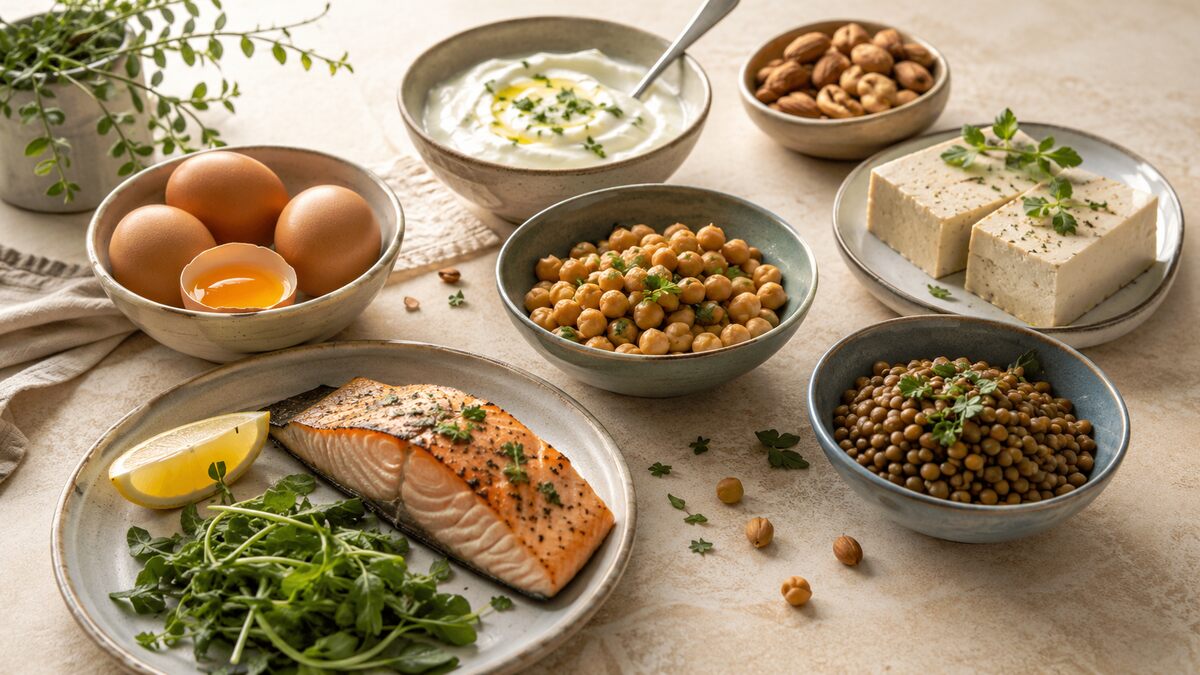
Eggs, dairy, fish, poultry, lean red meat, legumes, tofu, and tempeh all contribute meaningfully. For most people, hitting a good protein target is achievable through food alone; supplements like protein powder are a convenience, not a requirement.
The ISSN position stand reaches the same conclusion, stating that it is possible for physically active individuals to obtain their daily protein requirements from whole foods, with supplementation described as a practical convenience rather than a necessity.
Pairing with strength training
Protein intake and resistance training work together — protein alone, without a stimulus to use it, does less. Two to three strength sessions a week is a commonly cited starting point for maintaining muscle through midlife.
That figure aligns with the World Health Organization’s 2020 physical activity guidelines, which describe muscle-strengthening activities at moderate or greater intensity involving all major muscle groups on two or more days a week for adults aged 18 to 64, in addition to weekly aerobic activity. The National Institute on Aging is more pointed about which half of the equation carries the load, describing resistance training as the most important component because it builds muscle and reduces the loss of muscle mass.
What the research actually measured
The recommendation to spread protein across the day rests largely on short, tightly controlled feeding studies. The most frequently cited is Mamerow and colleagues’ 2014 trial in the Journal of Nutrition: a seven-day crossover study in eight healthy adults averaging 37 years of age, who ate about 90 g of protein daily either evenly across three meals or concentrated at dinner.
The even pattern produced roughly 25% higher 24-hour muscle protein synthesis. That is a real effect, but the outcome measured was a synthesis rate over a single day in eight people under laboratory feeding conditions — not muscle retained, strength gained, or function preserved over years.
Where the evidence is weak
When longer trials have looked at outcomes closer to daily life, the distribution effect has been harder to demonstrate. A 2017 randomised controlled trial by Kim and colleagues in Clinical Nutrition gave 14 adults aged 51 to 69 the same 1.1 g/kg/day of protein in either an even or a dinner-heavy pattern for eight weeks, and reported no significant differences in lean body mass, muscle strength or other functional outcomes.
Fourteen participants is small, and a null finding in a small trial is not proof of no effect — but it does mean the case for meal-by-meal distribution is weaker than its confident presentation in most articles suggests. The short-term laboratory signal is fairly consistent; the long-term functional evidence is thin.
The same caution applies to anabolic resistance itself. It is a well-described laboratory phenomenon, but translating it into a specific number of extra grams for a specific 45-year-old is a step the underlying studies do not directly support.
What guidelines around the world say
Guidelines disagree here, and the disagreement is worth knowing about. Harvard’s Nutrition Source describes the US Recommended Dietary Allowance as 0.8 g of protein per kg of bodyweight per day, explicitly a minimum rather than an optimum, within an acceptable range of 10–35% of daily calories. The European Food Safety Authority’s 2012 opinion set a Population Reference Intake of 0.83 g/kg/day and concluded that requirements for older adults are equal to those for younger adults.
Expert groups working from functional rather than nitrogen-balance data have landed higher. As summarised in a 2024 mini review by Groenendijk and colleagues in Frontiers in Nutrition, the PROT-AGE study group recommended at least 1.0–1.2 g/kg/day for older people in 2013, and ESPEN recommended 1.0–1.2 g/kg/day for healthy older people in 2014.
That same review notes the split has not resolved: some national bodies, including those in the Netherlands and the UK, have concluded the evidence remains insufficient to raise the figure, while Nordic and German-speaking countries have adopted 1.0–1.2 g/kg/day. Harvard’s page is similarly candid, noting that beyond the RDA there is relatively little solid information on the ideal amount of protein in the diet.
The takeaway
The forties are a reasonable point to start paying closer attention to protein intake, mainly because the body’s response to it is quietly changing. What the evidence supports most firmly is the direction of travel — adequate protein alongside regular resistance training — rather than any single number, which is precisely the part the guidelines still argue about.
This article is general information only and is not medical advice. It does not diagnose, treat, or cure any condition. Speak with a qualified healthcare professional before starting any supplement.