
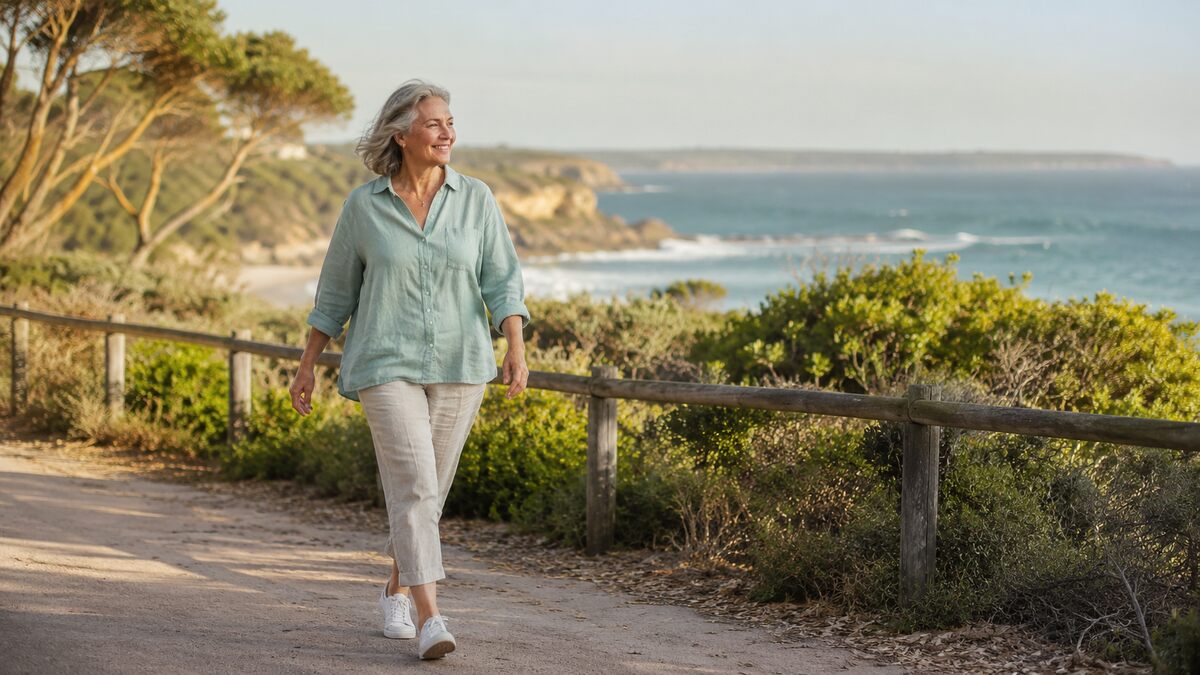
Most “healthy ageing protocols” sold online, such as supplement stacks, fasting plans, cold plunges and biological age tests, rest on far thinner evidence than the basics that public health guidelines have recommended for decades: regular physical activity including strength work, a varied diet, enough sleep, not smoking, limiting alcohol, social connection and routine health checks. The strongest research supports those unglamorous habits; the expensive extras are mostly unproven.
This guide includes a few product links near the end. As an Amazon Associate, michelle.net.au earns from qualifying purchases, at no extra cost to you.
This guide explains what the long-running studies actually measure, the one large trial that tested an exercise programme in older adults, where popular protocols overreach, a comparison of common protocols by evidence and cost, and a checklist for judging any new ageing claim before you spend money on it.
At a glance
- The basics win: activity, diet, sleep, not smoking, moderate or no alcohol, connection and check-ups appear in guidelines from the WHO, national health agencies and research reviews alike.
- Most evidence is observational: it shows strong associations, not proof of cause, because people choose their own habits.
- Experiments are rarer but exist: the LIFE trial found a structured activity programme lowered the rate of major mobility disability in sedentary adults aged 70 to 89.
- Supplements have mostly disappointed: the USPSTF advises against beta-carotene and vitamin E supplements for heart disease and cancer, and finds the multivitamin evidence insufficient.
- No national guideline recommends a supplement stack: be most sceptical of claims that come with a payment link.
What “ageing well” actually comes down to
Across the research that has held up over time, the same small set of factors appears again and again. The US National Institute on Aging’s healthy ageing guidance organises its evidence under physical activity, healthy eating, sleep, not smoking, limiting alcohol, regular check-ups, social connection and keeping the mind engaged. The World Health Organization’s ageing and health fact sheet makes the related point that although some variation in older people’s health is genetic, most of it reflects their physical and social environments, including the habits those environments make easier or harder.
None of this is new or exciting, which is probably why it gets so little attention next to a costly supplement stack. But the newer research mostly refines how much of each habit helps; it has not replaced them. The guide to five science-based habits for healthy ageing covers each one in more depth.
What the long-running studies measure
Much of what we know comes from large observational studies that follow people for decades. A 2020 analysis in the BMJ by Li and colleagues used the Nurses’ Health Study and the Health Professionals Follow-up Study to look at five low-risk factors together: a high-quality diet, at least 30 minutes a day of moderate-to-vigorous activity, a body mass index of 18.5–24.9, never smoking and moderate alcohol intake. Women who at age 50 had four or five of these factors lived on average about 34 more years free of diabetes, cardiovascular disease and cancer, compared with about 24 years for women with none. The pattern for men was similar.
Step-count research shows a similar picture. Saint-Maurice and colleagues, writing in JAMA in 2020, found that among US adults aged 40 and over, taking 8,000 or more steps a day was associated with a 51% lower risk of death from all causes over the follow-up period than taking 4,000.
These are associations drawn from people who chose their own habits, not from experiments. People who exercise and do not smoke differ from those who do not in many other ways, including income, education and access to care, and no statistical adjustment removes all of that. The findings are strong and consistent, but they are not a guarantee for any individual.
The trial that tested exercise in older adults
Randomised trials, where people are assigned to a programme by chance, can speak to cause rather than correlation. The LIFE study, reported by Pahor and colleagues in JAMA in 2014, randomly assigned 1,635 sedentary adults aged 70 to 89 to either a structured programme of walking, strength, flexibility and balance work aiming for 150 minutes a week, or a health education programme. Over an average of 2.6 years, the activity group had a lower rate of major mobility disability, defined as losing the ability to walk 400 metres.
That is a meaningful result in exactly the population most protocols are sold to, and it came from a free-to-adapt combination of walking and basic strength exercises. The guides to strength training and bone density and balance habits for healthy ageing explain how to build those elements in safely.
Where popular protocols overreach
Many protocols take a real but modest finding and stretch it into a much bigger promise. A compound that changes something in cells in a laboratory is marketed as changing how you age. A single small trial is presented as settled science. A short-term change in a blood marker is sold as a longer, healthier life.
The National Institute on Aging’s guidance on supplements for older adults notes that advertisements often promise products will help people feel better, stay well or live longer, and that there is often little, if any, science supporting these claims. Where popular supplements have been tested at scale, results have often been unimpressive. In 2022 the USPSTF, the independent US expert task force that reviews screening and supplement evidence, recommended against beta-carotene and vitamin E supplements for reducing the risk of cardiovascular disease or cancer, and concluded that the evidence on multivitamins was insufficient to weigh benefits against harms. The supplements evidence and label guide explains how to read that kind of evidence for any product.
Where the evidence is thinnest
- Fasting protocols: human trials are mostly small and short, often a few months long, and researchers themselves describe longer-term effects as uncertain.
- Brain training apps: the NIA notes that some computer-based cognitive training shows promise but that there is no conclusive evidence these applications are beneficial for long-term brain health.
- Biological age tests: commercial “biological age” or epigenetic clock tests are research tools that are not established for guiding individual health decisions, and results can vary between tests.
- Cold and light devices: the evidence is mixed and the risks are real for some people; see the guides to cold water immersion and red light therapy.
Common protocols compared
This table summarises the general state of the evidence for adults in later life. “Stronger” means consistent findings in people, including at least some randomised trials or very large long-term studies; “limited” means small, short or mostly laboratory studies.
| Protocol | Evidence in people | Typical cost | Main caution |
|---|---|---|---|
| Regular walking and everyday movement | Stronger | Free | Build up gradually if you have been inactive |
| Strength and balance training | Stronger (including the LIFE trial) | Free to low | Learn good technique; ask your doctor if you have a heart or joint condition |
| Varied, mostly whole-food diet with enough protein | Stronger (observational) | Normal food budget | Older adults may need more protein than they think |
| Consistent sleep | Stronger (observational) | Free | Persistent problems need a medical check |
| Not smoking, limiting alcohol | Stronger | Saves money | Ask for support; quitting help is widely available |
| Multi-ingredient supplement stacks | Limited to absent | Often high and ongoing | Interactions with medicines; doubling up on nutrients |
| Intermittent fasting or fast-mimicking plans | Limited, mostly short-term | Free to high (for branded kits) | Not suitable for everyone, including people on some diabetes medicines |
| Cold plunges and ice baths | Limited for ageing outcomes | Low to very high | Cold shock risk, especially with heart conditions |
| Biological age testing | Not established for individual decisions | Moderate to high | Results may not change what you should do |
The pattern is striking: the options with the strongest evidence tend to be the cheapest. Talk to your doctor or pharmacist before starting any supplement or a major change such as prolonged fasting, especially if you take medicines.
What guidelines around the world say
Public guidance is remarkably consistent across countries, which is itself informative:
- Physical activity: the US CDC advises adults to get 150 minutes of moderate-intensity activity a week, or 75 minutes of vigorous activity, plus muscle-strengthening activity on at least two days, with balance work for adults 65 and over. Australia’s physical activity guidelines for older Australians recommend at least 30 minutes of moderate-intensity activity on most, preferably all, days, including strength, balance and flexibility. The WHO’s principle is that any amount of activity is better than none, and its 2024 fact sheet reports that nearly a third of the world’s adults (about 1.8 billion people) do not meet recommended levels.
- Sleep: a 2015 consensus statement from the American Academy of Sleep Medicine and the Sleep Research Society advised adults to sleep seven or more hours a night regularly; the NIA gives seven to nine hours for older adults. The guide to sleep and recovery as you age explains what changes and why.
- Sitting less: guidelines in several countries now also stress breaking up long periods of sitting; the guide to everyday movement covers this.
What no national guideline anywhere recommends is a supplement stack.
A checklist for judging any ageing protocol
- Does it build on the basics or claim to replace them? Anything that suggests you can skip movement, food, sleep or medical care is a warning sign.
- Is the evidence from people? Cell and animal studies are early steps, not proof.
- What exactly was measured, and for how long? A blood marker at eight weeks is not the same as how someone functions at eighty.
- How many people were studied? A trial of a few dozen people is a starting point, not settled science.
- Who benefits financially? Be cautious when the person promoting a protocol sells the product, test or programme.
- What are the risks and interactions? Check with your doctor or pharmacist, particularly if you take medicines or have a heart condition.
- What is the total cost over a year? Ongoing subscriptions and repeat tests add up quickly.
- Would the money do more elsewhere? Walking shoes, a few sessions with an exercise physiologist or better food often have stronger evidence behind them.
Common mistakes
- Buying extras before the basics: spending on supplements while skipping strength work or sleep reverses the order of evidence.
- Reading associations as promises: observational findings describe groups, not guaranteed outcomes for you.
- Stacking products: combining several supplements raises the risk of interactions and of exceeding upper limits.
- Following protocols designed for different people: routines built by younger athletes or influencers may not suit older bodies or medical conditions.
- Chasing test numbers: changing a marker is not the same as living longer or better.
- Doing it all at once: big overhauls are hard to keep up. Small habits added one at a time tend to last.
- Not telling your doctor: your health team needs to know about every supplement and major change, especially fasting or intense cold exposure.
Sources this guide draws on: US National Institute on Aging, healthy ageing guidance and information on dietary supplements for older adults; World Health Organization, Ageing and health and Physical activity fact sheets; Li and colleagues, healthy lifestyle and life expectancy free of major chronic diseases, BMJ (2020); Saint-Maurice and colleagues, daily step count and mortality, JAMA (2020); Pahor and colleagues, the LIFE study, JAMA (2014); USPSTF, vitamin, mineral and multivitamin supplementation recommendation (2022); US CDC, physical activity guidelines for adults; Australian Government Department of Health, physical activity guidelines for older Australians; American Academy of Sleep Medicine and Sleep Research Society consensus statement (2015).
Handy kit for this guide
These are practical everyday products, not supplements or medicines. As an Amazon Associate, michelle.net.au earns from qualifying purchases, at no extra cost to you. Prices and availability are set by Amazon and may vary by country.
- The Blue Zones Kitchen by Dan Buettner
100 everyday recipes built around beans, greens and whole grains.
View on Amazon - Bambaw Insulated Stainless Steel Water Bottle (32 oz)
Plastic-free and keeps water cold all day, at home, on walks or at the gym.
View on Amazon - Gaiam Premium 5 mm Yoga Mat
Non-slip mat for yoga, Pilates, tai chi warm-ups and floor exercises.
View on Amazon
Frequently asked questions
What is a healthy ageing protocol?
It is a loose term for a structured routine aimed at ageing well, ranging from evidence-based habits like regular exercise and good sleep to commercial packages of supplements, tests and devices. The term itself has no official definition, so what is inside matters more than the label.
What habits have the strongest evidence for healthy ageing?
Regular physical activity including strength and balance work, a varied diet, enough sleep, not smoking, limiting alcohol, staying socially connected and keeping up with health checks. These appear in guidelines from the WHO, national health agencies and large long-term studies.
Do longevity supplements work?
Large trials of popular supplements have mostly been disappointing, and the USPSTF found the multivitamin evidence insufficient while advising against beta-carotene and vitamin E for heart disease and cancer risk. Talk to your doctor or pharmacist before taking any supplement, especially with other medicines.
Is it too late to start exercising in your seventies?
No. The LIFE trial enrolled sedentary adults aged 70 to 89 and found a structured walking and strength programme lowered the rate of major mobility disability. Start gently and check with your doctor if you have a heart, lung or joint condition.
Are biological age tests worth it?
Commercial biological age tests are based on research tools that are not established for guiding individual health decisions, and results can differ between tests. For most people, the money is better spent on habits with stronger evidence.
Is intermittent fasting good for healthy ageing?
Human studies are mostly small and short, so long-term effects on ageing remain uncertain. Fasting is not suitable for everyone, including some people with diabetes or a history of disordered eating, so speak to your doctor before trying it.
Healthy ageing is not a protocol you buy; it is a set of habits you keep up, most of which have been understood for decades. Prefer what appears in national guidelines, regard single studies as provisional, and save your strongest scepticism for claims that arrive with a payment link.
This guide is general education based on published research and public health guidance. It is not medical advice. Talk to your doctor or pharmacist before starting a supplement, a fasting plan or a new exercise programme if you have a health condition or take medicines.