
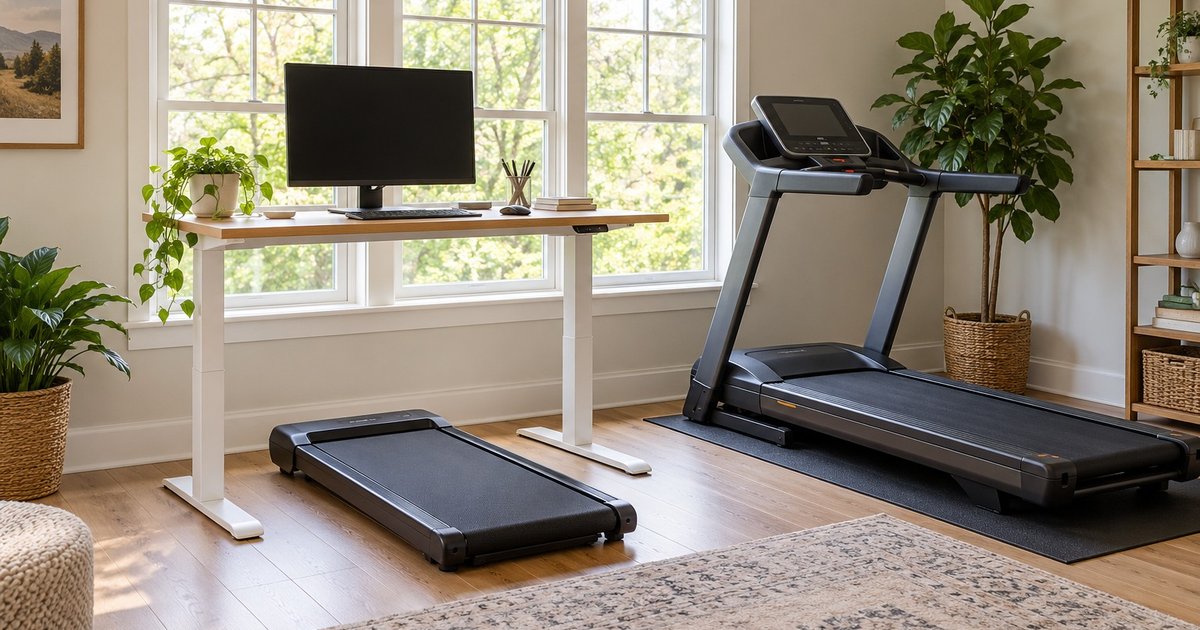
A walking pad is a compact, low, usually handrail-free belt designed mainly for walking, often under a standing desk, and it can be folded or slid away when you are done. A treadmill is larger and heavier, but it typically has handrails, more cushioning, higher speeds and an incline. For many older adults, the deciding question is balance: if you would like something to hold on to, a treadmill with full handrails is generally the safer fit; if your balance is steady and space is tight, a walking pad can work well for gentle daily walking.
This guide includes a few product links near the end. As an Amazon Associate, michelle.net.au earns from qualifying purchases, at no extra cost to you.
This guide compares the two on the points that matter most at home: handrails, the emergency stop key, speed, weight capacity, belt size, footprint, storage and noise. It includes a safety checklist, a room-measuring step list and questions to ask before you buy. It does not recommend any brand, and because specifications vary widely between models, always check the manufacturer’s stated figures for the exact machine you are considering. If you have a heart condition, joint problems, dizziness or a history of falls, talk to your doctor or physiotherapist before starting a new exercise routine.
Try our free zone 2 heart rate calculator to estimate your easy-pace heart rate range.
At a glance
- Handrails: treadmills usually have them; many walking pads have none, though some fold-up models add a front or side rail.
- Speed: consumer group Which? reports most walking pads top out at about 8 km/h or less, which suits walking rather than running.
- Safety stop: treadmills commonly use a clip-on safety key; on walking pads it varies, so check before you buy.
- Space: walking pads fold flat and store away; treadmills need a permanent spot plus clear space behind.
- Best fit: steady walkers with little space may suit a pad; anyone wanting support to hold may suit a treadmill.
Walking pad vs treadmill: the comparison
| Feature | Walking pad | Treadmill |
|---|---|---|
| Handrails | Often none. Some models have a fold-up front bar or short side rails | Usually front and side handrails |
| Emergency stop | Varies. Some have a safety key; many rely on a remote or app to stop | Commonly a clip-on safety key plus a stop button |
| Typical top speed | Mostly walking speeds; Which? reports about 8 km/h or less on most | Higher, suitable for jogging and running |
| Incline | Usually none | Often adjustable |
| Belt length and width | Shorter and narrower | Longer and wider |
| Cushioning | Thinner walking surface | Generally more cushioned deck |
| Controls | Handheld remote, app, or both | Console within reach on the handlebar |
| Footprint and storage | Compact, light, often folds flat or stores on its side | Large and heavy; some fold but are harder to move |
| Weight capacity | Varies by model; check the stated maximum user weight | Varies by model; check the stated maximum user weight |
| Noise | Varies widely; some are loud enough to disrupt calls | Varies; larger motors and running can be noisier |
The table describes typical differences reported by Which? and Healthline. Individual models vary, and some products are hybrids, so use it as a starting point and check the specification sheet for any machine you shortlist.
Safety features explained
Handrails
Handrails give you something to steady yourself on when you step on, adjust speed or feel unbalanced. Healthline’s comparison points to handrail support as one reason treadmills tend to suit older adults and people with limited mobility. If you are looking at a walking pad with a fold-up rail, check how high it sits, whether it feels firm when you lean lightly on it, and whether it runs along the sides or only across the front. A short front bar is not the same as full side rails.
Emergency stop key
A safety key is a magnetic or clip-on key attached to your clothing by a cord. If you slip or drift too far back, the cord pulls the key out and the belt stops. Consumer Reports advises keeping the key clipped on whenever you use a treadmill, and removing it and storing it away from the machine when you are not, so that children cannot start the belt. Which? notes that some walking pads have a key and some do not; for those without one, it suggests unplugging the pad when it is not in use.
Controls you can reach
Many walking pads are controlled by a small remote or a phone app. That is convenient at a desk, but it means your stop control is in your hand or pocket rather than in front of you. Which? advises keeping the remote within arm’s reach so you can slow or stop quickly. Ask yourself whether you could find and press the stop button easily if you lost your footing.
Maximum speed
For walking, a lower top speed is not a drawback. Which? notes that some walking pads can reach around 12 km/h, but that they feel less stable at those speeds than a full-sized treadmill. If you only plan to walk, a machine with walking-range speeds and gentle speed changes may feel more comfortable than one built for running.
Weight capacity
Every machine has a manufacturer’s maximum user weight. Which? found the walking pads it tested had limits of roughly 100 to 120 kg. Treadmill limits vary by model. Choose a machine whose stated limit comfortably exceeds your weight rather than one where you are close to the edge.
Belt size and stride
Walking pad belts are shorter and narrower than treadmill belts. Taller people, or anyone with a long stride, may find a short belt cramped, and a narrow belt leaves less room for error if your steps wander. If you can, stand on a display model and take a few steps before you buy.
Space, footprint and storage
A walking pad’s biggest advantage is that it can disappear. Many fold flat to slide under a bed, sofa or desk, and some can be stood on their side. Treadmills usually need a permanent spot. Remember that a machine also needs clear space around it, not just the floor it sits on.
Consumer Reports suggests leaving about 60 cm (two feet) on each side and about 2 metres (six feet) behind a treadmill, so that a fall does not push you into a wall or trap you against furniture. Which? gives similar advice for walking pads: do not place the back of the belt against a wall or furniture. Apply the same clearance whichever you choose.
How to measure your room
- Find the machine’s stated length and width, both in use and folded.
- Add about 60 cm on each side and about 2 metres behind.
- Mark the total area on the floor with masking tape.
- Check the floor is level and firm; avoid thick rugs.
- Check that a power point is close enough without a trailing extension lead across a walkway.
- For a walking pad, check where it will be stored and that you can move it there safely. Lifting is harder than it looks, so check the machine’s weight and whether it has wheels.
- Make sure a folded or upright machine cannot tip over.
Noise and household considerations
Noise varies a great deal between models. Which? notes some walking pads are loud enough to interfere with video calls. If you live in an apartment, have a partner working nearby or plan to walk early in the morning, look for independent noise test results and consider a mat underneath if the manufacturer allows it.
Think about grandchildren and pets too. Which? warns that gaps between the belt and frame can catch small hands or paws, and Consumer Reports notes that buttons and lights attract children. Remove the safety key or unplug the machine whenever you are not using it, and keep children and animals away while it is running.
A home safety checklist
- Clip the safety key to your clothing every time, if your machine has one.
- Start the belt at the slowest speed while standing on the side rails or frame, then step on.
- Keep the remote or stop button where you can reach it without looking.
- Wear supportive, closed shoes. Avoid socks only or loose slippers.
- Look ahead, not down at your feet or a screen below eye level.
- Change speed gradually.
- Wait for the belt to stop completely before stepping off, as Which? advises.
- Remove the key or unplug the machine afterwards, and store the key away from children.
- Keep the clear zone behind the belt free of furniture, pets and clutter.
Who each option suits
A walking pad may suit you if
- your balance is steady and you do not feel the need to hold on
- you want to walk while working at a standing desk
- space is limited and you need to store it away
- you only plan to walk, not jog or run
A treadmill may suit you better if
- you would like handrails to steady yourself
- you have a history of falls, dizziness or unsteadiness (check with your doctor first)
- you want incline walking or faster speeds
- you are tall or have a long stride
- you prefer controls on a fixed console rather than a remote
If neither feels right, walking outdoors, a local pool or a group class are other ways to stay active. See the guide to making the most of your local swimming pool, or home Pilates equipment for strength and balance work that needs very little space.
How much walking, and how to build up
The World Health Organization advises adults to aim for at least 150 minutes of moderate-intensity physical activity a week and to limit time spent sitting. A home walking machine is one way to fit that in, especially in bad weather. Short, regular sessions are a practical place to start, building time before speed. The article on everyday movement, sitting and walking explains why regular movement across the day matters, and balance habits for healthy ageing covers what the guidelines say about balance training, which a belt alone does not provide. Pairing walking with resistance work is also worthwhile; see strength training and bone density.
Common mistakes to avoid
- Buying on size alone. A compact pad is only a good choice if its lack of handrails suits your balance.
- Placing the back of the belt against a wall. Leave clear space behind.
- Not using the safety key, or leaving it in the machine where children can reach it.
- Ignoring the weight limit or choosing one close to your own weight.
- Underestimating the weight of the machine when you plan to move it daily.
- Walking while looking down at a phone or laptop, which takes your attention off your footing.
- Stepping off a moving belt. Always wait for it to stop.
- Trusting marketing labels such as “for seniors” instead of checking the actual handrails, stop key and specifications.
Questions to ask before you buy
- Does it have handrails, and are they full side rails or a short front bar?
- Does it have a clip-on safety key, and where is the stop button?
- What are the minimum and maximum speeds, and how gradually does speed change?
- What is the maximum user weight?
- What are the belt’s length and width?
- What are the dimensions in use and folded, and how heavy is it to move?
- Are there independent noise test results?
- What warranty, servicing and returns policy applies where you live? These differ by country and retailer.
Whichever machine you choose, it helps to know how to build up aerobic exercise safely over the first few weeks.
Sources this guide draws on: Which? guidance on walking pads and under-desk treadmills; Consumer Reports advice on treadmill safety; Healthline’s comparison of walking pads and treadmills; and the World Health Organization fact sheet on physical activity.
Handy kit for this guide
These are practical everyday products, not supplements or medicines. As an Amazon Associate, michelle.net.au earns from qualifying purchases, at no extra cost to you. Prices and availability are set by Amazon and may vary by country.
- Gaiam Premium 5 mm Yoga Mat
Non-slip mat for yoga, Pilates, tai chi warm-ups and floor exercises.
View on Amazon - Fabric Resistance Bands (5-Band Set)
Loop bands in graded resistance for home strength exercises.
View on Amazon - Bambaw Insulated Stainless Steel Water Bottle (32 oz)
Plastic-free and keeps water cold all day, at home, on walks or at the gym.
View on Amazon
Frequently asked questions
Is a walking pad safe for older adults?
It can be for people with steady balance who walk at gentle speeds and follow basic safety steps. Because many walking pads have no handrails, people who need support, feel unsteady or have had falls are often better suited to a treadmill with full handrails. Check with your doctor or physiotherapist if you are unsure.
Do walking pads have a safety key?
Some do and some do not. Which? notes that on models without one, you should unplug the pad when it is not in use. Check the product details before buying if a safety key matters to you.
Can you add handrails to a walking pad?
Some models come with a fold-up front bar or short side rails, but a walking pad without rails is not designed for them to be added later. If you want handrail support, it is safer to choose a machine built with it.
How much space do you need for a treadmill or walking pad?
Beyond the machine itself, Consumer Reports suggests about 60 cm on each side and about 2 metres behind. Walking pads store more compactly, but they need the same clear space while in use.
Can you run on a walking pad?
Most are designed for walking. Which? reports that most top out at about 8 km/h or less, and that models reaching higher speeds feel less stable than a full-sized treadmill. If you want to jog or run, a treadmill is generally the better tool.
Are walking pads quieter than treadmills?
Not necessarily. Noise varies widely by model, and Which? notes some walking pads are loud enough to disturb video calls. Look for independent noise testing rather than relying on product descriptions.
The right choice comes down to balance, space and how you plan to use it. If you want something to hold on to, start with treadmills. If your walking is steady and space is tight, a walking pad with a clear stop control can be a practical way to move more at home. Either way, set it up with room behind, use the safety key, and build up gradually.