
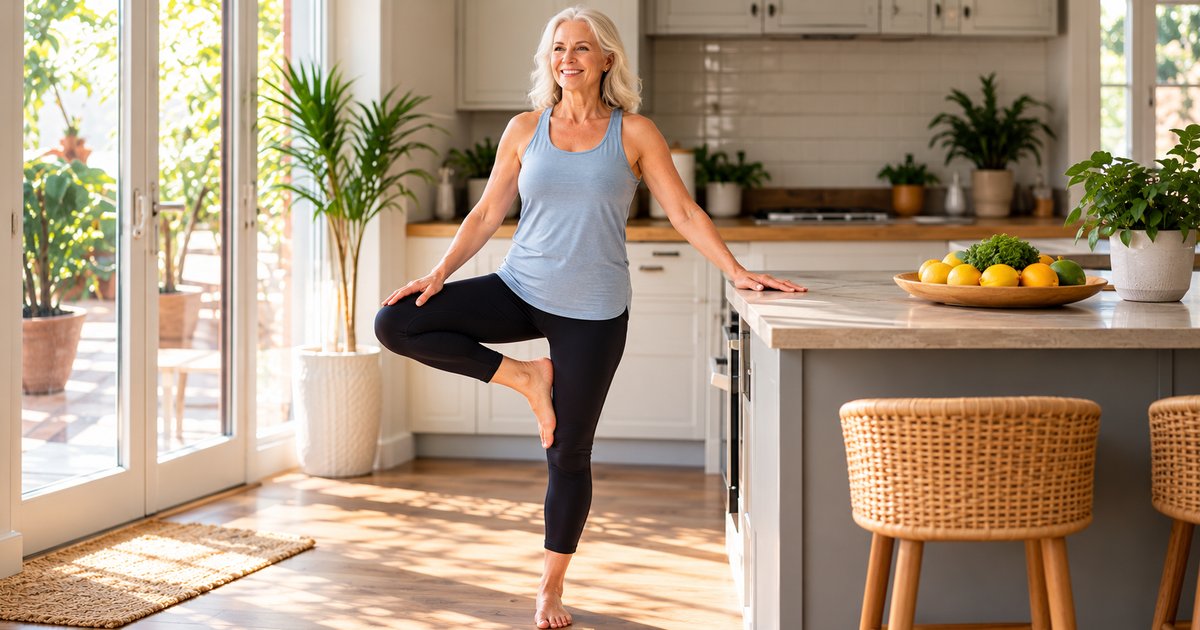
For healthy ageing, the World Health Organization’s physical activity guidelines ask adults aged 65 and over to do varied, “multicomponent” activity that emphasises functional balance and strength training on three or more days a week, as part of their usual weekly activity. In practice that means short, regular sessions of standing and stepping exercises, done next to something solid, combined with leg strength work and plenty of everyday movement. You do not need equipment or a gym, but you do need to set things up so that losing your balance is safe.
This guide includes a few product links near the end. As an Amazon Associate, michelle.net.au earns from qualifying purchases, at no extra cost to you.
This guide explains what the guidelines actually say, what balance is made of, a simple self-check you can do with someone present, a starter routine, how to choose a class, the mistakes that make people give up, and when to see a doctor or physiotherapist first.
The only affiliate links in this article are to the practical items listed near the end.
At a glance
- The guideline: adults 65 and over are advised to include balance and strength activity on three or more days a week, alongside aerobic activity and muscle strengthening.
- The evidence: a large Cochrane review found that structured exercise programmes, particularly balance and functional exercise, were linked with fewer falls among older people living in the community.
- Little and often works: a few minutes of practice, several times a week, attached to habits you already have, is easier to keep up than one long session.
- Safety first: practise beside a kitchen bench or sturdy chair, in flat shoes, with the floor cleared.
- Get checked if: you have fallen recently, feel dizzy or unsteady, or take medicines that affect alertness or blood pressure. Talk to your doctor or a physiotherapist before starting.
What the guidelines actually say
The World Health Organization’s 2020 guidelines on physical activity and sedentary behaviour set out recommendations for all adults, with an additional set for adults aged 65 and over. For adults in general, they recommend 150 to 300 minutes of moderate-intensity aerobic activity a week (or 75 to 150 minutes of vigorous activity, or a mix), plus muscle-strengthening activity on two or more days a week.
For older adults, they add a specific point: as part of their weekly activity, older adults should do varied multicomponent physical activity that emphasises functional balance and strength training at moderate or greater intensity, on three or more days a week. The guidelines also stress that some activity is better than none, and that people who cannot meet the full recommendation should be as active as their abilities allow.
National guidelines say broadly the same thing in their own words. The UK Chief Medical Officers’ guidelines, for example, ask older adults to include activities that improve strength, balance and flexibility on at least two days a week, and Australia’s physical activity guidelines for older Australians include balance among the types of activity to build into the week. If you live elsewhere, your national health department is likely to publish its own version.
Two details are easy to miss:
- Balance is part of a mix, not a standalone programme. The guideline pairs it with strength, because steady standing and walking depend on strong legs and hips as much as on coordination.
- “Multicomponent” means variety. Walking alone does not challenge balance in the way the guideline describes, and seated weight machines do not either. Standing, stepping, turning and rising from a chair all count.
Why balance gets singled out
The World Health Organization’s fact sheet on falls describes falls as the second leading cause of unintentional injury deaths worldwide, after road traffic injuries, with adults over 60 having the highest death rates. That is a population-level observation, and it does not predict what will happen to any one person. It is the reason balance and gait training and tai chi appear among the approaches the WHO lists for older people.
The research behind this is unusually strong for an exercise topic. A 2019 Cochrane review, which pooled 108 randomised trials involving more than 23,000 participants, reported that exercise programmes reduced the rate of falls among older people living in the community by around 23 per cent compared with control groups. Programmes built mainly around balance and functional exercise showed a similar result, and the reviewers rated that evidence as high certainty. Trials of tai chi also reported fewer falls, though with less certainty about the size of the effect.
Those are averages from structured, supervised programmes. They describe what groups of people experienced in trials, not a guarantee for an individual, and they tell you nothing about gadgets, wobble cushions or supplements sold on the same promise.
What balance is made of
Balance is not one skill. It is several body systems working together:
- Vision, which tells you where you are relative to the room.
- The inner ear (vestibular system), which senses head movement and tilt.
- Sensation from the feet and joints, which reports pressure and position.
- Muscle strength and reaction speed, especially in the ankles, hips and trunk, which let you act on what the other systems report.
When any of these changes, through new glasses, reduced feeling in the feet, an ear problem or simply less leg strength, everyday balance changes too. That is why good balance practice looks like ordinary movement done more deliberately, and why a sudden change in steadiness is a reason to see a doctor rather than just to practise more.
A simple balance self-check (with someone present)
Health professionals use standard tests to get a baseline. One widely used example is the four-stage balance test in the CDC’s STEADI resources for older adults. You stand in four positions, each harder than the last, and try to hold each one for 10 seconds without moving your feet or holding on:
- Feet side by side.
- One foot slightly forward, so the instep of one foot touches the big toe of the other.
- Tandem stand: one foot directly in front of the other, heel touching toe.
- Standing on one foot.
In the STEADI materials, an older adult who cannot hold the tandem stand for 10 seconds is considered to be at increased risk of falling. Use this as a conversation starter, not a diagnosis. Do it only next to a bench or wall, with another person beside you, and stop at the first stage you cannot hold. If you struggle, take the result to your doctor or a physiotherapist, who can do a fuller assessment.
Balance activities compared
There is no single best option. The table compares common approaches by what they ask of you.
| Approach | What it involves | Good for | Things to consider |
|---|---|---|---|
| Home practice at the bench | Weight shifts, heel-to-toe stands, single-leg holds with a hand on support | Fitting practice into daily routines; no cost | Easy to stall without progression; needs a safe set-up |
| Sit-to-stand and step-ups | Rising from a chair, stepping onto a low, stable step | Combining leg strength and balance | Use a stable chair without wheels; start with hands if needed |
| Tai chi class | Slow, flowing weight-shifting sequences | Social, low impact, widely available in community settings | Instructor quality varies; tell them about any health conditions |
| Physiotherapist-led programme | Individual assessment and a tailored, progressive plan | Anyone who has fallen, feels unsteady or has a health condition | Cost and access vary by country and health system |
| Dance, Pilates or pickleball | Movement that includes turning, stepping and changing direction | People who prefer a hobby to an exercise routine | Choose a beginner level; balance is trained indirectly |
If a hobby suits you better than a routine, the guides to choosing an adult dance class, what to expect at your first Pilates class and starting pickleball cover what to look for at a beginner level.
A starter routine you can do at the kitchen bench
These are examples of the kinds of activities used in community exercise programmes. They are not a prescription. Choose the ones that feel manageable, and stop if anything causes pain, dizziness or breathlessness.
- Set up. Stand facing a sturdy kitchen bench or the back of a heavy chair, in flat, secure shoes. Clear rugs and cords. Have someone nearby the first few times.
- Weight shifts (about 1 minute). With both hands on the bench, slowly shift your weight from one foot to the other, then forwards and backwards.
- Heel-to-toe stand (3 holds per side). Place one foot directly in front of the other and hold for up to 10 to 20 seconds, keeping a light grip.
- Single-leg stand (3 holds per side). Lift one foot a little off the floor and hold for up to 10 seconds. Hold the bench as firmly as you need.
- Sit-to-stand (5 to 10 repetitions). From a stable chair, stand up and sit down slowly. Use your hands at first if you need to.
- Side steps (1 minute). Step sideways along the bench and back, keeping your toes pointing forwards.
- Heel and toe raises (10 of each). Rise onto your toes, lower, then lift your toes with your weight on your heels.
The whole sequence takes around 10 minutes. Over weeks, progress slowly by holding positions for longer, using one hand instead of two, then a fingertip, and only much later trying a hold with hands hovering just above the bench. Progression should feel steady, never risky.
Leg strength underpins all of this. The guides to choosing resistance bands for seniors and strength training and bone density explain how to add simple strength work, and protein after forty covers the nutrition side of keeping muscle.
Making it a habit
Balance practice rarely fails because it is hard. It fails because it is forgotten. A few habits help:
- Attach it to something you already do. Single-leg holds while the kettle boils, heel raises while brushing your teeth (holding the basin), sit-to-stands during advertisement breaks.
- Keep a simple tally. A tick on a calendar for each day you practise helps you reach the three-days-a-week guideline.
- Move more through the day. Walking on grass or gentle slopes, gardening and climbing stairs carefully all add balance demands. The guide to everyday movement explains why the hours outside exercise matter.
- Make it social. Community classes are often as much about company as exercise, and people tend to keep going to things their friends go to.
Who should get checked first
Speak to your doctor or a physiotherapist before starting new balance activities if any of these apply:
- you have had a fall or a near-fall recently;
- you feel dizzy, light-headed or unsteady, or your vision or hearing has changed;
- you have a heart, nerve, joint or blood pressure condition;
- you take medicines that can cause drowsiness or affect blood pressure (a pharmacist can review your medicines with you);
- you have osteoporosis or have been told your bones are fragile;
- you have numbness, tingling or pain in your feet or legs.
A professional can assess what an article cannot, such as your strength, walking pattern, vision and medicines, and build a programme around what they find.
How to judge a class or programme
Use these questions when comparing a community class, a clinic programme or a personal trainer:
- Who runs it, and what training do they have in working with older adults?
- Is there a health questionnaire or assessment before you start?
- Does it include leg strength as well as balance?
- Does it get gradually harder as you improve, and offer easier versions?
- Is it safe to wobble, with chairs, rails or a wall within reach?
- Does it run at least twice a week, or give you exercises for home between sessions?
Be wary of anything that promises to stop falls, reverse ageing or “fix” balance with a device or pill. The strongest evidence is for structured exercise programmes done regularly over months.
Common mistakes
- Practising without support. Balance work should challenge you in a setting where a wobble costs nothing. Always have something solid within reach.
- Doing it once a week. The guideline is three or more days. Short and frequent beats long and rare.
- Skipping strength. Balance practice without leg and hip strength work misses half of the guideline.
- Progressing too fast. Letting go of the bench before you are steady with a light touch adds risk without adding benefit.
- Ignoring a sudden change. New dizziness or unsteadiness can have medical causes, including medicines, and needs a check rather than more practice.
- Buying gadgets first. Wobble boards and balance discs are not needed to start, and some make practice riskier for beginners.
For a wider view of which habits have the best evidence behind them, see the truth about healthy ageing protocols.
Related guide: 10 Easy Exercises for Seniors: A Simple, Safe Home Routine.
Related guide: Tai Chi Walking for Beginners: A Simple, Safe Way to Start.
Sources this guide draws on: World Health Organization, Guidelines on Physical Activity and Sedentary Behaviour (2020); World Health Organization fact sheet on falls; Sherrington and colleagues, Cochrane systematic review of exercise and falls in older people living in the community (2019); US CDC STEADI four-stage balance test; UK Chief Medical Officers’ Physical Activity Guidelines (2019); Australian Government Department of Health physical activity guidelines for older Australians.
Handy kit for this guide
These are practical everyday products, not supplements or medicines. As an Amazon Associate, michelle.net.au earns from qualifying purchases, at no extra cost to you. Prices and availability are set by Amazon and may vary by country.
- Gaiam Premium 5 mm Yoga Mat
Non-slip mat for yoga, Pilates, tai chi warm-ups and floor exercises.
View on Amazon - Fabric Resistance Bands (5-Band Set)
Loop bands in graded resistance for home strength exercises.
View on Amazon - Bambaw Insulated Stainless Steel Water Bottle (32 oz)
Plastic-free and keeps water cold all day, at home, on walks or at the gym.
View on Amazon
Frequently asked questions
How often should older adults do balance exercises?
The World Health Organization guidelines suggest balance and strength activity on three or more days a week for adults aged 65 and over, as part of their usual activity. Short sessions of around 10 minutes count. If that feels like too much at first, start with what you can manage and build up.
Is walking enough to keep my balance?
Walking is valuable for overall fitness, but on its own it does not challenge balance much. The guidelines describe varied activity that includes standing, stepping and strength work. Adding a few bench exercises or a tai chi or dance class covers what walking misses.
How long should I be able to stand on one leg?
There is no single target that suits everyone, and results vary with age and health. In the CDC’s four-stage test, the harder positions are held for 10 seconds, and difficulty holding a heel-to-toe stand for 10 seconds is a reason to talk to a health professional. Use your own times as a personal baseline rather than a pass or fail.
Is tai chi good for balance?
Tai chi is one of the approaches the World Health Organization lists for older people, and trials have reported fewer falls among people who took part, although the evidence is less certain than for balance and functional exercise programmes. It is low impact and widely available. Choose a class for beginners and tell the instructor about any health conditions.
Can I improve my balance at any age?
Trials of balance and strength programmes have included people well into their eighties and beyond, and participants have generally been able to take part safely when programmes were supervised and progressed gradually. What is realistic for you depends on your health, so it is worth asking your doctor or a physiotherapist where to start.
Should I see a physiotherapist?
It is a good idea if you have had a fall, feel unsteady, have a long-term health condition or are unsure what is safe. A physiotherapist can assess your balance and strength and set a programme at the right level. Access and costs differ between countries, so check what your health system or insurer covers.
Balance is a skill you can practise in your own kitchen, a few minutes at a time, with something solid to hold. Pair it with strength work and everyday movement, aim for three days a week, and get checked first if anything about your steadiness has changed.
This guide is general education based on published guidelines and research. It is not medical advice and cannot assess your individual health. If you have a health condition, take regular medicines or have fallen recently, talk to your doctor, pharmacist or physiotherapist before starting a new activity.