
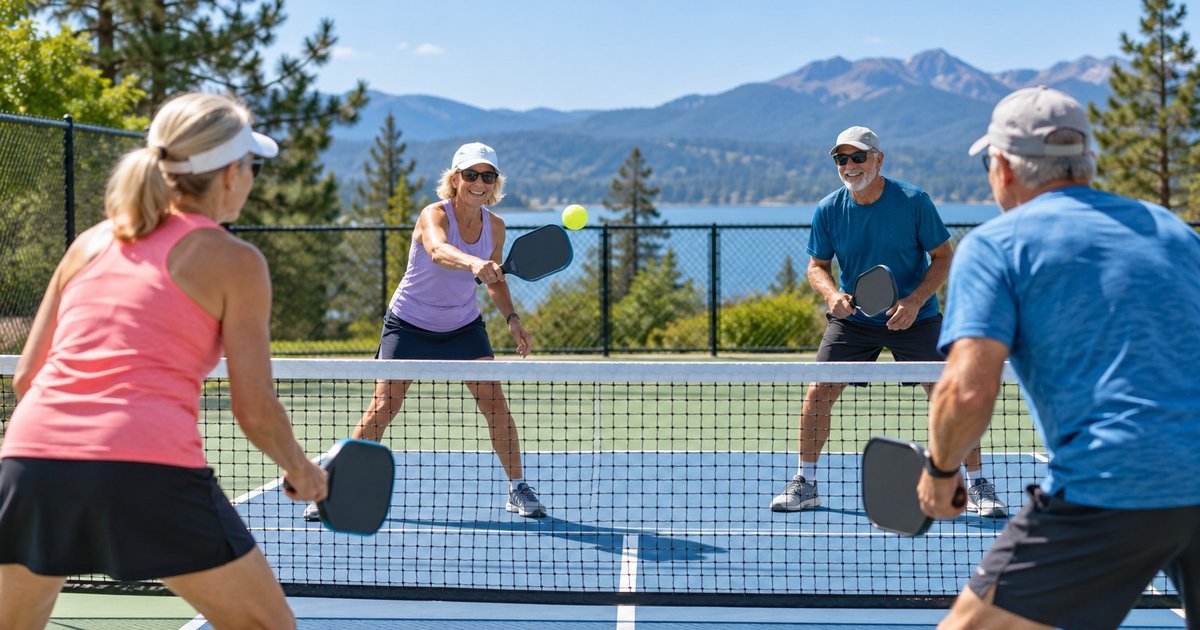
Pickleball is a paddle sport played on a small court with a perforated plastic ball, and beginners can usually learn the basics in a single session. To start, you need a paddle, a ball suited to indoor or outdoor play, supportive court shoes and a court or club nearby, which you can usually find through your local council, a national pickleball association or a nearby tennis or community centre. The rules are simple once you understand the serve, the two-bounce rule and the non-volley zone, often called “the kitchen”.
This guide includes a few product links near the end. As an Amazon Associate, michelle.net.au earns from qualifying purchases, at no extra cost to you.
This guide walks through the core rules, the equipment worth buying (and what can wait), how to find courts and clubs wherever you live, how to play safely as an older adult, and the etiquette that helps newcomers fit in quickly.
- Easy to start: the court is small, the ball is slow compared with tennis, and doubles is the most common format.
- Three rules matter most: serve underhand and diagonally, let the ball bounce once on each side before volleying, and never volley from inside the kitchen.
- Minimal kit: a beginner-friendly paddle, the right ball for your court, court shoes and protective eyewear.
- Finding a game: check your council, national association club finders, tennis clubs and community centres for beginner sessions.
- Play safely: warm up, protect your eyes, avoid backpedalling and talk to your doctor first if you have heart, balance or joint concerns.
At a glance
- Pickleball is a paddle sport on a small court with a slow plastic ball, and most beginners learn the basics in one session.
- Three rules matter most: serve underhand and diagonally, let the ball bounce once on each side, and never volley from the kitchen.
- The kitchen is the non-volley zone within 7 feet (about 2.13 metres) of the net on each side.
- Start with a beginner-friendly paddle, the right ball for your court, court shoes and protective eyewear; borrow paddles before buying.
- Find a game through your national association, local council, tennis clubs or community centres, ideally at a learn-to-play session.
- Warm up for 5 to 10 minutes, never backpedal for a lob, and check with your doctor first if you have heart, balance or joint concerns.
What pickleball is and why it suits beginners
Pickleball combines elements of tennis, badminton and table tennis. It is played as singles or, more commonly, doubles, on a court the same size as a badminton doubles court. The ball moves more slowly than a tennis ball, the court is smaller, and much of the game is played with soft, controlled shots near the net. That combination makes it social and approachable for people of many ages and fitness levels, which is one reason community centres and clubs in many countries now run beginner sessions.
If you already play or have played tennis, many of the skills carry over, although the serve, scoring and net rules are different. The guide to tennis for adults, local courts and coaching covers that sport if you want to compare the two.
The basic rules in plain language
Rules are set by governing bodies, and national organisations such as USA Pickleball, Pickleball Australia and Pickleball England publish official rulebooks and summaries. International federations also exist. Rules are updated from time to time, and local clubs sometimes play house variations, so check the current rulebook from your national body. The summary below reflects the core rules as published at the time of writing (October 2026).
The court and net
- The court is 20 feet wide and 44 feet long (about 6.10 by 13.41 metres) for both singles and doubles.
- The net is 36 inches (about 91 centimetres) high at the sidelines and 34 inches (about 86 centimetres) at the centre.
- The non-volley zone, or kitchen, is the area within 7 feet (about 2.13 metres) of the net on each side.
Serving
- The serve is made diagonally, crosscourt, and must land in the opposite service court, clearing the kitchen.
- With a standard volley serve, your arm must move in an upward arc, you must hit the ball below waist level, and the paddle head must not be above your wrist at contact.
- A drop serve is also allowed: you drop the ball and hit it after it bounces.
- At contact, at least one foot must be behind the baseline, and you get only one attempt.
- A serve that touches the kitchen line is short and counts as a fault.
The two-bounce rule
The receiving team must let the serve bounce before returning it, and the serving team must then let the return bounce before hitting it. After those two bounces, either team may volley (hit the ball in the air) or play it off the bounce.
The kitchen rule
You cannot volley while standing in the kitchen or touching its line, and your momentum must not carry you into it after a volley. You may step into the kitchen at any time to play a ball that has bounced.
Scoring
- In traditional scoring, only the serving team can win a point.
- Games are usually played to 11, and you must win by 2. Some tournament games go to 15 or 21.
- In doubles, the score is called as three numbers: the serving team’s score, the receiving team’s score and the server number (first or second server).
- Rally scoring, where a point is won on every rally, is an approved alternative in some rulebooks and events.
Common faults
- Hitting the ball into the net or out of bounds.
- Volleying before both bounces have happened.
- Volleying from inside the kitchen.
- Letting the ball bounce twice on your side.
- Touching the net or net post during play, or being hit by the ball.
A ball landing on any line is in, except on the serve, where landing on the kitchen line is a fault.
Equipment: what you need and what can wait
Paddles
Under USA Pickleball equipment rules, a paddle’s combined length and width cannot exceed 24 inches, and its length cannot exceed 17 inches. Hitting surfaces must be smooth, without rough or spin-enhancing textures. If you plan to play in sanctioned tournaments, check your national body’s approved equipment list; for social play, any reasonable paddle will do.
| Paddle type | How it tends to feel | Who it may suit |
|---|---|---|
| Wood | Heavier, durable, less responsive | Trying the sport cheaply, schools and loan sets |
| Composite or fibreglass face | Balanced; a little more power | Most beginners wanting one paddle to grow with |
| Graphite or carbon fibre face | Lighter; often more control and touch | Players who want a lighter paddle or more feel |
| Polymer honeycomb core | Softer, quieter, more control | Common in modern paddles; a sensible default |
For beginners, a mid-weight paddle with a comfortable grip size usually works well. A lighter paddle may be kinder on the shoulder and elbow, while a heavier one can feel more stable. If you can, borrow a few paddles at a club before buying. Paddle prices vary enormously, and prices change, so there is no need to buy a premium model to start.
Balls: indoor vs outdoor
Official rules allow between 26 and 40 round holes per ball. Manufacturers generally make two types.
| Feature | Indoor balls | Outdoor balls |
|---|---|---|
| Holes | Fewer, larger holes (often 26 to 30) | More, smaller holes (often close to 40) |
| Feel | Softer, slower, easier to control | Harder, faster, steadier in wind |
| Durability | Wear faster on rough outdoor surfaces | Stand up to outdoor courts but can crack, especially in cold weather |
| Best use | Gym floors and indoor sports halls | Asphalt, concrete and acrylic outdoor courts |
If you join a club, ask which ball they use, as many clubs standardise on one.
Shoes and clothing
Pickleball involves short, quick side-to-side movements. Court shoes designed for tennis, badminton or indoor sports offer better lateral support than running shoes, which are designed mainly for forward motion. Use non-marking soles indoors. Comfortable clothing, a hat and sun protection for outdoor play, and a water bottle complete the basics.
Eye protection
Protective sports eyewear is worth considering from day one. A study led by Houston Methodist, analysing ten years of United States emergency department data, found that pickleball-related eye injuries mainly affected older adults, with an average age of 58, and that most were caused by the fast-moving ball. Ask an optometrist about impact-resistant sports eyewear, including prescription options if you wear glasses.
How to find courts and clubs wherever you live
Pickleball facilities differ widely between countries, cities and rural areas. The following steps work almost anywhere.
- Start with your national body: most national pickleball associations list affiliated clubs, beginner programmes and coaching courses on their websites.
- Check your local council or municipality: many list public courts, sports halls and community programmes. Some tennis or netball courts also carry pickleball lines.
- Ask tennis and badminton clubs: many now run pickleball sessions or share their courts at set times.
- Try community and leisure centres: indoor sports halls, seniors’ centres, community associations and retirement villages often host social sessions.
- Use court-finder and club apps: several apps and websites map courts and let players organise games. Check reviews and how up to date listings are.
- Look for a “learn to play” session: these usually include loan paddles and a short introduction to the rules, which is the easiest way to begin.
- Ask about costs before you go: fees, memberships and court hire vary by country and club.
If you are new to local group activities, the guides to choosing a local dance class and making the most of your local swimming pool share useful tips on finding beginner-friendly sessions.
Playing safely as an older adult
Pickleball is often described as gentle, but it still involves quick starts, stops and changes of direction. A few habits make a real difference.
- Check with your doctor first if you have heart or lung conditions, high blood pressure, a history of falls, osteoporosis, joint replacements or recent surgery.
- Warm up for 5 to 10 minutes: brisk walking, gentle side steps, arm circles and some easy dinking at the net prepare your body for play.
- Never backpedal for a lob: walking backwards quickly is a common cause of falls. Turn sideways and shuffle, or let the shot go.
- Protect your eyes: wear impact-resistant sports eyewear.
- Mind the surface: avoid playing on wet, dusty or uneven courts, and clear stray balls from the court before each point.
- Pace yourself: start with shorter sessions, take breaks between games and drink water, especially in heat.
- Build supporting strength: leg, hip and core strength, plus balance practice, help you move with confidence. See the guides to balance habits for healthy ageing and resistance bands for beginners.
- Stop if something feels wrong: chest pain, unusual breathlessness, dizziness or sudden joint pain mean stopping play and seeking medical advice.
Etiquette for newcomers
- Follow the paddle rotation: many social sessions use a paddle rack or queue system. Place your paddle in line and wait your turn.
- Call the score before every serve so everyone stays in sync.
- Make line calls on your own side honestly, and give your opponent the benefit of the doubt if you are unsure.
- Wait before crossing courts: do not walk behind or across a court during a rally; wait for the point to finish.
- Return stray balls gently and call “ball on court” if one rolls into play, which stops the point for safety.
- Say if you are new: most players are happy to explain the rules.
- Tap paddles at the net after a game; it is the customary way to say “good game”.
Common beginner mistakes
- Rushing to the net after serving: remember the two-bounce rule; the serving team waits for the return to bounce.
- Standing too far back: much of the game happens near the kitchen line, so move forward once the bounces are done.
- Volleying with toes in the kitchen: watch your feet, including after the shot.
- Hitting everything hard: soft, controlled shots, often called dinks, win many points.
- Buying expensive gear too soon: borrow paddles first and work out what you like.
- Skipping the warm-up: cold muscles and quick lateral movements are a poor mix.
Your first session: a step-by-step plan
- Find a beginner or “learn to play” session through your national body, council or a local club.
- Check whether loan paddles are available and which balls they use.
- Wear court shoes, comfortable clothing and protective eyewear; bring water and sun protection if playing outdoors.
- Arrive early, introduce yourself and say you are new.
- Warm up for 5 to 10 minutes.
- Practise gentle dinks at the net and a few serves before playing games.
- Play a few short games, taking breaks between them.
- Afterwards, note what paddle felt best and whether the session format suited you.
Pickleball can be one enjoyable part of an active week. The guide to everyday movement explains why the rest of your day matters too.
Sources this guide draws on: the USA Pickleball rules summary and official rulebook equipment standards; the Pickleball Australia rules and scoring guidance; published court dimension standards; Houston Methodist-led research on sports-related eye injuries using United States Consumer Product Safety Commission emergency department data (2014 to 2023); and manufacturer guidance on indoor and outdoor ball construction.
Handy kit for this guide
These are practical everyday products, not supplements or medicines. As an Amazon Associate, michelle.net.au earns from qualifying purchases, at no extra cost to you. Prices and availability are set by Amazon and may vary by country.
- The Blue Zones Kitchen by Dan Buettner
100 everyday recipes built around beans, greens and whole grains.
View on Amazon - Bambaw Insulated Stainless Steel Water Bottle (32 oz)
Plastic-free and keeps water cold all day, at home, on walks or at the gym.
View on Amazon - Gaiam Premium 5 mm Yoga Mat
Non-slip mat for yoga, Pilates, tai chi warm-ups and floor exercises.
View on Amazon
Frequently asked questions
Is pickleball easy to learn for beginners?
Most people can learn the basic rules and start rallying in their first session. The small court and slower ball make it more forgiving than many racquet sports, although the kitchen and two-bounce rules take a little practice.
Is pickleball good exercise for seniors?
Pickleball gets you moving and is very social, which many older adults enjoy. As with any new activity, talk to your doctor first if you have health concerns, warm up, wear eye protection and build up gradually.
What is the kitchen in pickleball?
The kitchen is the non-volley zone, the area within 7 feet of the net on each side. You cannot hit the ball out of the air while standing in it or touching its line, but you can enter it to play a ball that has bounced.
Do I need special shoes for pickleball?
Court shoes designed for tennis, badminton or indoor sports are recommended because they support side-to-side movement. Running shoes are built for forward motion and offer less lateral stability. Use non-marking soles indoors.
What paddle should a beginner buy?
A mid-weight composite or graphite paddle with a polymer core and a comfortable grip suits most beginners. Try a few at a club first; there is no need to buy an expensive model to start.
Can you play pickleball on a tennis court?
Yes. A pickleball court is smaller, so temporary or permanent lines can be marked on a tennis court, and portable nets are available. Many councils and clubs now offer shared courts.
Pickleball rewards curiosity more than fitness or equipment. Find a beginner session near you, borrow a paddle, protect your eyes and enjoy learning a sport that many people take up at every stage of life.