
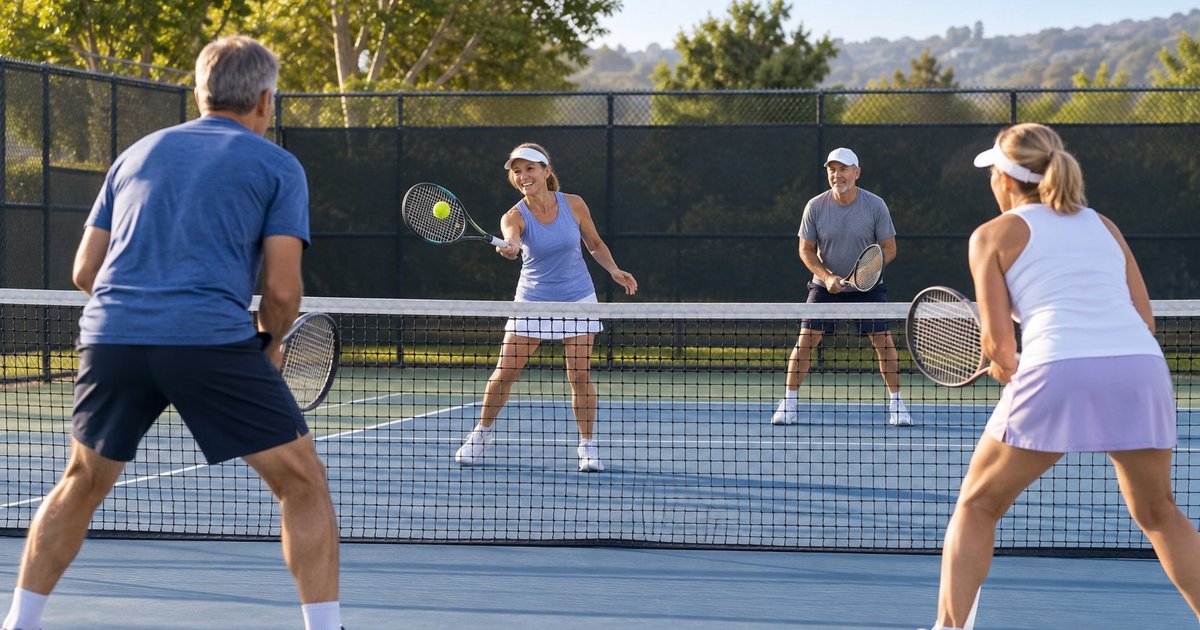
Adults can start tennis at almost any age, and the easiest route is not to buy kit or book a court straight away. Begin with a beginner group course or a social “come and try” session at a local club or leisure centre, borrow a racquet, wear proper court shoes, and play doubles once you can rally. Most areas have public courts, clubs and coaches who run sessions specifically for adults who are new or coming back after years away.
This guide includes a few product links near the end. As an Amazon Associate, michelle.net.au earns from qualifying purchases, at no extra cost to you.
This guide covers where to find courts and sessions near you, the main ways adults play (social, coached, cardio tennis and competition), what each tends to involve, the gear that actually matters, a first-month plan, the courtesies nobody tells you about, and the mistakes that make adult beginners give up or get sore.
At a glance
- Start coached, not solo: a short beginner course teaches grip, footwork and scoring, and stops habits forming that are hard to undo later.
- Shoes before racquet: tennis is full of sideways movement, and court shoes give the lateral support running shoes do not.
- Slower balls help: many adult beginner programmes use softer, lower-bounce balls so rallies happen sooner.
- Doubles is the social heart of adult tennis: less running, more conversation, and the format most club social sessions use.
- Check with your doctor first if you have a heart condition, a joint problem or have not exercised for a while. This guide is general information only.
Where to find courts, clubs and coaching
Before choosing a session, it helps to know what exists near you. Most towns and cities have three kinds of courts.
- Public or council courts: often in parks. Some are free and first-come, first-served; many now use an online booking system with a fee per hour.
- Club courts: usually reserved for members, though many clubs offer casual court hire, visitor fees or trial memberships.
- Leisure centres and sports complexes: sometimes have indoor or covered courts, which are useful in very hot, cold or wet climates.
The quickest ways to find them are your local council or municipal website, an online map search for tennis courts near you, and your national or regional tennis association, which in many countries runs a club, coach and court finder online. Club websites and social media pages usually list adult programmes under headings such as “adult tennis”, “social tennis” or “return to tennis”.
Many clubs hold open days or free “come and try” sessions at the start of a season. These are the lowest-pressure way to see whether a club suits you before paying anything.
The main ways adults play, compared
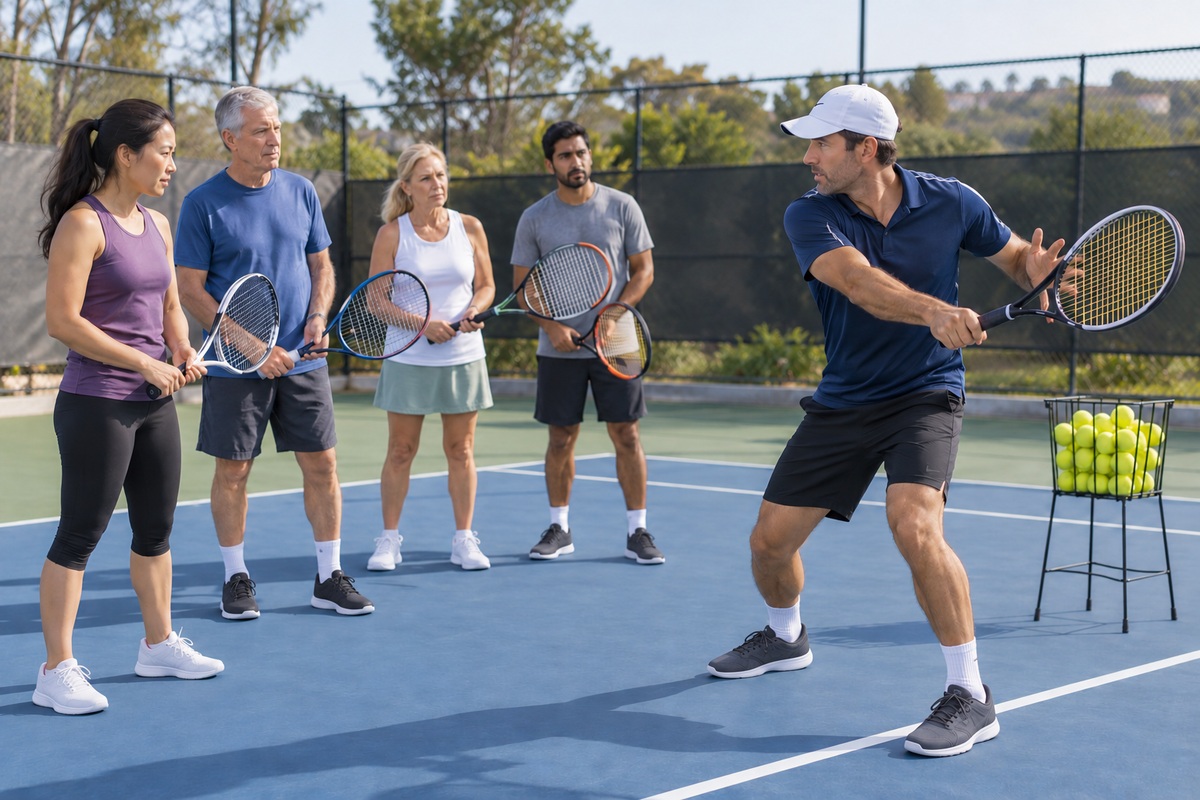
Adult tennis comes in several formats, and the right starting point depends on whether you are completely new, returning after a long break, or mainly after a sociable way to move.
| Format | What it involves | Best for | Watch out for |
|---|---|---|---|
| Beginner group course | A coach with a small group, usually weekly over a term or a set number of weeks | Complete beginners; learning grips, footwork and scoring | Less individual attention; check the group size |
| Private or semi-private lesson | One coach with one or two players | Fixing a specific stroke; returning players with old habits | Costs more per session; many adults mix it with group lessons |
| Cardio tennis | A high-energy group session of drills and short games, often set to music | Fitness and fun more than technique; people who like group classes | Fast pace; ask for an easier option if you are new to exercise |
| Social play | Turn up at a set time, get mixed into doubles, rotate partners | Meeting people once you can keep a rally going | Usually assumes you can serve and keep score |
| Competition and team play | Club ladders, championships or inter-club fixtures graded by standard | Players who rally comfortably and want a goal | A weekly commitment; check grading so matches are even |
| Casual hire with a friend | Book a public court and hit | Practice between lessons; flexible timing | Easy to practise bad habits without feedback |
Group lessons or private coaching?
Group lessons are cheaper per person, sociable and a good way to meet future hitting partners. Private coaching lets the coach focus entirely on your strokes and movement. A common and sensible pattern for adults is a group course for the basics, plus an occasional private lesson to work on whatever feels hardest.
Slower balls and smaller courts
The International Tennis Federation’s approach to starting players uses slower, lower-compression balls (often colour-coded red, orange and green) and sometimes smaller courts. Many coaches use the same idea for adult beginners: a softer ball bounces lower and travels more slowly, which gives you time to get into position and makes rallies possible far sooner. Moving to standard yellow balls comes later.
How to choose a club or coach
A good fit matters more than the fanciest facility. Use these questions when you phone, message or visit.
- Do you run sessions specifically for adult beginners or returning players?
- Can I try a lesson or a social session before joining?
- How many players are in a typical group lesson?
- Is the coach qualified or accredited with a recognised coaching body, and do they hold any first aid and working-with-children checks the club requires?
- Can I borrow a racquet for my first few sessions?
- What does membership include: court access, lights, social sessions, balls? Are there trial, off-peak, senior or family options?
- What does court hire cost for non-members, and do lights cost extra at night?
- How are social sessions organised, and do I need to book or just turn up?
- What happens if a lesson is rained out?
Costs for court hire, coaching and membership vary a great deal between countries, cities and clubs, so compare what is included rather than the headline price alone.
The gear you actually need
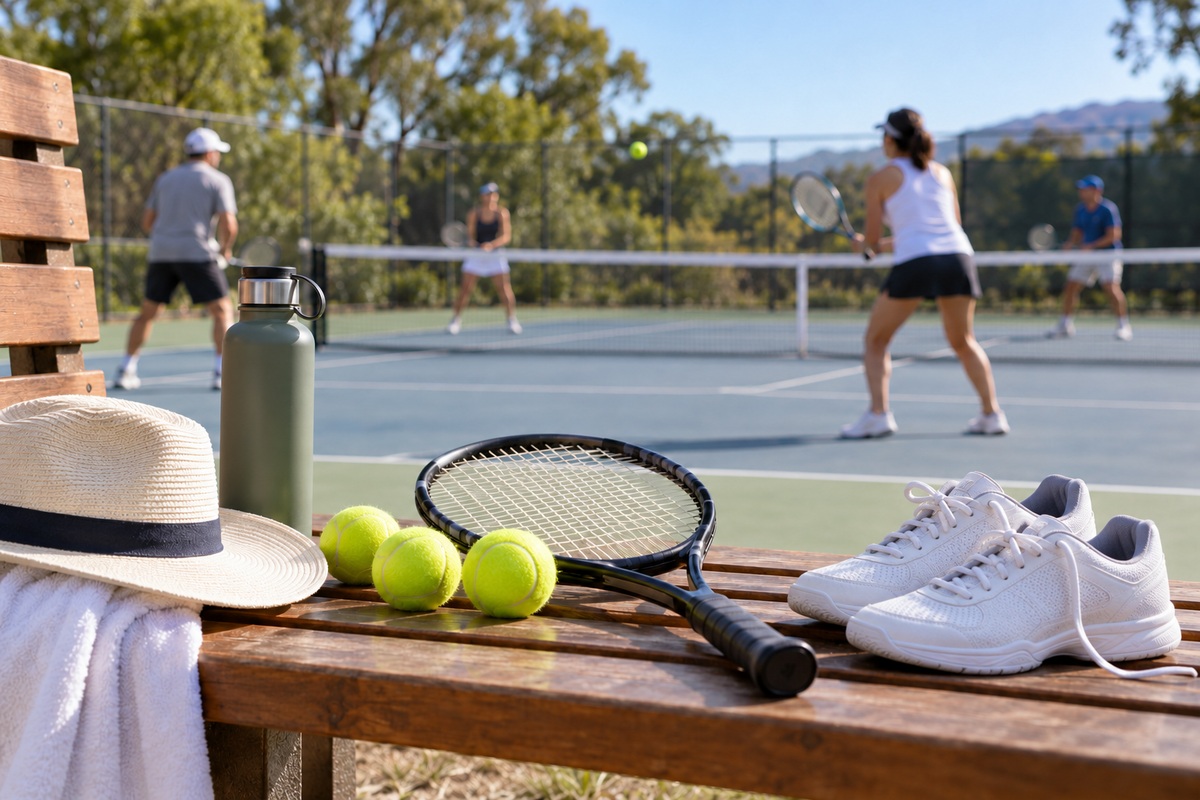
You need very little to start, and it is wise not to spend heavily until you know you will keep playing.
Shoes
Shoes matter more than the racquet. Running shoes are built mainly for forward movement; tennis involves constant side steps, stops and changes of direction. Court shoes give better lateral support and grip. Some clubs with grass or clay courts have rules about sole patterns, so check before you buy.
Racquet
Borrow one first. When you do buy, adult beginners often find a lighter racquet with a larger head more forgiving when the ball does not hit the centre of the strings. Grip size matters too: a grip that is too small or too large can make you squeeze harder. A coach or specialist shop can help you choose.
Balls, clothes and the rest
- Balls lose bounce over time; a fresh can now and then makes play easier.
- Comfortable, breathable clothing you can move in.
- For outdoor play: a hat, sunglasses and broad-spectrum sunscreen, reapplied as directed. Sun protection matters on open courts, particularly in high-UV countries such as Australia.
- A water bottle. For practical ways to work out how much you need after a hot session, see this guide to rehydrating after exercise.
Court surfaces in plain terms
A full-size court is 23.77 metres (78 feet) long and 10.97 metres (36 feet) wide for doubles, with the singles court 8.23 metres (27 feet) wide. The surface underneath changes how the ball and your body behave.
- Hard courts: the most common public surface. Predictable bounce, firm underfoot.
- Synthetic grass: sand-filled artificial turf, common at clubs because it is low-maintenance; slightly softer feel.
- Clay: loose, crushed surface that slows the ball and lets players slide. Takes some getting used to.
- Natural grass: fast and low-bouncing, and relatively rare for everyday adult play.
When you are starting out, play on whatever is closest and wear shoes suited to it.
Your first month: a simple step-by-step plan
- Week 1: find two or three options near you (club, leisure centre, public courts with a coach) and ask the questions above. Book a trial lesson or a “come and try” session.
- Week 1: if you have a health condition or have been inactive, check with your doctor before you start.
- Weeks 1 to 4: attend a beginner group course once a week. Borrow a racquet. Buy court shoes if you plan to continue.
- Weeks 2 to 4: add one relaxed practice hit a week with a friend or a hitting partner from your group, starting with “mini tennis” from the service lines.
- Before every session: warm up for five to ten minutes (see below) and finish with an easy walk and gentle stretching.
- End of month one: ask your coach whether you are ready for social doubles, cardio tennis, or another beginner block.
- Keep a light week whenever you feel sore or flat. Rest days are part of the plan, not a failure.
One or two sessions a week is plenty to begin with. For context, the World Health Organization’s guidelines suggest adults aim for 150 to 300 minutes of moderate activity a week (or 75 to 150 minutes of vigorous activity), plus muscle-strengthening activities on two or more days. Tennis can be one part of that mix, alongside the everyday movement that fills the rest of your week.
Warming up and looking after your body
Jumping straight into hard hitting is a classic adult mistake, especially after years away. A short warm-up lets your body ease into the movement.
- A few minutes of easy movement: brisk walking or a gentle jog around the court.
- Dynamic moves: arm circles, leg swings, trunk rotations and side steps.
- Mini tennis from the service lines at an easy pace, then move back to the baseline.
- A few gentle serves before you start a game.
Elbow and shoulder soreness is common in recreational players. Coaches often look at technique, grip size and string tension when this happens, so mention it early. Any pain that persists, or is sharp, swollen or worsening, is a reason to stop and see a doctor or physiotherapist.
Many adults also enjoy building some strength and balance work into their week alongside tennis. This guide to strength training and bone health explains the basics, and these balance habits for healthy ageing pair naturally with the quick steps and direction changes of doubles. For the day after a long session, see these active recovery techniques.
Tennis etiquette for newcomers
Nobody expects you to know every custom on day one, but these basics make you an easy person to play with.
- Wait for a break in play before walking behind or across a court that is in use.
- Return stray balls between points, not mid-rally, by rolling or hitting them gently back.
- Call the score clearly before you serve.
- Call the lines on your own side, and give your opponent the benefit of the doubt if you are unsure.
- Stick to your booking time and leave the court tidy.
- In doubles, talk to your partner: calling “mine” or “yours” on balls down the middle avoids clashes of racquets.
Doubles tips for beginners
- Keep the ball in play. In social doubles, consistency wins more points than power.
- Move as a pair: if your partner is pulled wide, shift across to cover the gap.
- Agree before the match who covers lobs and balls down the middle.
Who tennis suits, and who might prefer something else
Tennis tends to suit adults who enjoy learning a skill, like short bursts of movement mixed with pauses, and want a sport with a strong social side. It is less ideal if you want something you can pick up in a single session, or if quick sideways movement is uncomfortable for you right now.
Two related racquet sports are worth knowing about. Pickleball is played with a solid paddle and a light perforated plastic ball on a court 20 by 44 feet (about 6.1 by 13.4 metres), much smaller than a tennis court, and most beginners can rally in their first session. This pickleball for beginners guide covers how to start. Padel is a doubles game on an enclosed court of 20 by 10 metres, with walls the ball can bounce off and underarm serves. If racquet sports are not for you at all, this guide to making the most of your local pool offers a lower-impact option.
Common mistakes adult beginners make
- Buying an expensive racquet first. A high-end racquet designed for advanced players is often harder, not easier, to use. Borrow, then buy with advice.
- Playing in running shoes. Fine for a first try, but not for regular play with lots of side-to-side movement.
- Skipping lessons and teaching yourself. Old or self-taught habits, especially grips and serves, are hard to undo later.
- Going too hard, too soon. Long first sessions and big serves on cold muscles are a common route to sore shoulders, elbows and calves.
- Going for winners in social doubles. Partners and opponents generally prefer long rallies to big misses.
- Waiting until you are “good enough” to join a club. Most clubs want beginners, and beginner sessions exist precisely so you do not have to be good first.
- Ignoring heat and sun. Plan hot-weather play for cooler times of day, drink regularly and cover up.
Sources this guide draws on: International Tennis Federation rules of tennis (court dimensions) and its starter-ball programme guidance; World Health Organization Guidelines on Physical Activity and Sedentary Behaviour (2020); USA Pickleball official rulebook (court size); International Padel Federation regulations (court size).
Handy kit for this guide
These are practical everyday products, not supplements or medicines. As an Amazon Associate, michelle.net.au earns from qualifying purchases, at no extra cost to you. Prices and availability are set by Amazon and may vary by country.
- Gaiam Premium 5 mm Yoga Mat
Non-slip mat for yoga, Pilates, tai chi warm-ups and floor exercises.
View on Amazon - Fabric Resistance Bands (5-Band Set)
Loop bands in graded resistance for home strength exercises.
View on Amazon - Bambaw Insulated Stainless Steel Water Bottle (32 oz)
Plastic-free and keeps water cold all day, at home, on walks or at the gym.
View on Amazon
Frequently asked questions
Am I too old to start playing tennis?
Adults take up tennis at every stage of life, and many clubs have members playing well into later years. Start with a beginner programme or slower-ball sessions, build up gradually, and check with your doctor first if you have a heart condition, joint problems or have been inactive.
How many lessons does an adult beginner need?
There is no fixed number, but many adults find a beginner course over several weeks gives them enough grip, footwork and scoring knowledge to enjoy social doubles. Your coach can tell you when you are ready to move on, and an occasional private lesson can help with any stroke that is not clicking.
Do I need to join a club to play tennis?
No. You can book public courts with a friend, join a leisure centre course or attend casual sessions. A club simply makes it easier to find regular partners, organised social play and competitions.
What if I do not have anyone to play with?
Social sessions, group lessons and cardio tennis are designed for people who come along on their own. Group courses are also the easiest place to find a hitting partner at your level.
Is cardio tennis good for beginners?
Cardio tennis does not require good technique, so beginners can join, but it is fast-paced. If you are new to exercise, tell the coach so they can offer easier options, and consider a technique course alongside it.
Is singles or doubles better for beginners?
Most adult beginners find doubles easier and more sociable because there is less ground to cover. Singles is a good challenge later if you enjoy the running.
Getting started
Tennis asks for very little at the start: good shoes, a borrowed racquet and a beginner session you can actually get to. Find the nearest courts, ask a few questions, book a trial and build up gently. The skills come with time, and the social side often arrives much sooner.