
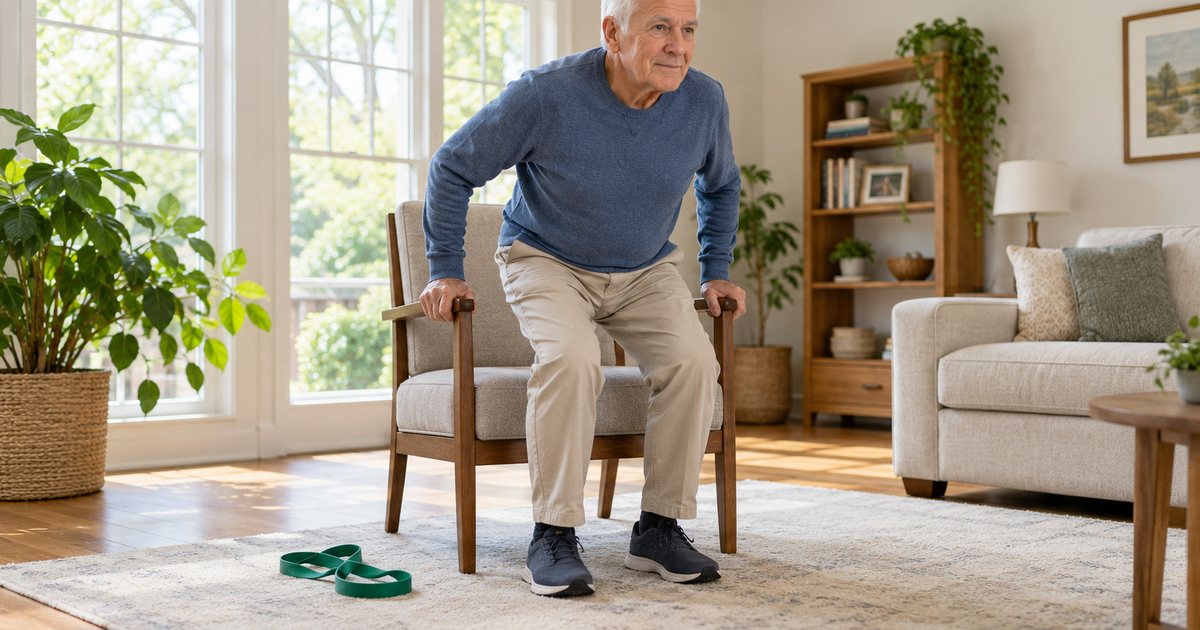
Sarcopenia is the loss of muscle strength, muscle mass and physical function that can happen with age, and resistance training is the approach with the strongest research behind it. A Cochrane review of 121 trials in older adults found that progressive resistance training, usually two to three times a week, produced large gains in muscle strength and smaller gains in everyday physical function such as walking speed and rising from a chair.
This guide includes a few product links near the end. As an Amazon Associate, michelle.net.au earns from qualifying purchases, at no extra cost to you.
This guide explains what sarcopenia is and how it is assessed, what the trials of resistance training in older adults actually measured, and a beginner-friendly progression using bodyweight and bands. Protein is covered separately in how much protein after 40, and bone health in strength training and bone density, so this page focuses on muscle.
At a glance
- What sarcopenia is: a recognised muscle condition defined mainly by low muscle strength, confirmed by low muscle quantity or quality, and rated severe when physical performance is also low.
- How it is checked: simple tests such as grip strength and timing five rises from a chair, followed by body composition scans if needed.
- What resistance training research shows: large improvements in strength, a moderate to large improvement in chair-rise ability, and a modest improvement in walking speed.
- How much: the World Health Organization advises older adults to do muscle-strengthening activity on two or more days a week.
- Check first: talk to your doctor or a physiotherapist before starting if you have heart, joint or balance problems, or have been inactive for a long time.
What is sarcopenia?
Muscle mass and strength peak in early adulthood and gradually decline from midlife. For some people the decline is steep enough to affect daily life: climbing stairs, carrying shopping, getting up from a low chair or recovering from a stumble. When that happens, it may be sarcopenia.
The most widely used definition comes from the European Working Group on Sarcopenia in Older People, whose updated consensus (known as EWGSOP2) was published in Age and Ageing in 2019, led by Alfonso Cruz-Jentoft. A key change in that update was to put muscle strength, rather than muscle size, at the centre of the definition, because strength is a better guide to how well people function.
The three stages in EWGSOP2
| Stage | What it means | Example measures and cut-offs |
|---|---|---|
| Probable sarcopenia | Low muscle strength | Grip strength under 27 kg for men or under 16 kg for women, or taking more than 15 seconds to rise from a chair five times |
| Confirmed sarcopenia | Low strength plus low muscle quantity or quality | Measured with body composition scans such as DXA, for example appendicular muscle mass relative to height squared under 7.0 kg/m² for men or 5.5 kg/m² for women |
| Severe sarcopenia | All of the above plus low physical performance | Walking speed of 0.8 metres per second or slower, a Timed Up and Go of 20 seconds or more, or a Short Physical Performance Battery score of 8 or less |
These cut-offs were set for European populations; other expert groups, such as the Asian Working Group for Sarcopenia, use different values. Assessment should be done by a health professional, who will also consider other causes of weakness.
Why muscle declines with age
Several things contribute, and they often act together:
- Less activity: muscles that are not challenged gradually shrink, and periods of illness or bed rest can speed this up.
- Changes in nerves and muscle fibres: the fast, powerful fibres used for quick movements tend to decline more.
- Hormonal changes: including those around menopause in women and gradual changes in men.
- Nutrition: low overall food intake and low protein intake are common in older adults.
- Chronic health conditions and some medicines, which can affect appetite, activity and muscle.
Weak legs in older age: when to see a doctor
Leg weakness is not always sarcopenia. It can also come from nerve problems, joint disease, circulation problems, side effects of medicines, low thyroid function, vitamin deficiencies and other conditions. See your doctor promptly if weakness comes on suddenly, affects one side, is accompanied by numbness, pain or falls, or is getting worse quickly.
What the resistance training research shows
Resistance training means making muscles work against a load, such as bodyweight, bands, dumbbells or machines. “Progressive” means gradually increasing the challenge as you get stronger.
| Source | What it covered | Key findings |
|---|---|---|
| Liu and Latham, Cochrane review of progressive resistance training in older adults (search to 2008) | 121 randomised trials, about 6,700 participants; most trained two to three times a week | Large improvement in strength; moderate to large improvement in chair-rise time; walking speed improved by about 0.08 metres per second; small improvement in overall physical function. Adverse events were poorly recorded |
| International Conference on Sarcopenia and Frailty Research (ICFSR) clinical practice guidelines, 2018 | Expert guideline for identifying and managing sarcopenia | Strongly recommended prescribing resistance-based physical activity as the first-line approach |
| World Health Organization guidelines on physical activity, 2020 | Global guidelines for adults 65 and over | Muscle-strengthening activity involving all major muscle groups on two or more days a week, plus varied balance and strength activity on three or more days a week |
| Australia’s Physical Activity and Exercise Guidelines for older Australians | National guidelines for people 65 and over | Be active on most, preferably all, days and include activities that build fitness, strength, balance and flexibility |
How to read the research
- The strongest evidence is for improved strength. Gains in everyday function were smaller but still meaningful in tasks such as rising from a chair.
- Most trials were supervised, which helps people progress safely and stick with it.
- The Cochrane authors noted that adverse events were poorly reported. Muscle soreness and joint discomfort were common where they were tracked; serious problems were rare.
- Results for people with significant health conditions should be applied with care, which is why a check with your doctor or physiotherapist is sensible.
Before you start: check with your doctor first
- You have a heart or lung condition, high blood pressure, diabetes or osteoporosis.
- You have had recent surgery, a fall or an injury.
- You have joint pain, a hernia or a back problem.
- You get chest pain, dizziness or unusual breathlessness when active.
- You have been inactive for a long time and are unsure where to begin.
A physiotherapist or accredited exercise physiologist can assess your starting point and tailor a programme. In many countries, community health services offer subsidised strength classes for older adults.
A beginner-friendly progression with bodyweight and bands
This is a general example, not an individual prescription. Move slowly and with control, breathe out during the effort, and stop if you feel sharp pain, dizziness or chest discomfort.
- Weeks 1 to 2: learn the movements. Two sessions a week, one set of 8 to 10 repetitions of each exercise: sit-to-stand from a sturdy chair (hands on thighs if needed), wall push-ups, seated knee extensions, standing calf raises holding a bench, and seated band rows.
- Weeks 3 to 4: add a second set. Keep the same exercises and rest a minute or two between sets.
- Weeks 5 to 6: make it harder. Use a slightly lower chair for sit-to-stands or stop using your hands, move from wall to bench push-ups, and step up to a firmer band. Aim for the last two repetitions of each set to feel hard but manageable.
- Weeks 7 to 8: add exercises. Include step-ups onto a low step with support, band side steps and a light carry (shopping bags or water bottles).
- After 8 weeks: keep progressing. Increase resistance gradually, consider three sessions a week, or join a supervised strength class or gym programme designed for older adults.
Choosing the right bands is covered in resistance bands for seniors, and gentle starter moves are in 10 easy exercises for seniors.
Comparing your training options
| Option | Good for | Watch out for |
|---|---|---|
| Bodyweight at home | Starting out, no cost, functional moves like sit-to-stand | Can become too easy; progress by changing chair height, tempo or range |
| Resistance bands | Cheap, portable, easy to progress | Check bands for wear; anchor them securely |
| Dumbbells or ankle weights | Precise, gradual increases | Start light and focus on control |
| Gym machines | Stable, guided movement and easy load changes | Ask staff to set seat positions and show you technique |
| Supervised classes or physiotherapy | Tailored programmes, feedback, motivation | Costs vary; ask about subsidised community options |
Where protein and other habits fit
Exercise and nutrition work together. Adequate protein spread across the day supports the muscle-building response to training, and the details are in the protein after 40 guide rather than repeated here. Some people also ask about creatine; the evidence is summarised in creatine after 50. Balance work matters as well, because strength and balance together keep you steady; see balance habits for healthy ageing. Aerobic activity rounds out the picture, as covered in aerobic exercise for older adults.
Menopause and muscle loss
Many women notice changes in strength and body composition around menopause, as hormone levels change. The same principles apply: regular, progressive resistance training on two or more days a week, adequate protein, and a check with your doctor about any other symptoms.
Common mistakes
- Thinking walking alone is enough. Walking is valuable for the heart, but it does not challenge muscles enough to build much strength.
- Starting too hard. Doing too much in the first week leads to soreness and quitting; build up gradually.
- Never progressing. If every set feels easy, your muscles have adapted; increase the challenge.
- Training only the arms. Leg strength matters most for standing up, stairs and steadiness.
- Holding your breath. Breathe out during the effort and keep breathing.
- Stopping after illness. Muscle is lost quickly during bed rest; ask your doctor when and how to restart.
- Assuming weakness is just age. Unexplained or rapid weakness should be checked by a doctor.
Sources this guide draws on: Cruz-Jentoft AJ and colleagues, “Sarcopenia: revised European consensus on definition and diagnosis” (EWGSOP2), Age and Ageing, 2019; Liu CJ and Latham NK, Cochrane review of progressive resistance strength training for improving physical function in older adults; Dent E and colleagues, ICFSR international clinical practice guidelines for sarcopenia, Journal of Nutrition, Health and Aging, 2018; World Health Organization guidelines on physical activity and sedentary behaviour, 2020; Australian Government Physical Activity and Exercise Guidelines for older Australians.
Handy kit for this guide
These are practical everyday products, not supplements or medicines. As an Amazon Associate, michelle.net.au earns from qualifying purchases, at no extra cost to you. Prices and availability are set by Amazon and may vary by country.
- Fabric Resistance Bands (5-Band Set)
Loop bands in graded resistance for home strength exercises.
View on Amazon - Amazon Basics Vinyl Coated Hand Weights
Easy-grip hand weights in a range of sizes for home workouts.
View on Amazon - Gaiam Premium 5 mm Yoga Mat
Non-slip mat for yoga, Pilates, tai chi warm-ups and floor exercises.
View on Amazon
Frequently asked questions
Can resistance training reverse sarcopenia?
Trials in older adults show resistance training can produce large gains in muscle strength and improvements in tasks such as rising from a chair, even in very old age. Whether that moves a person out of the sarcopenia range depends on their starting point and health, so a doctor or physiotherapist is the best person to track progress.
What are the best sarcopenia exercises?
Exercises that load the major muscle groups, especially the legs, are the core: sit-to-stands, step-ups, calf raises, push-ups against a wall or bench, and rows with a band. The most important factors are regularity and gradually increasing the challenge.
How often should older adults do resistance training?
The World Health Organization advises muscle-strengthening activity on two or more days a week for older adults. Most trials in the Cochrane review used two to three sessions a week.
Is it ever too late to start strength training?
Trials have included people in their 80s and 90s, and many showed strength gains. Starting gently, ideally with guidance from a physiotherapist or exercise physiologist, is the safest approach at any age.
How is sarcopenia diagnosed?
Usually with a grip strength test or a timed chair-stand test first, then a body composition scan to measure muscle, and walking speed or other performance tests to rate severity. Your doctor will also look for other causes of weakness.
Muscle loss with age is common, but it is not a one-way street. Regular, progressive resistance training, started safely and built up steadily, is the approach with the strongest evidence for keeping you strong for the things you want to do.