
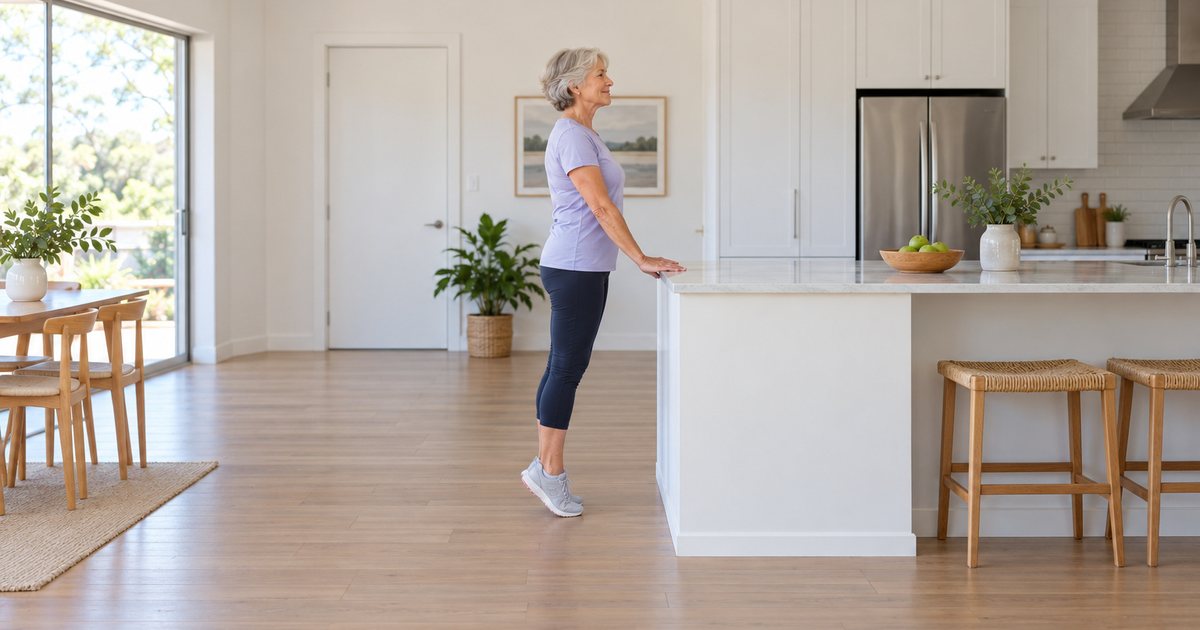
The best easy exercises for seniors at home cover three things: strength (such as standing up from a chair), balance (such as standing on one leg while holding a bench) and mobility (such as gentle ankle and trunk movements). The World Health Organization’s 2020 guidelines suggest older adults do activities that combine balance and strength on three or more days a week, and muscle-strengthening activities on at least two. A short routine at home, started gently and built up slowly, is one practical way to work towards that.
This guide includes a few product links near the end. As an Amazon Associate, michelle.net.au earns from qualifying purchases, at no extra cost to you.
This guide gives you ten low impact moves, each with a “start here” version and a “progress to” version, plus a simple weekly plan, clear stop signs, and the mistakes that most often hold people back. It is general education, not a personal program, so check with your GP or a physiotherapist before you begin, especially if you have a health condition, recent surgery or a history of falls.
At a glance
- Aim for a mix of strength, balance and mobility rather than one type only.
- WHO and Australia’s guidelines both suggest balance and strength work on three or more days a week for adults 65 and over.
- Start with the supported version of each move and progress only when it feels steady and comfortable.
- Always have a sturdy chair, bench or kitchen counter within reach for balance moves.
- Stop and seek medical help for chest pain, unusual breathlessness, dizziness or sudden sharp pain.
What the guidelines recommend for older adults
National and international guidelines broadly agree. They ask older adults to move most days, build strength and practise balance, and both stress breaking up long periods of sitting.
| Guideline | Aerobic activity | Strength | Balance and functional activity |
|---|---|---|---|
| World Health Organization (2020), adults 65 and over | 150 to 300 minutes of moderate activity a week, or 75 to 150 minutes vigorous | At least 2 days a week | Varied activities combining balance and strength on 3 or more days a week |
| Australia’s guidelines for older adults (65 and over) | At least 30 minutes of moderate to vigorous activity on most days | 2 or more days a week | Balance, mobility and coordination activities on 3 or more days a week |
The routine below focuses on the strength and balance parts. For walking, swimming and other aerobic options, see this site’s guide to aerobic exercise for older adults, and for more ways to sit less during the day, sitting too much? the simple way to move more.
Why it is important to ease into an exercise program
Muscles adapt within weeks, but tendons, joints and balance systems take longer, and confidence takes longest of all. Starting too hard is one of the most common reasons people stop. Easing in lets you learn the movements safely, notice how your body responds over the following day, and build a habit you can keep. It also gives your GP or physio a chance to flag anything that needs adapting, such as a replaced hip or a heart condition.
A sensible approach is to begin with one set of each move, a few repetitions, on two or three days a week, and add a little only when the current level feels easy for a full week.
Before you start: a safety checklist
- Speak with your GP or physiotherapist if you have heart, lung or joint conditions, have had recent surgery, have fallen in the past year, or feel unsteady.
- Choose a clear, well-lit space with no rugs or cords to trip on.
- Use a solid chair without wheels, placed against a wall, and a sturdy counter or bench for support.
- Wear supportive, closed shoes rather than socks or slippers.
- Keep water and a phone within reach.
- Warm up with two to three minutes of marching on the spot (seated or standing) and arm swings.
- Breathe normally throughout; do not hold your breath while you push or lift.
Stop signs
Stop exercising and seek medical help if you notice chest pain or tightness, breathlessness that is unusual for you, dizziness or light-headedness, a racing or irregular heartbeat, or sudden sharp pain in a joint. Mild muscle tiredness or slight soreness the next day is normal; pain that lingers or gets worse is a reason to stop and check with a health professional.
The ten moves: start here and progress to
Do the moves in order. Each has an easier version to begin with and a harder one to work towards over weeks or months.
Strength
| Move | What it works | Start here | Progress to |
|---|---|---|---|
| 1. Sit to stand | Thighs and hips; getting out of chairs and cars | Stand up from a firm chair using your hands on the armrests, then sit down slowly | Stand up with arms crossed over your chest, using a lower chair as strength improves |
| 2. Wall push-up | Chest, shoulders and arms; pushing and carrying | Hands on the wall at shoulder height, feet close to the wall, bend elbows and push back | Step your feet further back, or progress to a sturdy kitchen bench |
| 3. Heel raises | Calves and ankles; walking and stairs | Hold the bench with both hands, rise onto your toes and lower slowly | Hold with one hand, or fingertips only |
| 4. Seated knee extension | Front of thighs; knee strength for stairs | Sitting tall, straighten one knee, hold for a count of two, lower slowly | Hold for longer, or add a light ankle weight as advised by a physio |
| 5. Side leg raise | Outer hip; side-to-side stability | Hold the bench, lift one leg out to the side a short way, keep your body upright | Lift a little higher and lower more slowly, or loop a light resistance band above the knees |
Begin with 5 to 8 slow repetitions of each strength move and build towards 10 to 15. If you want to add resistance, this site’s guide to resistance bands for seniors explains how to choose the right level. These leg exercises for seniors are also the ones most often used in research on strength and bone; see strength training and bone density for what those studies looked at.
Balance
| Move | What it works | Start here | Progress to |
|---|---|---|---|
| 6. Supported single-leg stand | Standing balance; stepping into the shower or onto a kerb | Hold the bench with both hands, lift one foot just off the floor, hold for up to 10 seconds | Hold with one hand, then fingertips, building towards 30 seconds |
| 7. Heel-to-toe walk | Walking balance; narrow paths and crowds | Walk along the counter with one hand on it, placing one foot in front of the other | Walk with a hand hovering just above the counter, eyes looking ahead |
| 8. Side-stepping | Sideways balance; reacting to a bump or trip | Facing the counter, hold on and take small steps to the side and back | Take larger steps, or step over a rolled-up towel |
Always do balance moves next to support, never in the middle of the room. For daily habits that support balance outside of exercise sessions, see balance habits for healthy ageing.
Mobility
| Move | What it works | Start here | Progress to |
|---|---|---|---|
| 9. Seated trunk rotation | Upper back; looking over your shoulder, reaching behind | Sit tall, cross arms over your chest and gently turn to one side, then the other | Turn a little further while keeping hips facing forward, holding for a few breaths |
| 10. Ankle circles and calf stretch | Ankle movement; walking smoothly | Seated, circle each ankle slowly in both directions | Standing at the wall, step one foot back and gently stretch the calf for 20 to 30 seconds |
A simple weekly plan
This is a starting template, not a prescription. Adjust it with your GP or physio.
| Week | Days | What to do |
|---|---|---|
| Weeks 1 to 2 | 2 to 3 non-consecutive days | Warm-up, then one set of each move at the “start here” level, 5 to 8 repetitions or short holds |
| Weeks 3 to 4 | 3 days | Two sets of strength moves; balance holds a little longer |
| Weeks 5 to 8 | 3 days, plus balance moves on other days if you like | Move one or two exercises to the “progress to” level when they feel easy |
| Ongoing | 3 or more days | Keep progressing slowly; add walking or another low impact workout for seniors on most days |
A full session at the start takes about 15 to 20 minutes. Many people find it easier to attach it to an existing habit, such as after morning tea.
How structured home programs have been studied
One of the best known home routines is the Otago Exercise Programme, developed in New Zealand. It combines a set of leg strengthening and balance exercises with walking, done about three times a week, and it is prescribed and progressed by a trained health professional such as a physiotherapist. According to the US National Council on Aging, studies of the program in older adults at higher risk of falling have reported around 35 to 40 per cent fewer falls. That result comes from a supervised, tailored program, so ask your GP whether a referral to a physio or a community falls program is available where you live.
Who this routine suits, and who needs a tailored plan
- Likely suits: older adults who can stand up from a chair and walk around the house independently, and who want a gentle home routine.
- Check first: people with heart or lung conditions, osteoporosis, joint replacements, recent surgery, or diabetes affecting the feet.
- Needs a tailored plan: anyone who has fallen recently, uses a walking frame, feels dizzy when standing, or cannot stand without help. A physio can design safer options, often starting fully seated.
Common mistakes
- Doing balance moves without support. Always keep a counter or sturdy chair within reach.
- Rushing the repetitions. Slow, controlled movement builds more strength and is safer than speed.
- Holding your breath. Breathe out as you push or stand.
- Progressing too fast. Stay at a level for at least a week before stepping up.
- Only doing strength or only doing stretches. Guidelines emphasise combining strength and balance.
- Skipping recovery days. Rest days between strength sessions matter; see active recovery for gentle options.
- Forgetting food. Muscles need protein to adapt; protein and muscle after 40 explains why.
Related guide: Printable Chair Yoga for Seniors: 10 Simple, Safe Moves.
Sources this guide draws on: World Health Organization, Guidelines on physical activity and sedentary behaviour (2020); Australian Government Department of Health, Physical activity recommendations for older adults (65 years and over); National Council on Aging, summary of the Otago Exercise Programme.
Handy kit for this guide
These are practical everyday products, not supplements or medicines. As an Amazon Associate, michelle.net.au earns from qualifying purchases, at no extra cost to you. Prices and availability are set by Amazon and may vary by country.
- Gaiam Premium 5 mm Yoga Mat
Non-slip mat for yoga, Pilates, tai chi warm-ups and floor exercises.
View on Amazon - Fabric Resistance Bands (5-Band Set)
Loop bands in graded resistance for home strength exercises.
View on Amazon - Bambaw Insulated Stainless Steel Water Bottle (32 oz)
Plastic-free and keeps water cold all day, at home, on walks or at the gym.
View on Amazon
FAQ
What are the easiest exercises for seniors to start with?
Supported sit to stand, wall push-ups, heel raises holding a bench, and seated ankle circles are gentle starting points for many people. Begin with a few slow repetitions and check with your GP or physio if you have any health conditions.
How often should older adults do strength and balance exercises?
WHO and Australian guidelines suggest muscle-strengthening on at least two days a week and balance and functional activities on three or more days. Starting with two or three short sessions a week and building up is a common approach.
Are these low impact exercises safe for people with arthritis?
Many people with arthritis use similar low impact movements, but the right version depends on which joints are affected. A physiotherapist can adapt the moves so they suit you.
Can I do these exercises sitting down?
Several moves, such as seated knee extensions, trunk rotations and ankle circles, are done seated already. A physio can suggest seated alternatives for the standing moves if standing is not safe for you yet.
How long until exercise feels easier?
There is no fixed timeline, because it depends on your starting fitness, health and how regularly you practise. Steady, regular sessions that build up gradually matter more than occasional hard ones.
Easy exercises for seniors work best when they are regular, supported and built up slowly. Pick a time, set up your chair and counter, and talk to your GP or physio about the version that suits you.