
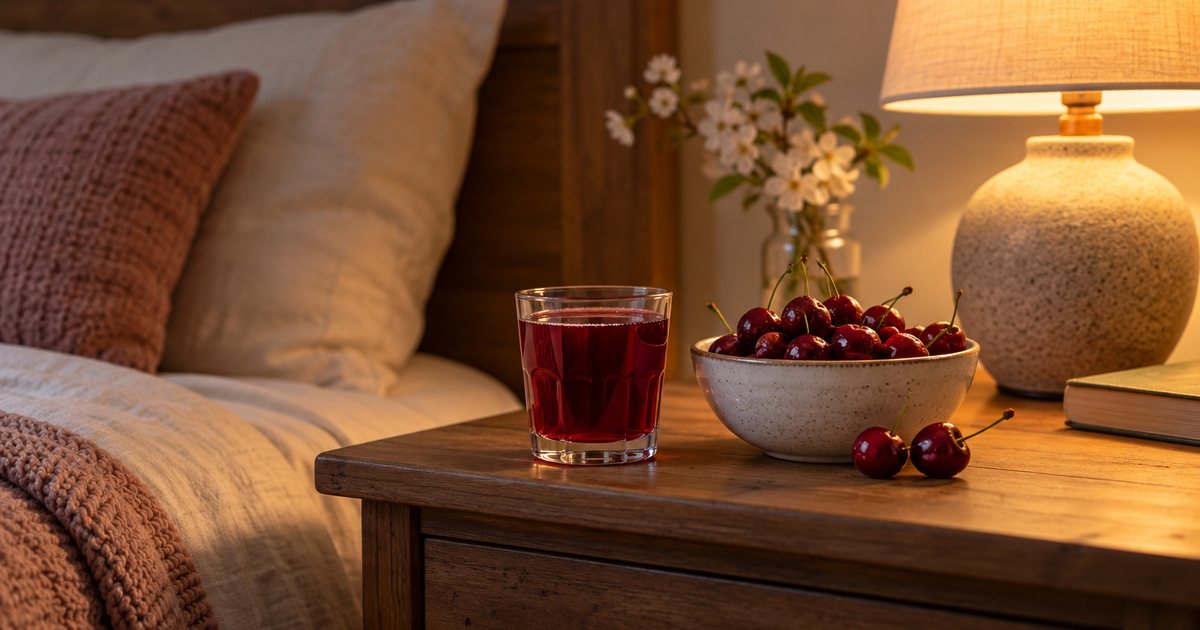
Does tart cherry juice help sleep? A handful of small studies suggest it might make a modest difference for some people, but the evidence is limited: most trials involved fewer than 25 people, lasted one or two weeks, and used specific products. A 2025 systematic review concluded that tart cherry may improve sleep quality but that the evidence is still limited and inconsistent.
This guide includes a few product links near the end. As an Amazon Associate, michelle.net.au earns from qualifying purchases, at no extra cost to you.
This guide puts every key human trial in one table with its size, who took part, the product used and what was measured. It then compares tart cherry juice, concentrate and capsules, including the sugar question that most product pages skip. For general sleep habits as you age, see the separate guide to sleep and ageing; this page sticks strictly to tart cherries.
At a glance
- Small studies only: the best-known trials enrolled 8, 15 and 20 people.
- Mixed results: some sleep measures improved compared with placebo, while many others did not.
- Melatonin is part of the story: tart cherries contain small amounts of natural melatonin, and one trial reported higher melatonin levels in urine, but the mechanism is not settled.
- Sugar matters: even unsweetened tart cherry juice is naturally high in fruit sugar, and trial amounts added up to a lot of juice.
- Talk to your doctor about ongoing sleep problems, and about tart cherry products if you have diabetes, another long-term condition or take regular medicines.
What are tart cherries?
Tart cherries (Prunus cerasus), also called sour cherries, are a different species from the sweet cherries most people eat fresh. Montmorency is the best-known tart cherry variety and the one used in most of the sleep research. Tart cherries are rarely eaten raw because of their sharp taste; they are usually sold as juice, concentrate, dried fruit, frozen fruit or powder in capsules.
Researchers have been interested in tart cherries for sleep for two main reasons. They contain small amounts of melatonin, the hormone involved in the body’s sleep and wake timing, and they are rich in polyphenols such as anthocyanins (which give them their deep red colour) and procyanidins.
Tart cherry juice and sleep: every key trial in one table
| Study | Who took part | Product and duration | What was measured | What was reported |
|---|---|---|---|---|
| Pigeon and colleagues, Journal of Medicinal Food, 2010 | 15 adults aged 65 and over (average about 72) with chronic insomnia, otherwise healthy | Tart cherry juice blend, two 8 oz (about 240 ml) serves a day for 2 weeks vs a sugar-matched placebo drink, crossover | Sleep diaries, insomnia severity scale | Insomnia severity and time awake after falling asleep were lower than with placebo; time to fall asleep, total sleep time and sleep efficiency did not differ significantly from placebo. Authors called the effects modest. Funded by the juice maker. |
| Howatson and colleagues, European Journal of Nutrition, 2012 | 20 healthy adults | Tart cherry juice concentrate for 7 days vs placebo, double-blind crossover | Wrist-worn activity monitor (actigraphy), sleep questionnaires, urinary melatonin | Reported higher urinary melatonin and longer measured sleep time with tart cherry concentrate |
| Losso and colleagues, American Journal of Therapeutics, 2018 | 11 randomised, 8 completed; all over 50 with insomnia (3 excluded for sleep apnoea) | Montmorency tart cherry juice, 240 ml twice a day for 2 weeks vs placebo, crossover | Overnight sleep laboratory recording (polysomnography), five questionnaires, blood markers | Total sleep time measured in the lab was about 84 minutes longer; one questionnaire measure improved, four showed no significant difference |
| Barforoush and colleagues, Food Science and Nutrition, 2025 (systematic review) | 7 intervention studies | Varied products, doses and durations | Sleep measures, melatonin, inflammatory markers | Three studies reported improved sleep measures and three reported higher melatonin; authors said evidence is limited and inconsistent and called for better-designed trials |
How to read these studies
- Tiny samples: the Losso pilot analysed 8 people. A difference seen in 8 people can easily disappear in a larger group.
- Short durations: one to two weeks tells us little about longer-term use.
- Mixed outcomes: in each trial, some measures improved and others did not. Headlines usually report only the positive one.
- Different populations: older adults with insomnia and healthy younger adults may respond differently.
- Funding: the Pigeon trial was funded entirely by the company that made the juice. That does not make it wrong, but independent replication matters.
- Comparison with proven approaches: the Pigeon authors noted that the effects they saw were smaller than those of established insomnia approaches such as cognitive behavioural therapy for insomnia (CBT-I) and sleep medicines.
Do cherries help you sleep? The melatonin question
Many product pages say tart cherries “raise melatonin”. The reality is more cautious. Tart cherries do contain melatonin, but in small amounts, and the content varies between batches and products. The Howatson trial reported higher levels of a melatonin breakdown product in urine during the tart cherry phase, which is consistent with cherries adding some melatonin. The Losso pilot explored a different idea: that procyanidins in the juice might affect how the body uses tryptophan, an amino acid the body uses to make serotonin and melatonin. Both explanations are still at the research stage.
If you are curious about other options studied for sleep, the guide on magnesium glycinate and sleep takes the same evidence-first approach.
Who the research does and does not cover
It helps to be clear about who was actually studied before deciding whether the findings are relevant to you.
- Covered, in small numbers: otherwise healthy adults over 50 or 65 with long-standing insomnia (the Pigeon and Losso pilots), and healthy adults without sleep problems (the Howatson trial).
- Largely not covered: people with sleep apnoea, restless legs, chronic pain, depression or anxiety, shift workers, people taking sleep medicines, and people with diabetes.
- Not studied over the long term: none of the main trials ran for longer than two weeks per phase.
If you fall into one of the groups that has not been studied, the trial results tell you very little about what to expect, and a conversation with your doctor matters even more.
Juice vs concentrate vs capsules
Tart cherry products come in several forms, and the label tells you different things for each.
| Form | What it is | Used in sleep trials? | Sugar and label points |
|---|---|---|---|
| Unsweetened tart cherry juice | Pressed juice, sometimes “not from concentrate” | Yes (Losso used 240 ml twice a day) | Naturally high in fruit sugar even with nothing added; check sugars per serve on the panel |
| Tart cherry juice blends | Tart cherry mixed with other juices such as apple | Yes (Pigeon used a blend) | Check the percentage of tart cherry; other juices add sugar and dilute the cherry content |
| Tart cherry concentrate | Juice with most of the water removed, diluted at home | Yes (Howatson) | Serve sizes are small, but sugar per serve can still be significant; follow the dilution on the label |
| Tart cherry capsules or pills | Dried tart cherry powder or extract | Far less studied for sleep | Little sugar, but the amount of cherry per capsule varies and may not match the trials |
| Dried or frozen tart cherries | Whole fruit | Not the focus of the main sleep trials | Dried cherries are often sweetened; check the ingredients |
The sugar question
Tart cherry juice is often marketed as “unsweetened”, which means no sugar was added, not that it is low in sugar. Fruit juice concentrates the natural sugars of the fruit. The trial amounts were substantial: two 240 ml serves a day adds up to nearly half a litre of juice. For people managing their weight, blood glucose, dental health or diabetes, that is worth discussing with a doctor or dietitian before trying it. Compare sugars per serve on the nutrition panel, and compare products using the same serve size.
How to compare labels quickly
- Find the serve size the manufacturer uses and convert it to the amount you would actually drink.
- Read the sugars line for that serve, not just the per 100 ml column.
- Check the ingredients for added juices, sweeteners or “cherry flavour”.
- For concentrates, check how much water the label says to add, so you compare like with like.
- For capsules, look for the amount of tart cherry powder or extract per capsule and what it is equivalent to, if stated.
Before you try tart cherry: a checklist
- See your doctor about ongoing sleep problems. Persistent insomnia, loud snoring, pauses in breathing or daytime sleepiness need proper assessment; the Losso trial excluded three people who turned out to have sleep apnoea.
- Check medicines with your pharmacist, especially if you take medicines for diabetes, blood pressure, sleep or blood thinning, or have a long-term health condition.
- Read the label: confirm it is tart (sour) cherry, ideally Montmorency, and check the percentage of tart cherry in blends.
- Check sugars per serve and think about how it fits your daily intake.
- Watch for added ingredients such as melatonin, herbs or sweeteners in “sleep” products; melatonin is regulated as a medicine in some countries, including Australia.
- Keep realistic expectations. The research shows small, inconsistent effects in small groups, not a reliable sleep solution.
- Keep a simple sleep diary if you try it, so you can discuss real patterns with your doctor rather than impressions.
Common mistakes
- Believing the headline number. “84 extra minutes of sleep” came from 8 people over two weeks.
- Confusing sweet and tart cherries. The research used tart (sour) cherries, not the sweet cherries sold fresh.
- Assuming “unsweetened” means low sugar. It means no added sugar; natural fruit sugar remains.
- Assuming capsules match the juice trials. Most sleep research used juice or concentrate.
- Using it instead of getting checked. Ongoing sleep problems can have medical causes that need diagnosis.
- Stacking sleep products. Combining tart cherry with melatonin, herbs or sleep medicines without advice can cause problems.
Sleep often changes with age, and normal changes are explained in how sleep changes as you age. If you nap during the day, the guide to nap length may help, and for food more broadly, anti-inflammatory foods looks at what the research on fruit and vegetables does and does not show. For checking any product, see how to read a supplement label.
Sources this guide draws on: Pigeon WR and colleagues, pilot study of tart cherry juice in older adults with insomnia, Journal of Medicinal Food, 2010; Howatson G and colleagues, tart cherry juice and melatonin levels and sleep quality, European Journal of Nutrition, 2012; Losso JN and colleagues, pilot study of tart cherry juice in insomnia, American Journal of Therapeutics, 2018; Barforoush F and colleagues, systematic review of tart cherry and sleep, Food Science and Nutrition, 2025.
Handy kit for this guide
These are practical everyday products, not supplements or medicines. As an Amazon Associate, michelle.net.au earns from qualifying purchases, at no extra cost to you. Prices and availability are set by Amazon and may vary by country.
- The Blue Zones Kitchen by Dan Buettner
100 everyday recipes built around beans, greens and whole grains.
View on Amazon - The Complete Mediterranean Cookbook (America’s Test Kitchen)
500 kitchen-tested recipes with plenty of fish, legumes and vegetables.
View on Amazon - Etekcity Digital Kitchen Scale
Reads in grams, handy for portions, recipes and checking a scoop against a label.
View on Amazon
Frequently asked questions
Does tart cherry juice really help you sleep?
A few small trials reported improvements in some sleep measures, such as time awake during the night or total sleep time, but other measures did not change. A 2025 systematic review described the evidence as limited and inconsistent. It is reasonable to call it promising but unproven.
What is Montmorency tart cherry juice?
Montmorency is a variety of tart (sour) cherry and the one used in most sleep research. Labels that say “Montmorency” tell you the variety, but not how much cherry is in the product or how it was processed.
Is tart cherry concentrate better than juice?
Not necessarily. Concentrate is juice with most of the water removed, so you use a small amount diluted in water. Both forms have been used in trials, and sugar per serve can be significant in either, so compare labels.
Do tart cherry pills work as well as the juice?
There is little sleep research on capsules, and the amount of cherry per capsule varies between products. It is not safe to assume a capsule gives the same result reported in the juice trials.
Is tart cherry juice safe for everyone?
It is a food, but it is high in natural sugar, so people with diabetes, other long-term conditions or those taking regular medicines should check with their doctor or pharmacist first. Anyone with persistent sleep problems should see a doctor.
Tart cherry juice is an interesting food with a small and inconsistent body of sleep research. If you choose to try it, read the sugar line on the label, keep expectations modest, and let your doctor help with any ongoing sleep problem.