
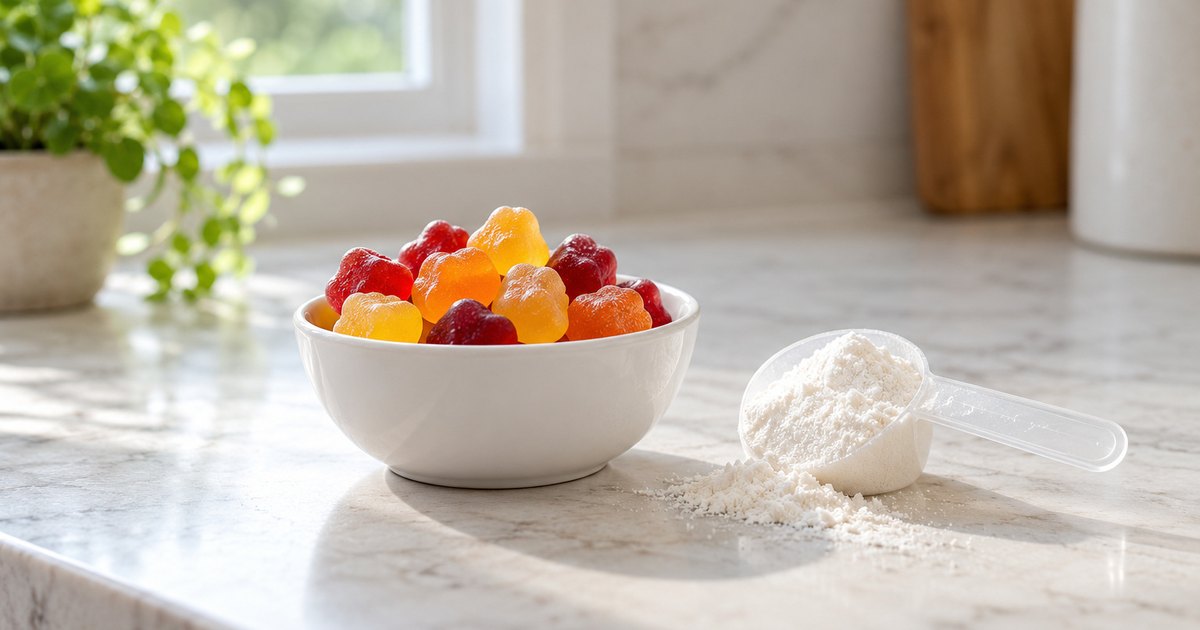
Creatine gummies can contain the creatine they promise, but independent testing has found that some held little or none. The format is the hard part: a serve has to be split across several small, chewy pieces, and creatine can break down during manufacturing and storage. Before you pay the premium for gummies, check the grams of creatine per serve, whether the product has independent testing that covers label content, and what you are paying per gram compared with powder.
This guide includes a few product links near the end. As an Amazon Associate, michelle.net.au earns from qualifying purchases, at no extra cost to you.
This guide explains what testing found, why gummies are a tricky format, how gummies compare with powder and capsules, how to read the label, and how the rules differ between countries. It does not recommend an amount to take; that is a conversation for your doctor, pharmacist or sports dietitian.
At a glance
- Most creatine research used creatine monohydrate, usually as powder, not gummies.
- In March 2024, supplement maker NOW reported testing 12 creatine gummy brands and finding that 5 contained little to no creatine.
- Read grams of creatine per serve, not per gummy, and check how many gummies make one serve.
- Testing seals differ. Some programmes focus on banned substances; others also check that the label amounts are correct.
- Gummies usually cost more per gram of creatine than plain powder, so work out the cost per gram before you buy.
What creatine gummies are
Creatine is a compound the body makes and also gets from foods such as meat and fish. As a supplement, it is sold mainly as creatine monohydrate, which the International Society of Sports Nutrition (ISSN) position stand describes as the most extensively studied form. Creatine gummies are chewable confectionery-style products with creatine added, usually alongside sugar or sweeteners, gelling agents, flavours and colours.
Most gummies name creatine monohydrate on the label. Some use other forms, such as creatine hydrochloride (HCl). Other forms are less researched than monohydrate, so a label saying “advanced” or “fast-absorbing” creatine is not a reason to pay more.
A “serve” on a gummy label is usually several gummies, not one. That single detail explains a lot of confusion about value and about how much creatine people are actually buying. If you want the basics on the powder form, the guide to how to read a creatine monohydrate label covers it in detail.
What independent testing found
Concerns about creatine gummies went mainstream in 2024. In March that year, the trade publication SupplySide Supplement Journal reported that NOW, a US supplement company, had bought 12 creatine gummy brands from Amazon or directly from brand websites and tested them:
- 7 of the 12 met their label claim for creatine.
- 5 of the 12 contained little to no creatine.
- All 5 failing products contained creatinine, a breakdown product of creatine, in small to significant amounts.
- Nearly all the products claimed creatine monohydrate; one used a patented creatine HCl form.
Three points of context matter. First, NOW sells supplements, including creatine, so it is not a neutral party, although the testing was published openly. Second, the report said the third-party labs NOW normally uses would not test these gummies, which itself shows how hard the format is to check. Third, this was one round of testing on one set of products at one point in time, so it cannot tell you about any particular brand on the shelf today. The safest conclusion is not “all gummies are empty” but “the format has a known quality problem, so ask for proof”. The same proof-first approach works for any product; see how to judge any supplement.
Why gummies are a hard format for creatine
A gummy is a small, moist, chewy piece of confectionery. Fitting a few grams of creatine into a serve means splitting it across several pieces; the products NOW tested spread one serve across three to five gummies. That leaves less room for anything else and makes the gummy larger or more numerous than a typical vitamin gummy.
Stability is the second issue. Creatine can convert into creatinine, which the body does not use the way it uses creatine. In the NOW report, its senior quality director suggested the creatine in the failing products may have degraded during gummy manufacturing, and that creatine’s instability in moist or liquid formulations could also shorten shelf life, while noting it was hard to say which factor mattered most. Heat during storage and shipping is a reasonable extra concern for any gummy, so read the storage instructions.
The third issue is what else you are eating. Gummies add sugar or sweeteners, gelling agents and colours to every serve. That is fine for many people but worth knowing if you are watching sugar or have a sensitive stomach.
Gummies vs powder vs capsules
This comparison uses typical label patterns rather than specific products. Always read the panel on the product in front of you.
| Format | Pieces per serve | Testing | Sugar and fillers | Cost per gram of creatine | Convenience |
|---|---|---|---|---|---|
| Creatine monohydrate powder | One scoop | Widely available with independent certification | Usually none in unflavoured powder | Usually lowest | Needs mixing; scoop size varies |
| Capsules or tablets | Often several capsules | Varies | Capsule shell, minor fillers | Usually higher than powder | No taste; many capsules to swallow |
| Gummies or chews | Often three to five or more | Harder to test; independent testing found failures | Sugar or sweeteners, gelling agents, colours | Usually highest | Easy to take; heat-sensitive |
| Gummies with other creatine forms (such as HCl) | Varies | Varies | As for gummies | Varies, often high | Less research on the form itself |
Worked example: cost per gram
These are made-up round numbers to show the method, not real product prices. Prices change and differ by country.
- Gummy pack: costs 40 (in your local currency), holds 120 gummies, and the label says 4 gummies provide 3 grams of creatine. That is 30 serves and 90 grams of creatine. Cost per gram: 40 divided by 90, which is about 0.44.
- Powder tub: costs 40, holds 300 grams of creatine monohydrate. Cost per gram: 40 divided by 300, which is about 0.13.
In this example the gummies cost more than three times as much per gram of creatine, and that assumes the gummies actually contain what the label says. The ISSN position stand describes maintenance amounts of around 3 to 5 grams a day in research; that figure is useful here only to compare packs on the same basis, not as advice on what you should take. The same method works for any supplement; the guide to comparing protein powders the same way uses it for protein.
How to check a creatine gummy label
The general steps in reading the supplement facts panel apply, plus a few that matter specifically for gummies.
Before you buy creatine gummies: a nine-point check
- Find the grams of creatine per serve on the panel itself, not just on the front of the pack.
- Check how many gummies make that serve, and how many serves are in the pack.
- Confirm the form is named, ideally creatine monohydrate.
- Look for an independent seal and find out what it tests. NSF Certified for Sport states that it checks label claims, contaminants and banned substances; Informed Sport focuses on testing for substances banned in sport. The guide to what Informed Sport and NSF seals mean explains more.
- See whether the seller publishes a certificate of analysis or batch test result, and check that it is recent and matches the batch.
- Read the sugar and sweetener amounts per serve.
- Check the storage instructions, especially in hot climates.
- Work out the cost per gram of creatine using the method above.
- If you have a kidney condition, take regular medicines, or are pregnant or breastfeeding, ask your GP or pharmacist before buying.
Who should talk to a doctor first
The ISSN position stand concludes that creatine monohydrate has a good safety record in research on healthy people. That does not cover every situation. Speak to your doctor or pharmacist before using any creatine product if you have kidney disease or reduced kidney function, take regular medicines, are pregnant or breastfeeding, or are buying for a teenager. Older adults considering creatine will find the research summarised in what the research says about creatine after 50, and creatine is often discussed alongside strength training and bone health, which matters more than any supplement.
Rules differ by country
- United States. Creatine gummies are generally sold as dietary supplements. The FDA does not approve dietary supplements before they go on sale, which is why independent testing and certification carry so much weight.
- Australia. Sports supplements can be regulated as foods or as medicines depending on their ingredients, claims and form. Food Standards Australia New Zealand covers formulated supplementary sports foods under Standard 2.9.4, which requires labels to carry a warning about use by children under 15 and pregnant women. Since 30 November 2023, sports supplements in tablet, capsule or pill form are regulated by the TGA as therapeutic goods, as are products making therapeutic claims such as muscle gain. Other products, including gummies, are assessed case by case.
- United Kingdom and European Union. Creatine products are generally sold as food supplements under food law, and health claims must be on an approved list. Labelling details vary by country.
Products bought from overseas websites may follow a different country’s rules from where you live, so the label you receive may not meet your local standard.
Common mistakes
- Reading “per gummy” as “per serve”. A serve is usually several gummies.
- Assuming any seal confirms the label amount. Check what the programme actually tests.
- Buying on influencer reviews. Taste and convenience are easy to review; creatine content is not.
- Comparing gummies with powder at different serve sizes. Compare cost per gram of creatine.
- Leaving gummies in a hot car or letterbox. Heat and moisture are the format’s weak points.
- Ignoring the “other ingredients” line. Sugar, sweeteners and colours add up across a pack.
The same label-checking approach applies to other popular supplements; see our MSM evidence and label check.
Sources this guide draws on: SupplySide Supplement Journal’s March 2024 report on NOW’s testing of 12 creatine gummy brands; the International Society of Sports Nutrition position stand on the safety and efficacy of creatine supplementation (Kreider and colleagues, 2017); NSF’s description of its Certified for Sport programme; descriptions of the Informed Sport programme; Food Standards Australia New Zealand’s guidance on sports foods and Standard 2.9.4; and the TGA’s changes to the regulation of sports supplements.
Handy kit for this guide
These are practical tools, not supplements or medicines. As an Amazon Associate, michelle.net.au earns from qualifying purchases, at no extra cost to you. Prices and availability are set by Amazon and may vary by country.
- Ezy Dose Weekly AM/PM Pill Organiser (X-Large)
Seven days with separate morning and evening compartments, so you can see at a glance what has already been taken.
View on Amazon - Vaydeer Metal 7-Day Travel Pill Case
Slim metal case with a built-in desiccant, for keeping a week of tablets dry in a bag or suitcase.
View on Amazon - Bambaw Insulated Stainless Steel Water Bottle (32 oz)
Plastic-free and keeps water cold all day, useful when a label says to take a product with a full glass of water.
View on Amazon
Frequently asked questions
Do creatine gummies actually contain creatine?
Some do and some have not. In the 2024 testing reported by SupplySide Supplement Journal, 7 of 12 gummy brands met their label claim and 5 contained little to no creatine. Look for products with independent testing that covers label content, or a recent batch certificate.
Are creatine gummies as good as powder?
If a gummy really contains the labelled amount of creatine monohydrate, the creatine itself is the same compound. The differences are reliability, added sugar and price: gummies have a known testing problem and usually cost more per gram. Most research used creatine monohydrate, usually as powder.
How many gummies make one serve?
It depends on the product. In the products NOW tested, one serve was split across three to five gummies. Always check the serving size line on the panel rather than assuming one gummy is a serve.
Why are creatine gummies so expensive?
Gummies cost more to make, need several pieces per serve, and are sold as a convenience product. Working out the cost per gram of creatine usually shows a large premium over plain powder.
Do creatine gummies need special storage?
Follow the label. Creatine is less stable in moist products, and gummies can soften or melt in heat, so a cool, dry place away from direct sun is sensible.
Can older adults use creatine gummies?
Research on creatine in older adults has mostly used creatine monohydrate powder. Anyone with a kidney condition or on regular medicines should talk to their doctor first. The site’s guide to creatine after 50 covers what the studies measured.
If you prefer gummies, pay for proof rather than flavour: clear grams per serve, testing that checks label content, and a sensible cost per gram. And if you have any health conditions, check with your doctor or pharmacist before you start.