
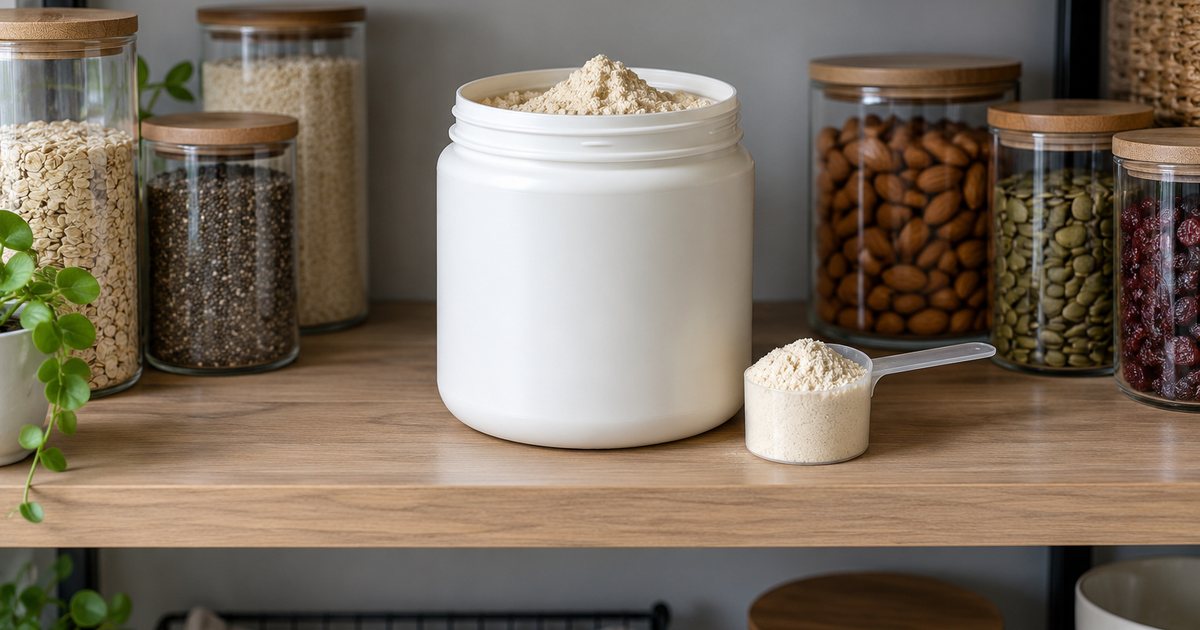
Yes, protein powder does expire, but in most cases it loses quality slowly rather than becoming unsafe on a set date. Dry powders are a poor home for microbes, and the date on most tubs is a best-before date about taste, colour and texture, not a use-by date about safety. Research on whey shows that heat and humidity speed up the changes, so how you store the tub matters as much as the date printed on it.
This guide includes a few product links near the end. As an Amazon Associate, michelle.net.au earns from qualifying purchases, at no extra cost to you.
This guide explains what the studies on whey storage actually found, what best-before and use-by mean in different countries, how to store powder so it lasts, and the signs that it is time to throw it out.
At a glance
- Most protein powders carry a best-before date. It marks peak quality, not the point where the powder becomes dangerous.
- Heat is the main enemy. In a US Department of Agriculture study, whey concentrate kept for about 9 months at 35 °C but at least 18 months at lower temperatures.
- Old powder changes before it spoils. Yellowing, caking, stale smells and small losses of the amino acid lysine were all recorded as whey aged.
- Bin it if it smells off, tastes bitter, has damp clumps, mould or insects, whatever the date says.
- A sealed, cool, dry cupboard is the best home. Not the fridge door, not the car, not beside the kettle.
Does protein powder expire? What the date on the tub means
Date labels are not the same everywhere, and the wording matters.
Australia and New Zealand
The Australia New Zealand Food Standards Code (Standard 1.2.5) uses two date marks. A best-before date is the date up to which the food, unopened and stored correctly, will stay fully marketable and keep any specific qualities it claims. A use-by date is the date after which the food should not be eaten, for safety reasons. Foods with a best-before date of two years or more are not required to carry a date mark at all, which is why some tubs only show a batch number or a manufacture date. Protein powders are normally sold with a best-before date, because the risk is a slow decline in quality rather than sudden spoilage.
United States
According to the US Department of Agriculture’s Food Safety and Inspection Service (FSIS) guidance on food product dating, federal rules do not require dates on most foods; infant formula is the exception. A “Best if used by” date describes when a product will have its best flavour or quality and is not a purchase or safety deadline. FSIS advises that properly handled food should still be safe after the date until signs of spoilage appear. Many US protein powders are sold as dietary supplements, but manufacturers commonly print the same style of quality date.
Other countries
Most countries use a similar split between quality dates and safety dates, but the exact rules and wording vary. If you buy protein powder from an overseas website, the label may follow another country’s system. The guide to buying supplements overseas explains what to check.
What the research shows about whey protein shelf life
Most of the published storage research is on whey, so that is what this section covers. Plant and egg powders have been studied far less, so their best-before date is the best guide.
The USDA whey concentrate study
Researchers led by Michael Tunick at the US Department of Agriculture, publishing in the Journal of Dairy Science in 2016, stored two whey protein concentrates (one about 35% protein, one about 80%) in sealed bags for up to 18 months. Samples were kept under ambient conditions and at raised temperatures and humidity. Key findings:
- The powders became more yellow with time, a sign of browning reactions.
- Lysine, an essential amino acid that is particularly vulnerable to these reactions, decreased.
- Water activity rose, volatile flavour compounds formed and the powders caked more.
- Samples at 35 °C were removed from the study by 12 months because of their poor appearance.
- Bacteria, yeast and mould counts stayed low in all samples.
The authors concluded that, in sealed bags, the powders had a shelf life of about 9 months at 35 °C and at least 18 months at lower temperatures. In most samples relative humidity was not the main factor; temperature was.
Why whey changes colour and loses lysine
Whey contains some lactose. Over time, the lactose reacts with proteins in what is called the Maillard reaction, the same family of reactions that browns toast. In the early stages, lactose attaches to lysine, which reduces how much usable lysine is left. Later stages produce brown pigments and new flavour compounds. A 2005 study by Sithole and colleagues, also in the Journal of Dairy Science, measured the rate of this browning in sweet whey powder, and a 2022 study in the Journal of Food Engineering by Paul and colleagues found that higher storage temperatures caused more protein change in whey powder, even though the powders still rehydrated well.
Because whey isolate contains less lactose than concentrate, you might expect it to brown more slowly, but the 2022 study found that browning during storage was largely independent of lactose content, so do not assume an isolate is immune to heat. If you want to know how isolate and concentrate differ in other ways, see the guide to choosing the right type of protein powder.
What this means in practice
Expired protein powder that has been stored well does not suddenly become harmful on the day after the date. What happens is gradual: it may taste staler, mix less smoothly and contain slightly less of some amino acids than the label says. Stored somewhere hot, those changes happen much faster, and in a warm climate a tub kept in a hot pantry can age well before its date.
How long protein powder lasts: a practical guide
These are general expectations, not guarantees. Always follow the manufacturer’s date and storage instructions first.
| Situation | What to expect | What to do |
|---|---|---|
| Sealed, before the best-before date, stored cool and dry | Full quality as labelled | Use as normal |
| Opened, before the date, lid kept tight | Usually fine; quality declines faster once air and moisture get in | Use within the time the label suggests after opening, if it gives one |
| Past the best-before date, looks and smells normal | Likely lower quality: flavour, mixability and some amino acids may have declined | Check carefully; if anything seems off, discard |
| Stored somewhere hot (car, sunny shelf, near an oven) | Faster browning and staling, even before the date | Inspect closely; move remaining stock somewhere cooler |
| Damp, hard clumps, mould, insects, rancid or sour smell | Spoiled or contaminated | Throw it out, whatever the date |
| Carries a use-by date | Safety limit set by the maker | Do not consume after the date |
Signs your protein powder has gone bad
FSIS notes that spoiled foods develop an off odour, flavour or texture, and that food showing these changes should not be eaten. For protein powder, look for:
- A sour, rancid, cardboard-like or bitter smell or taste. Whey that has aged in heat often smells stale.
- Noticeable yellowing or darkening compared with how it looked when new.
- Hard, damp clumps that do not break apart. Light, dry clumps that crumble easily are often just settling; wet, sticky lumps mean moisture has got in.
- Any visible mould or fuzzy spots.
- Insects or webbing, which pantry moths and beetles can leave in dry foods.
- A swollen or damaged pack, or a broken seal on a tub you have not opened.
If you are unsure, the safest choice is to discard it. If you have a weakened immune system, are pregnant, or are buying for an older relative in care, be more cautious with old food products and talk to your doctor or pharmacist if you have questions.
How to store protein powder so it lasts: step by step
- Check the date when you buy. Choose the tub with the longest date if you will be using it slowly.
- Keep it in a cool, dry, dark cupboard. Away from the stove, dishwasher, kettle and sunny windows. The USDA study found temperature mattered more than humidity for sealed bags.
- Close the lid or reseal the bag straight after each use. Air and moisture speed up staling and caking.
- Use a dry scoop. A wet scoop puts water straight into the powder, which encourages clumping and spoilage.
- Do not decant into an unlabelled jar unless you write the product name, batch number and date on it. You will need them if there is ever a recall.
- Avoid the fridge for opened tubs. Taking a cold tub in and out can cause condensation inside. Follow the label if it says otherwise.
- Do not store it in a car or gym bag for long. Cars in a warm climate can get far hotter than 35 °C.
- Buy a size you will finish. A huge tub that takes a year to use may lose quality before you reach the bottom, which wipes out the saving.
Mixed shakes and ready-to-drink protein
Once powder is mixed with water, milk or a milk alternative, it is no longer a dry product, and it needs the same care as any perishable drink: refrigerate it and drink it within the time the label recommends. Ready-to-drink protein shakes may carry a use-by date and should be refrigerated after opening if the label says so. If you take nutrition drinks for a health reason, the guide to supplement drinks for older adults covers how those products are labelled.
Common mistakes
- Reading the best-before date as a safety cliff. It is a quality date. The condition of the powder tells you more.
- Ignoring heat. A tub kept in a hot pantry or car can age much faster than its date suggests.
- Using a wet scoop or leaving the lid loose. Moisture is how most powders end up clumped and spoiled.
- Bulk-buying to save money, then wasting half. Work out how long a tub will last you before choosing the larger size.
- Assuming added ingredients last as long as the protein. Powders with added vitamins, probiotics or other actives may have a shorter quality life for those ingredients, which is why the overall date may be shorter.
- Keeping a tub with a recall notice or broken seal. Return or discard it.
Quick check before you use an old tub
- Date: best-before or use-by? Is it past?
- Storage: has it been somewhere hot or damp?
- Look: normal colour, no mould, no insects?
- Smell: neutral and familiar, not sour, rancid or stale?
- Texture: dry and free-flowing, no wet lumps?
- Taste a tiny amount only if everything else passes. If it is bitter or off, discard it.
The same storage habits suit other powders in your cupboard; see how to buy creatine monohydrate for that product’s label checks, what supplement seals mean for independent testing, and how to read a supplement label for where to find batch numbers and dates.
Sources this guide draws on: Tunick and colleagues, “Physical and chemical changes in whey protein concentrate stored at elevated temperature and humidity”, Journal of Dairy Science (2016); Sithole and colleagues, “Rate of Maillard browning in sweet whey powder”, Journal of Dairy Science (2005); Paul and colleagues, “Deciphering the impact of whey protein powder storage on protein state and powder stability”, Journal of Food Engineering (2022); Australia New Zealand Food Standards Code Standard 1.2.5 (date marking); US Department of Agriculture Food Safety and Inspection Service guidance on food product dating.
Handy kit for this guide
These are practical tools, not supplements or medicines. As an Amazon Associate, michelle.net.au earns from qualifying purchases, at no extra cost to you. Prices and availability are set by Amazon and may vary by country.
- BlenderBottle Classic V2 Shaker (20 oz)
The wire whisk ball mixes powders into water or milk without lumps.
View on Amazon - Etekcity Digital Kitchen Scale
Reads in grams, handy for checking a scoop against the serving size printed on the label.
View on Amazon - Stainless Steel Measuring Spoon Set (6 pieces)
Plastic-free spoons for level, repeatable measures of powders.
View on Amazon
Frequently asked questions
Can you use protein powder after the expiration date?
If it carries a best-before date, has been stored cool and dry, and looks, smells and tastes normal, it is generally a quality issue rather than a safety one. Expect some loss of flavour and possibly a little less of certain amino acids. If it carries a use-by date, do not use it after that date.
How long does protein powder last once opened?
That depends on the product and how it is stored, so follow any “use within” guidance on the label. Keeping the lid tight, using a dry scoop and storing the tub somewhere cool will help it keep its quality for longer.
Can expired protein powder make you sick?
Dry powder that has been stored properly is not a friendly environment for microbes, and the USDA whey study found low microbial counts even after long storage. Powder that has got damp, grown mould, been invaded by insects or smells rancid is a different matter and should be thrown out.
Does protein powder lose protein over time?
The total protein does not vanish, but its quality can decline. In the USDA study, the amino acid lysine decreased as whey aged, especially at higher temperatures, because of browning reactions with lactose.
Should protein powder be kept in the fridge?
Usually not. A cool, dry cupboard is better for most powders because moving a cold tub in and out of the fridge can cause condensation. Check the label, as a few products have their own storage instructions.
Why has my protein powder gone lumpy?
Light, dry lumps are often just settling and break up easily. Hard, damp lumps mean moisture has got in, often from a wet scoop or loose lid, and the powder is more likely to spoil, so inspect it carefully or discard it.
Protein powder ages quietly rather than going off overnight. Keep it cool, dry and sealed, check it with your eyes and nose as well as the date, and buy a tub size you will finish while it is still at its best.