
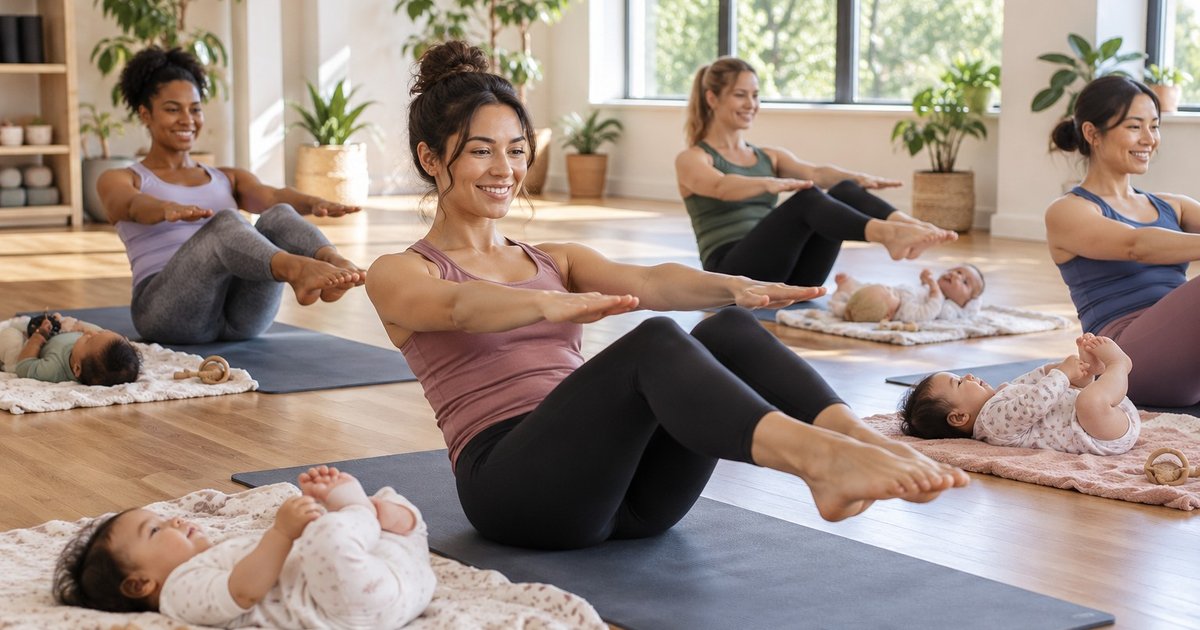
Mums and bubs Pilates is a gentle, usually mat-based group class you attend with your baby beside you, designed for parents who have recently given birth. The right time to start is not set by a class or a website: check with your GP, midwife or a women’s health (pelvic health) physiotherapist before returning to exercise, especially if you had a caesarean, notice any leaking, heaviness or pelvic pain, or have a gap along the middle of your tummy. Once you have the all-clear, choose a small class led by an instructor with postnatal training who asks about your birth and health before you start.
This guide includes a few product links near the end. As an Amazon Associate, michelle.net.au earns from qualifying purchases, at no extra cost to you.
This guide explains what these classes involve, when people usually start, the pelvic floor and abdominal separation cautions to know about, how to compare classes near you, what happens in a first session, and the alternatives if a group class is not right yet. It is general education only, not medical advice.
At a glance
- Clearance first: speak with your GP, midwife or a women’s health physiotherapist before returning to exercise after birth. Recovery after a vaginal birth and after a caesarean can be very different.
- Know the stop signs: leaking, heaviness or dragging in the pelvis, pain, new or heavier bleeding, or doming along the middle of your tummy during an exercise.
- Pick the instructor, not the studio: look for specific pre and postnatal training, a health questionnaire and small class sizes.
- Build up slowly: the World Health Organization encourages physical activity after birth where there is no medical reason to avoid it, increased gradually.
- Your baby stays low and safe: on a mat, blanket or car seat on the floor beside you.
What mums and bubs Pilates is
Mums and bubs Pilates (also called mum and baby, parent and baby, or postnatal Pilates with baby) is a group class for parents who want to bring their baby along. Babies lie on a blanket or play mat beside you, or rest in a car seat or bassinet on the floor, while the instructor leads slow, controlled exercises.
Classes usually focus on breathing, posture, gentle deep abdominal and pelvic floor awareness, glute and leg work, and the movements new parents repeat all day: lifting, bending, carrying, feeding and getting up off the floor. Some include a few calm, floor-level exercises with the baby; others simply keep babies close by.
If Pilates itself is new to you, this guide to Pilates for beginners and what to expect explains the method and the language instructors use.
How it differs from a regular class
- Interruptions are expected. Stopping to feed, settle or change your baby is normal.
- Exercises are chosen for the postnatal body. Good instructors modify or leave out movements that put high pressure through the abdomen or pelvic floor in the early months.
- There is a social side. Many parents value meeting others at the same stage as much as the exercise.
Before you start: clearance and timing
There is no single start date that suits everyone. Many health systems offer a postnatal check some weeks after birth, but the timing and what it covers vary between countries and practitioners, and a routine check does not always include a pelvic floor or abdominal assessment. It is reasonable to ask for one, or to book a women’s health physiotherapist directly.
A few widely used reference points, for context only:
- The World Health Organization’s 2020 physical activity guidelines encourage regular activity after birth where there is no medical reason to avoid it, including aerobic and muscle-strengthening activity and gentle stretching, built up gradually.
- The American College of Obstetricians and Gynecologists advises that exercise can usually resume gradually after birth once it is medically safe, which depends on the type of birth and any complications.
- A widely cited UK clinical guideline on returning to running after birth (Goom, Donnelly and Brockwell, 2019) suggests a graded return to low-impact exercise first, with running generally not before about 12 weeks. Gentle mat Pilates is low impact, but the principle of building up step by step is the same.
Your own doctor, midwife or physiotherapist is the right person to tell you when, and how, any of this applies to you.
After a caesarean
A caesarean is major abdominal surgery. How well the scar and the layers underneath have recovered, and your energy levels, all affect when exercise feels comfortable. Follow the advice of your own medical team on lifting and activity, tell your instructor about the surgery, and expect some exercises to be modified for longer than you might think.
Pelvic floor and abdominal separation: what to know
Pregnancy and birth place a lot of load on the pelvic floor muscles and the abdominal wall. Changes are common and often improve with time and the right guidance, but some need individual assessment. This section is education, not diagnosis.
Pelvic floor
The pelvic floor is a group of muscles that supports the bladder, bowel and uterus. After birth, some people notice leaking when they cough, sneeze, laugh or exercise, an urgent need to go, or a feeling of heaviness or dragging in the vagina, which can be a sign of prolapse. Pelvic floor muscle training is widely recommended during and after pregnancy; for example, the UK’s National Institute for Health and Care Excellence guideline on pelvic floor dysfunction (2021) recommends that it is offered. Doing the exercises correctly matters, and a women’s health physiotherapist can check your technique.
Abdominal separation (diastasis recti)
During pregnancy the two sides of the long abdominal muscle (rectus abdominis) stretch apart along the connective tissue in the midline. This is a normal part of pregnancy, and for many people the gap narrows in the months after birth. For some it remains wider, and you may notice a ridge or doming along the middle of your tummy when you sit up, lift or strain.
Abdominal separation does not automatically mean you cannot do Pilates, but it does mean having it assessed and getting guidance on which movements to modify. Many instructors will adapt or leave out full sit-ups, crunches and some front-loaded positions until a physiotherapist has given advice.
Stop and seek advice if you notice
- Leaking of urine, wind or bowel motions during or after exercise.
- Heaviness, dragging, pressure or a bulge in the vagina.
- Doming, coning or bulging along the middle of the tummy during an exercise.
- Pelvic, back, hip or scar pain.
- New bleeding, or bleeding that becomes heavier after activity.
- Dizziness, chest pain or unusual breathlessness.
Any of these is a reason to pause the exercise and speak with your GP, midwife or a women’s health physiotherapist before continuing.
Who it suits, and who should get individual guidance first
| Your situation | A mums and bubs class may suit you if | Consider one-to-one guidance first if |
|---|---|---|
| Medical clearance | You have been cleared to exercise | You have not yet had a check, or were advised to wait |
| Type of birth | Your recovery is going as expected and you feel ready | You had a caesarean, a significant tear or other complications and have not had specific advice |
| Pelvic floor | You have no leaking, heaviness or pain | You notice leaking, heaviness, dragging or pain |
| Abdominal wall | No noticeable doming or gap, or it has been assessed | You see a ridge or doming along the midline and have not had it checked |
| Baby’s stage | Your baby is not yet crawling | Your baby is mobile; a parent-only postnatal class may suit better |
| Goals | Gentle, guided movement and meeting other parents | You want a tailored programme for a specific concern |
Many classes also welcome partners and other carers, so it is worth asking.
How to choose a class near you: a step-by-step checklist
Searching for mums and bubs Pilates or postnatal Pilates with baby near you usually turns up boutique studios, physiotherapy clinics, gyms, community centres and independent instructors in local halls. Work through these steps to compare them.
- Check the instructor’s training. Pre and postnatal qualifications are additional training on top of a general Pilates certification. Some classes are run by physiotherapists who teach clinical Pilates. Ask directly; a good instructor will be happy to explain.
- Ask about the health check. A good class asks about your birth, how long ago it was, clearance to exercise and any pelvic floor, abdominal or scar concerns before your first session.
- Ask about class size. Smaller groups mean more individual attention and modifications.
- Check the baby age range. Most classes suit babies from the early weeks until crawling.
- Look at the practical side. Pram access, parking or public transport, stairs or a lift, somewhere to leave the pram, a change table and a warm, clean room.
- Check the timetable. Mid-morning classes are common because they often fit around feeds and naps.
- Compare booking options. Casual drop-in, class packs, terms or memberships. Ask about a trial class and the cancellation policy; babies get sick and nights go badly, so flexibility can be worth more than a lower price.
- Book a trial and notice how you feel. Did the instructor offer options, check on you and make it easy to stop? That matters more than the decor.
For broader advice on comparing studios, this guide on how to choose a Pilates or yoga studio covers instructor credentials, contracts and trial classes in more depth.
What to expect in your first class
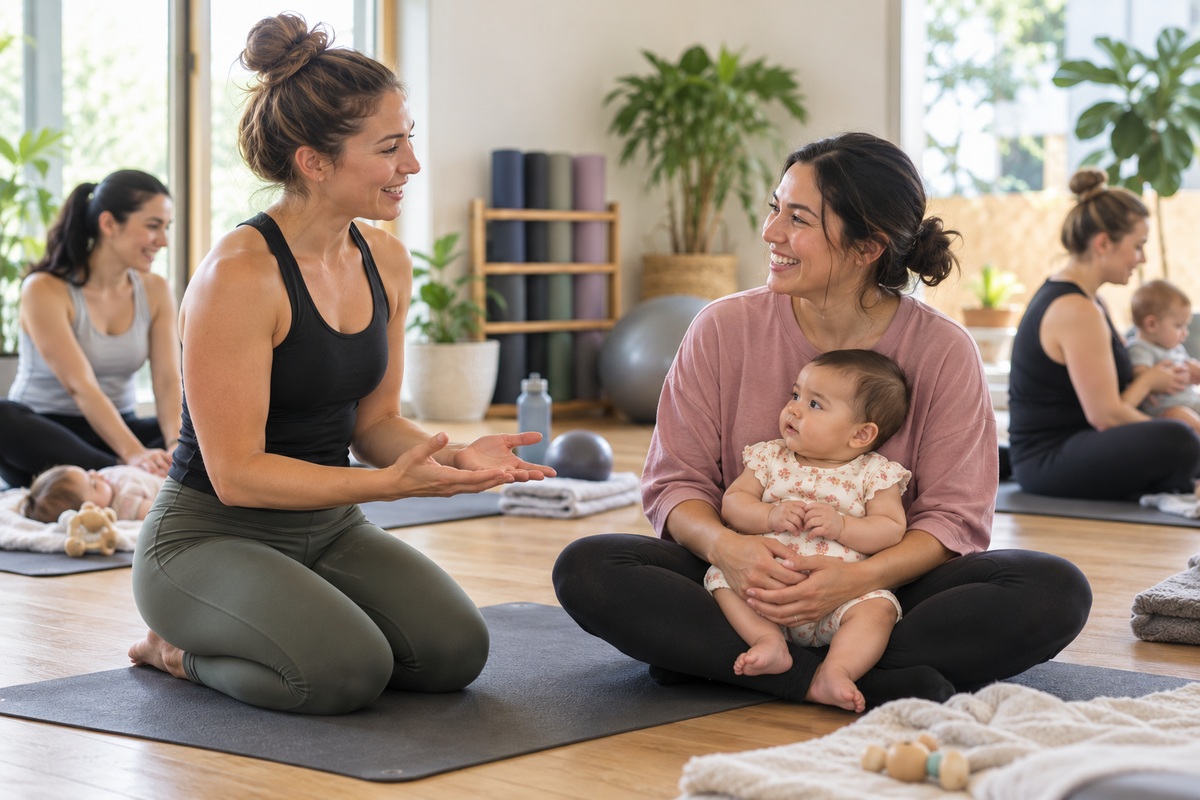
- A health check-in: a form or a quick chat about your birth and any concerns. This is a good sign.
- Settling in: set up your mat with your baby on a blanket beside you, where you can see and reach them easily.
- Breathing and warm-up: often lying down or seated, connecting breath with gentle deep abdominal and pelvic floor activation.
- The main section: gentle core and pelvic floor work, glute and leg exercises, upper-body work for carrying and lifting, and posture-focused movement, usually with easier and harder options.
- Baby-inclusive moments: some instructors include your baby in calm, floor-level exercises. You never have to join in.
- Cool-down: gentle stretching and relaxation, often with time to chat afterwards.
Spending part of the class feeding, rocking or changing your baby is completely normal. It still counts.
A note on baby safety
Good classes keep babies low and simple. Babies should lie on a mat or blanket beside their parent, or rest in a car seat or bassinet placed on the floor nearby. Any exercise involving your baby should be slow, close to the floor and with the baby well supported. Skip anything that does not feel safe or comfortable to you; your instinct is a good guide.
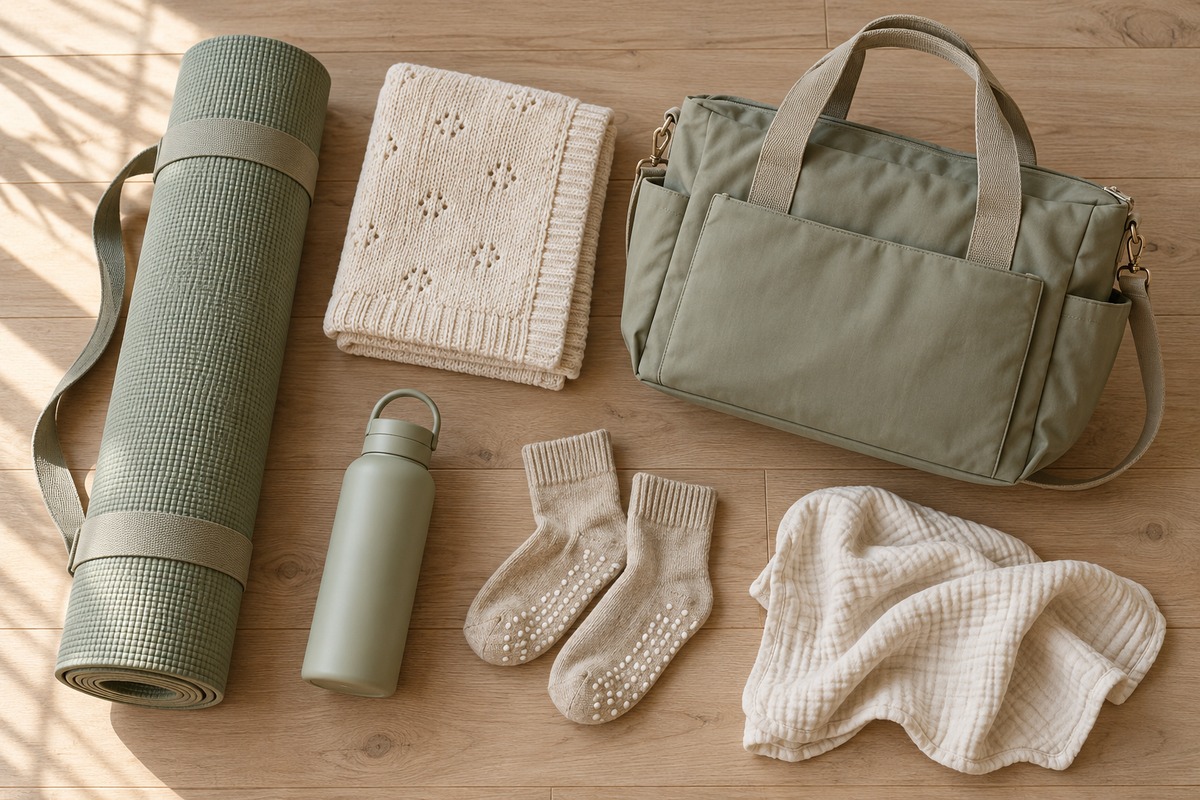
What to bring
- Comfortable clothing you can move in, plus a supportive or feeding-friendly top.
- A mat if the studio does not provide one; a thicker mat of around 6 to 10 mm is often more comfortable for floor work. This guide to Pilates mats, props and reformers explains the options.
- A soft blanket or play mat for your baby.
- Your nappy bag: nappies, wipes, a change of clothes and anything your baby uses to settle.
- Feeding supplies, whether that is a cover, bottles, formula or a muslin cloth.
- A water bottle for you, especially if you are breastfeeding.
- Socks, or grip socks if the studio asks for them.
Alternatives to a mums and bubs class
| Option | Good for | Trade-off |
|---|---|---|
| One-to-one with a women’s health physiotherapist | Assessment of the pelvic floor, abdominal separation or scar; a tailored plan | Usually costs more per session; may not include baby |
| Postnatal Pilates without baby | Focusing fully on technique; babies who are now mobile | Needs childcare |
| Online postnatal classes | Exercising at home during nap time | No one checks your form; best after a few in-person sessions |
| Reformer Pilates (postnatal or beginner) | Adding spring support or resistance later on | Babies in the room are less common; ask the instructor when it suits you |
| Walking with the pram | Gentle daily activity with no booking | No guidance on pelvic floor or abdominal work |
On days when a class is not happening, ordinary activity still counts; this guide to everyday movement, sitting and walking has ideas. Later, when you are ready and have the all-clear, the guide to strength training and bone health explains the basics of resistance work.
Common mistakes
- Skipping the health check. Starting without clearance, or without telling the instructor about your birth, means you miss the modifications that matter most.
- Pushing through warning signs. Leaking, heaviness, doming or pain are signals to pause and seek advice, not to try harder.
- Rushing back to crunches and high-impact work. Comparing yourself with others, or with social media timelines, is a common route to setbacks.
- Assuming a gap or leaking is “just normal now”. These are common, but a women’s health physiotherapist can often help; it is worth asking.
- Choosing on price or convenience alone. The instructor’s postnatal training matters more than the studio’s location or decor.
- Forgetting rest. Broken sleep affects recovery and energy. This guide to sleep and rest explains why rest matters so much.
Sources this guide draws on: World Health Organization Guidelines on Physical Activity and Sedentary Behaviour (2020); American College of Obstetricians and Gynecologists Committee Opinion on physical activity and exercise during pregnancy and the postpartum period; National Institute for Health and Care Excellence guideline NG210 on pelvic floor dysfunction (2021); Goom, Donnelly and Brockwell, Returning to running postnatal: guidelines for medical, health and fitness professionals (2019).
Handy kit for this guide
These are practical everyday products, not supplements or medicines. As an Amazon Associate, michelle.net.au earns from qualifying purchases, at no extra cost to you. Prices and availability are set by Amazon and may vary by country.
- Gaiam Premium 5 mm Yoga Mat
Non-slip mat for yoga, Pilates, tai chi warm-ups and floor exercises.
View on Amazon - Fabric Resistance Bands (5-Band Set)
Loop bands in graded resistance for home strength exercises.
View on Amazon - Bambaw Insulated Stainless Steel Water Bottle (32 oz)
Plastic-free and keeps water cold all day, at home, on walks or at the gym.
View on Amazon
Frequently asked questions
How soon after birth can I do mums and bubs Pilates?
There is no single answer. It depends on your type of birth, any complications and how your recovery is going. Get clearance from your GP, midwife or women’s health physiotherapist first, and tell your instructor how long ago you gave birth.
Can I do Pilates with abdominal separation?
Often yes, with the right modifications, but have the separation assessed first by a women’s health physiotherapist. They can advise which movements to change or leave out, and your instructor can then adapt the class.
Can I go if I had a caesarean?
Many people who have had a caesarean attend postnatal Pilates, but timing depends on your own recovery. Follow your medical team’s advice on activity and lifting, and tell your instructor so they can suggest modifications.
What if I leak or feel heaviness during class?
Stop that exercise and let the instructor know. Leaking and heaviness are common after birth, but they are a reason to see your GP or a women’s health physiotherapist for an assessment before continuing.
Is mums and bubs Pilates safe for my baby?
In a well-run class, babies stay on mats or blankets beside their parent, or in a car seat or bassinet on the floor, and any baby-inclusive movement is slow and close to the ground. Skip any exercise that does not feel right to you.
What if my baby cries the whole class?
It happens, and nobody minds. Instructors expect interruptions, and you can stop to feed or settle your baby at any time.
Finding the right fit
The best mums and bubs class is one where you have been cleared to start, the instructor understands the postnatal body and asks the right questions, and getting there is easy enough that you will keep going. Go gently, know the stop signs, and ask for help early if anything does not feel right.