
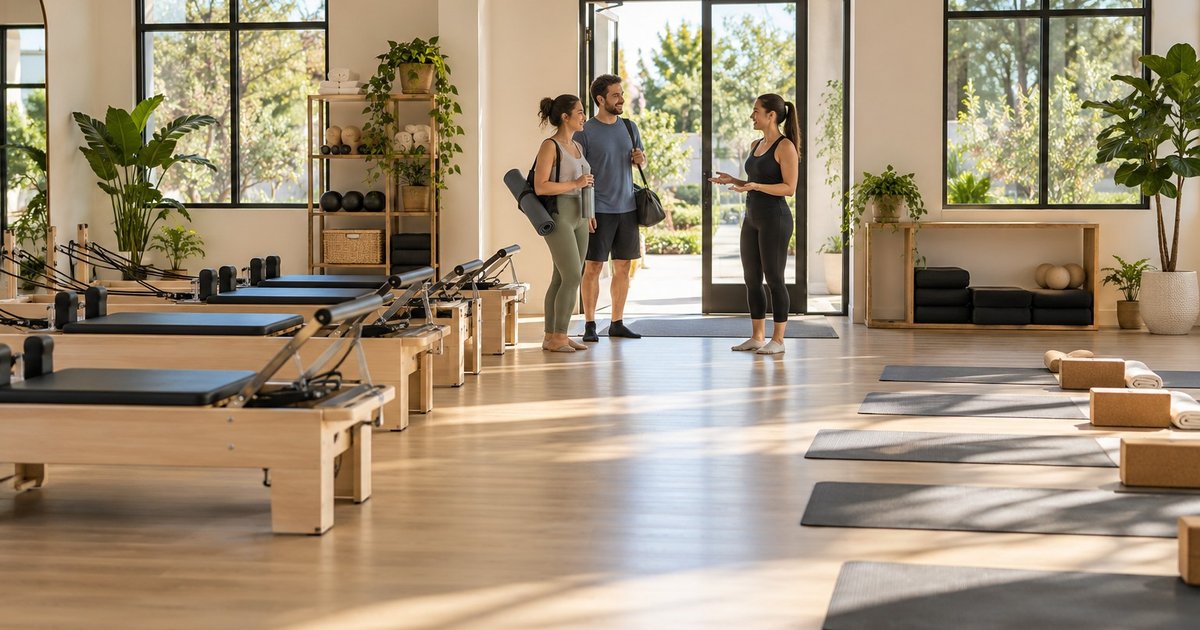
To choose a good Pilates or yoga studio near you, decide which style you want, check that instructors have recognised training, ask about class sizes and beginner options, visit the space, and read the cancellation and membership terms before you pay. A trial class at two or three studios is the most reliable way to find one where you feel safe and well looked after.
This guide includes a few product links near the end. As an Amazon Associate, michelle.net.au earns from qualifying purchases, at no extra cost to you.
This guide gives you a step-by-step method that works wherever you live: how to tell the main styles apart, what to ask about qualifications, what a good first visit looks like, how to compare prices fairly, and the warning signs that suggest a studio is not the right fit.
At a glance
- Know the format: mat Pilates, reformer Pilates, flowing yoga and gentle or restorative yoga feel very different.
- Ask about training: in many countries anyone can use the title “instructor”, so ask what course they completed and whether they belong to an industry body.
- Smaller is usually better for beginners: you get more individual guidance.
- Work out cost per class based on how often you will really go, and read the cancellation terms.
- Health first: if you have an injury, a health condition or are pregnant, talk to your doctor or physiotherapist before you start.
Step 1: Decide what you are looking for
“Pilates” and “yoga” each cover a wide range of classes, and two studios using the same word can offer very different experiences. Class names are not standardised, so read descriptions and ask.
Common class formats compared
| Format | What it involves | Typical class feel | Things to check |
|---|---|---|---|
| Mat Pilates | Floor exercises on a mat, sometimes with small props | Controlled, focused on posture and core; classes can be larger | Whether you can get down to and up from the floor comfortably, or whether modifications are offered |
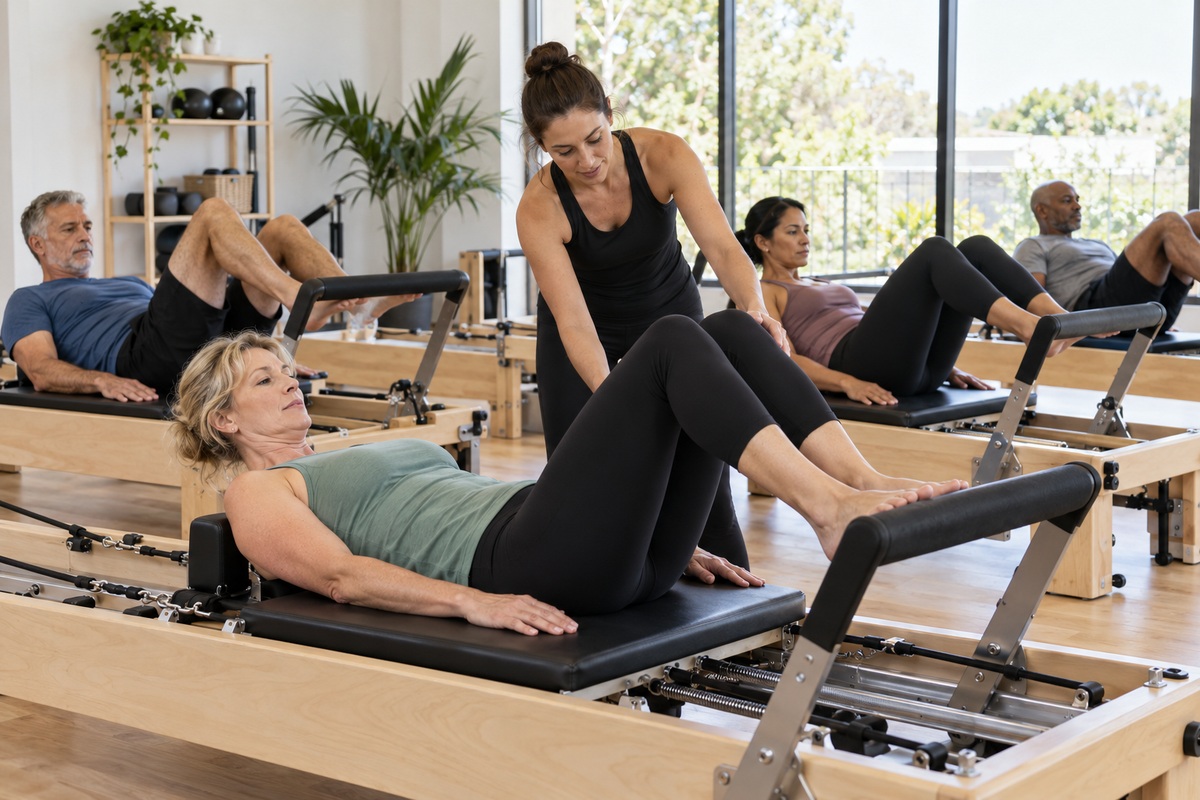
| Reformer Pilates | A sliding carriage with springs, ropes and a footbar | Smaller groups, more equipment to learn | Whether there is a compulsory introductory session; how springs are explained |
| Clinical or physiotherapist-led Pilates | Pilates run by or with a physiotherapist or other health professional | Very small groups or one-to-one, often after an assessment | Whether a referral is needed and whether any health fund or insurance cover applies where you live |
| Flowing yoga styles | Moving from posture to posture with the breath | More active, can be faster paced | Whether there is a true beginner level |
| Alignment-focused yoga | Holding postures for longer with attention to position | Slower, detailed | Use of props and support |
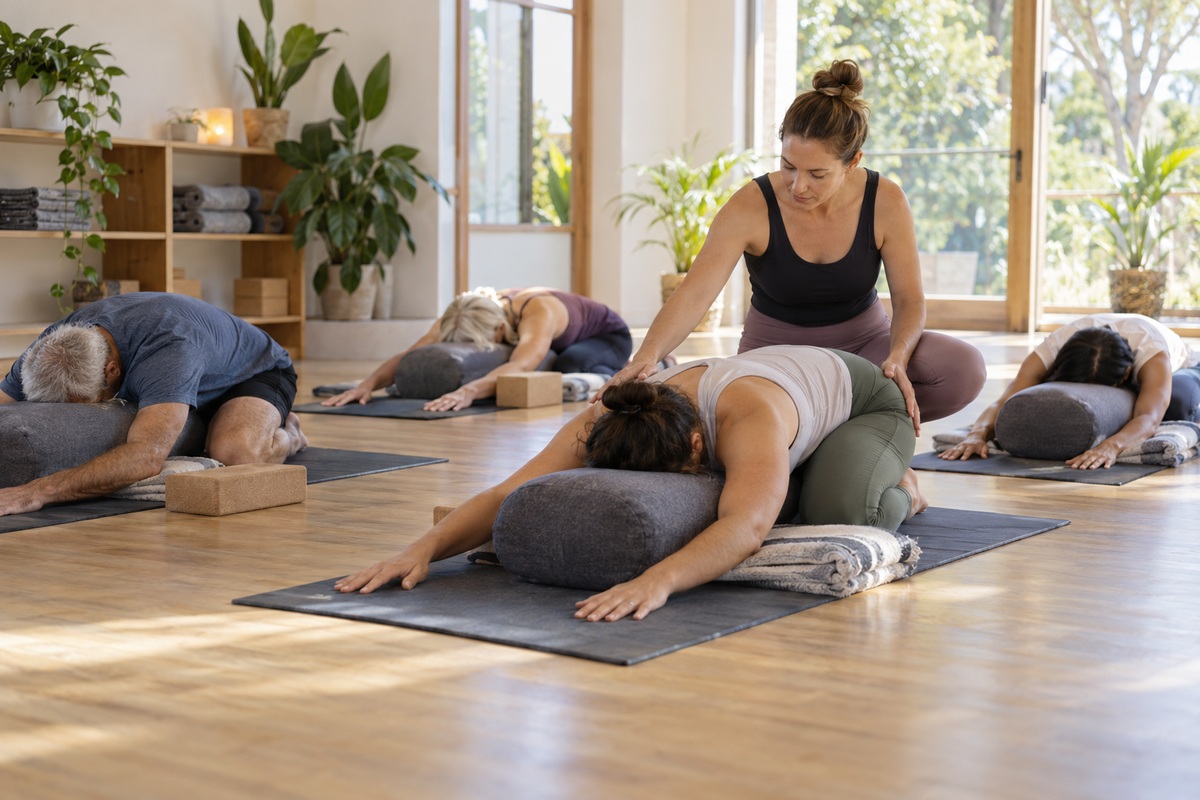
| Gentle, restorative or chair yoga | Supported postures with bolsters, blankets or a chair | Calm, low intensity | Whether it suits limited mobility |
| Heated classes | Pilates or yoga in a warmed room | Sweaty and demanding | Room temperature and whether it suits your health; ask your doctor if you have heart or blood pressure concerns, or are pregnant |
If you are completely new, the guide to Pilates for beginners and what to expect explains the basics. If you have recently had a baby, how to choose a mums and bubs Pilates class covers the extra questions to ask.
Think about your goals and your health
Many people use Pilates or yoga to build regular movement into the week, work on flexibility and balance, or have an hour that is just for them. Knowing your priorities makes it easier to judge fit. If you have an injury, a health condition, osteoporosis, a joint replacement, or you are pregnant, speak with your doctor or a physiotherapist first and take their advice with you when you contact a studio.
Step 2: Check instructor training
This is the most important step and the easiest to skip. In many countries there is no legal requirement to hold a particular qualification before teaching Pilates or yoga. Training ranges from short weekend workshops to long programmes with assessed teaching hours.
Many countries have Pilates or yoga industry bodies or teacher registers that set training standards, keep member lists and may require ongoing professional development and first aid. Requirements differ, so ask each instructor:
- What training did you complete, with which organisation, and how long was it?
- Did it include supervised teaching practice?
- Are you a member of an industry body or listed on a teacher register?
- Do you hold current first aid, and does the studio carry insurance?
- Have you had training in teaching older adults, beginners or people with health conditions?
A good instructor will be happy to answer. Vague or defensive replies are a warning sign.
In Australia, for example, Pilates industry guidance for consumers suggests looking for an instructor trained through a recognised training organisation who belongs to an industry body and can show a certificate. Healthdirect, the Australian Government-funded health information service, points readers to industry associations such as Yoga Australia to help find instructors. In other countries, look for the equivalent bodies and check whether your instructor is listed.
Step 3: Ask about class sizes
Class size affects how much attention you receive. In a smaller class the instructor can watch your technique, suggest changes and offer alternatives. In a large class led from the front, individual guidance may be limited.
As one example, a Pilates industry association in Australia suggests group mat classes of no more than 12 people for a newer instructor and no more than 20 for a more experienced one, with the instructor moving around the room rather than only demonstrating. Guidance differs elsewhere, but the principle applies anywhere: ask how many people usually attend and whether the instructor walks around to help. For reformer classes, size is limited by the number of machines; ask whether beginners are mixed in with experienced clients.
Step 4: Look at the space
A short visit before you book tells you a lot. Notice:
- Equipment condition: springs, straps and moving parts should look well maintained.
- Room between mats or machines: enough to move without bumping your neighbour.
- Cleanliness: ask how often mats, props and equipment are cleaned.
- Ventilation and temperature: the room should feel fresh.
- Facilities: change area, toilets, storage for belongings and drinking water.
- Accessibility: stairs, parking, step-free entry and support for getting down to the floor.
Step 5: Look for real beginner options
- Introductory or foundation classes for people who are new.
- A trial class or introductory offer.
- Instructors who ask about injuries, health conditions and pregnancy before class, and offer modifications.
- Private or small-group sessions, which are a helpful way to learn reformer basics.
- Classes for older adults or gentle levels if that suits you. The guide to balance habits for healthy ageing offers everyday ideas to use alongside classes.
Step 6: Understand costs and terms
Prices vary between studios, cities and countries, and reformer classes usually cost more than mat classes because of the equipment and smaller groups. Compare how payment works rather than the headline price.
| Payment option | How it works | Good for | Watch out for |
|---|---|---|---|
| Casual class | Pay per class | Trying a studio; irregular schedules | Highest cost per class |
| Class pack | Buy a set number of classes | Steady but flexible attendance | Expiry dates |
| Unlimited pass | As many classes as you like for a set period | People attending several times a week | Only good value if you use it |
| Ongoing membership | Billed automatically each week or month | Committed regulars | Minimum terms, notice periods and cancellation steps |
A simple worked example: if a pack of ten classes costs the same as eight casual classes but expires in two months, it is only better value if you will genuinely attend at least eight times in that period. Do the same sum for unlimited passes using your realistic weekly attendance.
Before you pay, check the late-cancellation fee and notice period, whether packs expire, whether you can pause for illness or travel, and how to end a membership. Read any agreement in full, keep a copy and ask for anything unclear in writing. Consumer protections differ by country, so check your rights where you live.
Step 7: Make it convenient
The best studio on paper is not much use if you never get there. Consider location, timetable fit and how you will travel. Regular attendance matters more than the perfect class; the World Health Organization recommends that adults, including older adults, aim for 150 to 300 minutes of moderate activity a week plus muscle-strengthening work on two or more days, and older adults are encouraged to include balance and strength activities on three or more days. A weekly class can be one part of that. For ideas beyond the studio, see everyday movement, sitting and walking and strength training and bone density.
Step 8: Read reviews with care
Look for patterns rather than single reviews. Several mentions of attentive instructors are encouraging; several mentions of billing problems, difficult cancellations or overcrowding are worth noting. A recommendation from someone you trust, combined with your own visit, is often more useful than a star rating.
Checklist: questions to ask on your first visit
- What training do your instructors hold, and with which organisations?
- Are they members of an industry body, first aid trained and insured?
- How many people are usually in a class, and does the instructor move around to help?
- Which classes do you recommend for a complete beginner, or for someone my age or with my health history?
- How do you handle injuries, health conditions and pregnancy?
- Is there a trial class or introductory offer?
- What are the payment options and the cost per class?
- What is the cancellation policy, and can memberships be paused or ended easily?
- How often is equipment cleaned and serviced?
- Can I watch a class or look around before booking?
How to search for studios in your area
Combine your suburb, town or neighbourhood with the class type, for example “reformer Pilates”, “mat Pilates”, “beginner yoga”, “chair yoga” or “restorative yoga”. Check the member directory of a Pilates or yoga industry body in your country if one exists, and look at community centres, councils, gyms and physiotherapy clinics, which often run classes too. Shortlist two or three and compare them with the steps above.
Common mistakes
- Signing a long membership before a trial class. Try first, then commit.
- Starting in an advanced or heated class. Begin at foundation level, even if you are fit from other activities.
- Not mentioning health issues. Instructors can only adapt for what they know about.
- Assuming a title means training. Ask, politely, every time.
- Pushing through pain. Mild effort is normal; sharp or worsening pain means stop and seek advice.
- Buying equipment too early. Wait until you know what you enjoy; the guide to Pilates equipment for home explains what is worth buying first.
Sources this guide draws on: Pilates Association Australia, guidance on choosing a studio; Pilates Alliance Australasia, guidance on instructor qualifications; Healthdirect Australia, health benefits of yoga and Pilates; World Health Organization, guidelines on physical activity and sedentary behaviour.
Handy kit for this guide
These are practical everyday products, not supplements or medicines. As an Amazon Associate, michelle.net.au earns from qualifying purchases, at no extra cost to you. Prices and availability are set by Amazon and may vary by country.
- Gaiam Premium 5 mm Yoga Mat
Non-slip mat for yoga, Pilates, tai chi warm-ups and floor exercises.
View on Amazon - Fabric Resistance Bands (5-Band Set)
Loop bands in graded resistance for home strength exercises.
View on Amazon - Bambaw Insulated Stainless Steel Water Bottle (32 oz)
Plastic-free and keeps water cold all day, at home, on walks or at the gym.
View on Amazon
Frequently asked questions
Is Pilates or yoga better for beginners?
Neither is automatically better. Both offer beginner classes, and many people try each before deciding. It often comes down to preference, the instructor and how the class feels. If you have a health condition or injury, ask your doctor or physiotherapist which is more suitable.
Do I need to be flexible or fit to start?
No. Beginner classes are designed for people who are new, and a good instructor offers options so you can work at your own level.
Should I start with mat or reformer Pilates?
Either can work. Mat classes need less equipment and are easy to find. Reformer classes involve learning the machine, so many studios recommend an introductory session first.
Can I do Pilates or yoga if I have an injury or am pregnant?
Speak with your doctor or a physiotherapist first. Then tell the instructor before class so they can suggest modifications. Some studios run pregnancy-specific classes or private sessions.
How often should I go to classes?
Start with a frequency you can comfortably keep up, such as once or twice a week. A realistic routine you maintain is usually more useful than an ambitious one you abandon.
What should I wear and bring to my first class?
Comfortable clothes that are not so loose they catch on equipment. Many studios ask for grip socks in reformer classes or bare feet for yoga. Bring water and, if not provided, your own mat and towel.
Take your time, try a class or two, and choose the studio where the instructors are properly trained, the terms are clear and you feel welcome from the first visit.
This article is general information only and is not medical advice. If you have an injury, a health condition or are pregnant, speak with a qualified health professional before starting a new exercise programme, and stop and seek advice if anything causes pain.