
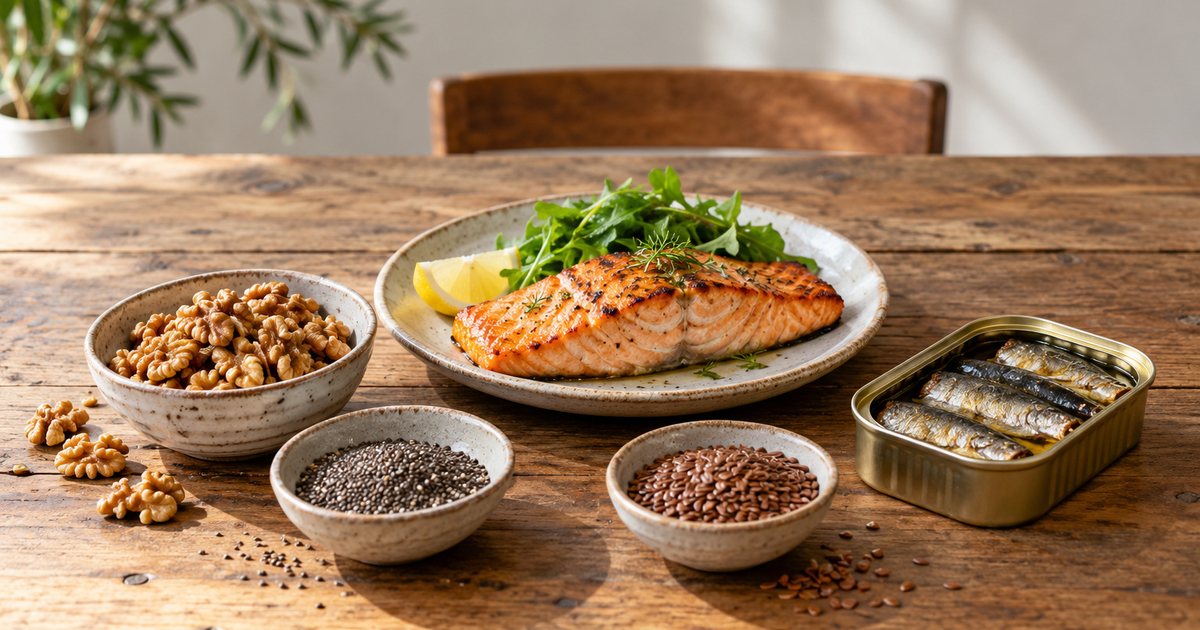
Omega-3s are a family of fats your body uses to build the membranes around every cell, and they are especially concentrated in the brain, the retina of the eye and sperm. They are also used to make signalling molecules involved in the heart and blood vessels, the lungs, the immune system and hormones. Your body cannot make the plant omega-3 called ALA, so it has to come from food, and it turns only a small amount of ALA into the longer EPA and DHA found mainly in oily fish.
This guide includes a few product links near the end. As an Amazon Associate, michelle.net.au earns from qualifying purchases, at no extra cost to you.
This guide takes a food-first look at omega-3: which fish and plant foods supply EPA and DHA or ALA, roughly how much a typical serve provides, how that compares with official intake reference values, and what the word “omega-3” on a food label does and does not tell you. If you take or are thinking about a supplement, our guide to reading an omega-3 label covers capsules in detail.
At a glance
- There are three main omega-3s in food: ALA (from plants) and EPA and DHA (mainly from fish and seafood, which get them from algae).
- The body converts only a small share of ALA into EPA and DHA; the US National Institutes of Health reports conversion rates below 15%.
- Oily fish such as salmon, herring, sardines and mackerel supply far more EPA and DHA per serve than white fish, prawns or canned light tuna.
- Flaxseed, chia, walnuts, canola oil and soy supply ALA, not EPA or DHA.
- Olive oil is mostly monounsaturated fat and is not a meaningful source of omega-3.
What does omega-3 do in the body?
According to the NIH Office of Dietary Supplements fact sheet, omega-3s are structural parts of the phospholipids that make up cell membranes. DHA is found in especially high levels in the retina, brain and sperm. Omega-3s also provide energy and are used to make eicosanoids, a group of signalling molecules that take part in cardiovascular, lung, immune and hormone-system processes.
That is a description of their normal roles, not a promise of any particular result from eating more of them. Research on omega-3s and specific health outcomes is large and mixed, and it is outside the scope of this food guide. If you have a heart condition, take blood-thinning medicine or are planning a big change to your diet, talk to your doctor, dietitian or pharmacist.
ALA, EPA and DHA: what is the difference?
| Omega-3 | Where it comes from | Key point |
|---|---|---|
| ALA (alpha-linolenic acid) | Flaxseed, chia, walnuts, canola and soybean oils, some legumes | The only essential omega-3: your body cannot make it, so it must come from food |
| EPA (eicosapentaenoic acid) | Oily fish and seafood; algae | Made from ALA only in small amounts, so food is the practical source |
| DHA (docosahexaenoic acid) | Oily fish and seafood; algae | Concentrated in the brain and retina |
A fourth long-chain omega-3, DPA, is also found in fish and in smaller amounts in meat. Australian and New Zealand reference values count it together with EPA and DHA.
What food has omega-3 in it? The best sources
The figures below come from the NIH Office of Dietary Supplements omega-3 fact sheet, which draws on US food composition data. Fish figures are for a cooked 3-ounce serve (about 85 g). Values in your country can differ with the species, whether the fish is farmed or wild, the season and how it is prepared, so read these as approximate.
Fish and seafood (EPA and DHA)
| Food (about 85 g cooked) | DHA (g) | EPA (g) | EPA + DHA (g, approx.) |
|---|---|---|---|
| Atlantic salmon, farmed | 1.24 | 0.59 | 1.83 |
| Atlantic salmon, wild | 1.22 | 0.35 | 1.57 |
| Atlantic herring | 0.94 | 0.77 | 1.71 |
| Sardines, canned in tomato sauce, drained | 0.74 | 0.45 | 1.19 |
| Atlantic mackerel | 0.59 | 0.43 | 1.02 |
| Pink salmon, canned, drained | 0.63 | 0.28 | 0.91 |
| Rainbow trout, wild | 0.44 | 0.40 | 0.84 |
| Sea bass | 0.47 | 0.18 | 0.65 |
| Oysters, eastern, wild | 0.23 | 0.30 | 0.53 |
| Prawns (shrimp) | 0.12 | 0.12 | 0.24 |
| Light tuna, canned in water, drained | 0.17 | 0.02 | 0.19 |
| Tilapia | 0.11 | not listed | 0.11 |
| Pacific cod | 0.10 | 0.04 | 0.14 |
The pattern is clear: oily fish provide several times more EPA and DHA than white fish, prawns or canned light tuna. That does not make white fish a poor choice; it simply supplies less of these particular fats.
Plant foods (ALA)
| Food | Serve | ALA (g) |
|---|---|---|
| Flaxseed (linseed) oil | 1 tablespoon | 7.26 |
| Chia seeds | 1 ounce (about 28 g) | 5.06 |
| Walnuts (English) | 1 ounce (about 28 g) | 2.57 |
| Whole flaxseed | 1 tablespoon | 2.35 |
| Canola oil | 1 tablespoon | 1.28 |
| Soybean oil | 1 tablespoon | 0.92 |
| Edamame, prepared | half a cup | 0.28 |
| Kidney beans, canned | half a cup | 0.10 |
Eggs, chicken, beef, bread and milk contain only small amounts of omega-3 unless they come from animals fed omega-3-rich feed, or the food has been enriched. In the NIH table, a regular cooked egg provides about 0.03 g of DHA.
How much omega-3 do you need?
Intake reference values differ between countries, which is why figures online can look inconsistent. Two common sets are shown below for adults. They are population reference values, not personal targets; your own needs depend on your health, diet and life stage, so ask your doctor or dietitian if you are unsure.
| Reference | Men | Women |
|---|---|---|
| Australia and New Zealand (NHMRC): adequate intake, ALA | 1.3 g a day | 0.8 g a day |
| Australia and New Zealand (NHMRC): adequate intake, long-chain omega-3 (DHA + EPA + DPA) | 160 mg a day | 90 mg a day |
| Australia and New Zealand (NHMRC): suggested dietary target, long-chain omega-3 | 610 mg a day | 430 mg a day |
| United States (NIH): adequate intake, ALA | 1.6 g a day | 1.1 g a day |
The US has no official adequate intake for EPA and DHA in adults, because ALA is the only omega-3 classed as essential. The Australian and New Zealand values set a separate figure for the long-chain omega-3s and a higher “suggested dietary target” linked to chronic disease risk at a population level.
Worked example: food against the reference values
Using the tables above, one cooked serve of about 85 g of farmed Atlantic salmon supplies roughly 1,830 mg of EPA plus DHA. Spread across a week, two such serves average a little over 500 mg a day, which sits around the Australian and New Zealand suggested dietary targets of 430 mg for women and 610 mg for men. By contrast, the same weight of canned light tuna supplies about 190 mg, so you would need several serves to reach a similar weekly total. These are rough estimates; real fish varies.
For plant omega-3, a tablespoon of whole flaxseed (about 2.35 g of ALA) or a small handful of walnuts (about 2.57 g per 28 g) is already above the ALA adequate intake for most adults. That does not add up to the same thing as eating EPA and DHA, because only a small fraction is converted.
Does olive oil have omega-3 fatty acids?
Olive oil contains a small amount of ALA, but most of its fat is monounsaturated oleic acid (an omega-9 fat). It is not a meaningful source of omega-3 compared with flaxseed, canola or soybean oil, and it supplies no EPA or DHA. Olive oil can still be part of a healthy eating pattern; it is simply not where your omega-3 comes from.
What has omega-6, and does the ratio matter?
Omega-6 fats are found in many vegetable oils (such as sunflower, safflower, corn and soybean oils), nuts and seeds, and foods made with them. The main omega-6, linoleic acid, is also essential. The NIH fact sheet notes that ALA and linoleic acid compete for the same enzymes, and that an optimal ratio of omega-6 to omega-3 has not been defined. Most experts, it says, see raising EPA and DHA as more important than cutting omega-6. In practice, a mix of oily fish, nuts, seeds and plant oils covers both.
What “omega-3” on a food label does and does not mean
Words like “source of omega-3”, “rich in omega-3” or “with omega-3” appear on eggs, milk, spreads, bread and snack foods. Rules for these claims vary by country, so check what your local food regulator requires. Some useful checks:
- Which omega-3? A spread or cereal labelled omega-3 often contains ALA from a plant oil, not EPA and DHA. Look for the names in the nutrition panel or ingredient list.
- How much per serve? Compare the amount per serve with the tables above. A small amount of DHA in a slice of bread is very different from a serve of salmon.
- “Omega-3-6-9” blends. These mix fats you may already get plenty of from food. Our omega-3 label guide explains why the total can mislead.
- The whole food still matters. An omega-3 claim on a sugary snack does not make it a nutritious choice.
Mercury and choosing fish
Most fish are low in mercury, but some large predatory fish contain more. Food Standards Australia New Zealand advice, as summarised by state health departments, uses a 150 g serve for adults and says the general population can eat 2 to 3 serves a week of any fish or seafood other than shark (flake) or billfish such as swordfish and marlin. For those fish, the advice is 1 serve a week with no other fish that week.
Pregnant women, women planning pregnancy and children up to six years have stricter advice that also limits orange roughy (sea perch) and catfish. Salmon, canned tuna and shellfish such as prawns, lobster and oysters are listed as lower-mercury choices. Advice in other countries differs, so check your local food safety authority.
A simple checklist for getting omega-3 from food
- Pick one or two oily fish you enjoy, such as salmon, sardines, mackerel, herring or trout, fresh, frozen or canned.
- Check the mercury advice for your country and life stage, especially if you are pregnant or feeding young children.
- Add an ALA food most days, such as ground flaxseed in porridge, chia in yoghurt, walnuts as a snack or canola oil in cooking.
- Read labels on “omega-3” foods and note whether the omega-3 is ALA or EPA and DHA, and how much a serve contains.
- If you do not eat fish, ask a dietitian about plant and algae sources; our guide comparing fish, krill and algae oils explains the algae option.
- Before starting any omega-3 supplement, especially with blood-thinning medicines or before surgery, talk to your doctor or pharmacist.
Common mistakes
- Assuming all fish are equal. White fish and canned light tuna supply far less EPA and DHA than oily fish.
- Counting ALA as if it were EPA and DHA. Flaxseed and chia are good ALA sources, but very little turns into the long-chain forms.
- Relying on olive oil for omega-3. It is mainly monounsaturated fat.
- Taking “omega-3” on a label at face value. Check which omega-3 and how much.
- Doubling up on cod liver oil. It also contains vitamin A and vitamin D; see cod liver oil vs fish oil before combining products.
- Ignoring mercury advice for pregnancy and young children. The serve limits are different for these groups.
For a wider picture of eating patterns, see our guides to anti-inflammatory foods and the hype around them and vitamins and minerals for beginners.
Sources this guide draws on: NIH Office of Dietary Supplements, Omega-3 Fatty Acids fact sheet for health professionals; NHMRC Nutrient Reference Values for Australia and New Zealand (fats); Food Standards Australia New Zealand mercury in fish advice, as summarised by the Victorian Better Health Channel.
Handy kit for this guide
These are practical everyday products, not supplements or medicines. As an Amazon Associate, michelle.net.au earns from qualifying purchases, at no extra cost to you. Prices and availability are set by Amazon and may vary by country.
- The Blue Zones Kitchen by Dan Buettner
100 everyday recipes built around beans, greens and whole grains.
View on Amazon - The Complete Mediterranean Cookbook (America’s Test Kitchen)
500 kitchen-tested recipes with plenty of fish, legumes and vegetables.
View on Amazon - Etekcity Digital Kitchen Scale
Reads in grams, handy for portions, recipes and checking a scoop against a label.
View on Amazon
Frequently asked questions
What do omega-3s do?
Omega-3s are building blocks of cell membranes, with DHA especially concentrated in the brain and retina. They also provide energy and are used to make signalling molecules involved in the heart and blood vessels, lungs, immune system and hormones.
What food has the most omega-3?
For EPA and DHA, oily fish such as salmon, herring, sardines and mackerel lead the list. For ALA, flaxseed oil, chia seeds, walnuts and whole flaxseed are the richest common foods.
Can I get enough omega-3 without eating fish?
You can meet ALA reference values from plant foods, but your body converts only a small share into EPA and DHA. Algae-based products are a non-fish source of EPA and DHA; a dietitian can help you plan if you avoid fish.
Does olive oil have omega-3?
Only a small amount. Olive oil is mostly monounsaturated oleic acid, so oils such as canola, soybean or flaxseed are much richer plant sources of omega-3.
Is canned tuna a good source of omega-3?
Canned light tuna provides some DHA but much less than salmon or sardines. It is listed as a lower-mercury choice in Australian advice, so it can be part of the mix.
What has omega-6?
Sunflower, safflower, corn and soybean oils, nuts, seeds and many processed foods contain omega-6. Most people already eat plenty, and the NIH notes that an ideal omega-6 to omega-3 ratio has not been defined.
Getting omega-3 from food comes down to a few habits: oily fish a couple of times a week if you eat fish, a daily ALA food, and a careful read of any “omega-3” label. Small, steady choices add up across the week.