
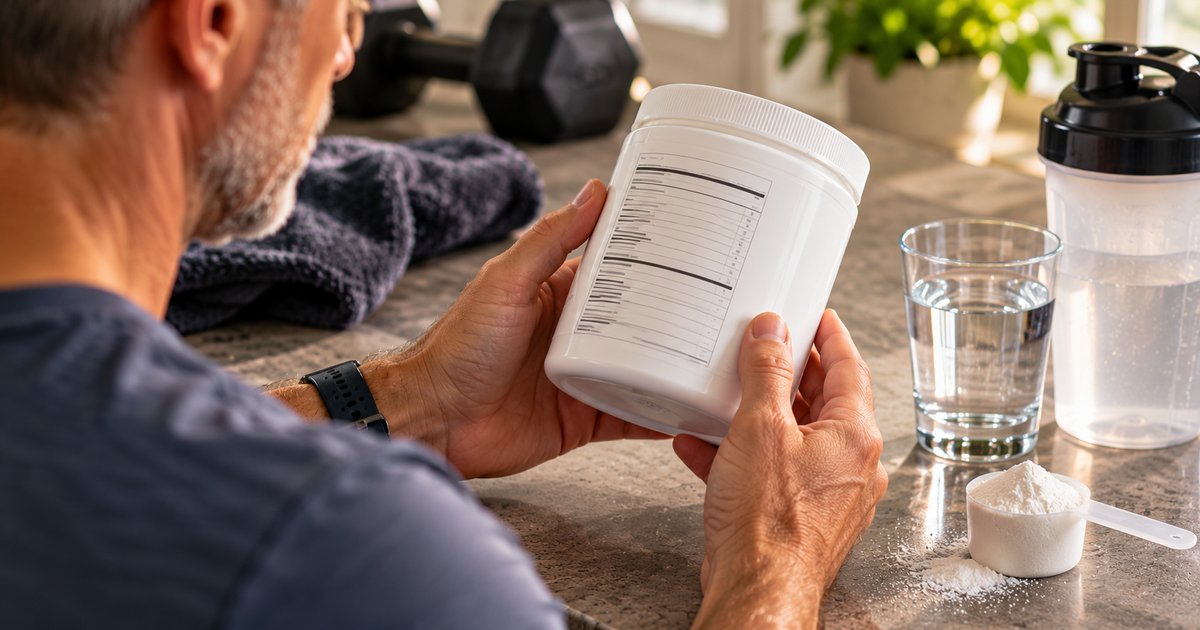
When you buy creatine, plain creatine monohydrate is the form with almost all of the published research behind it, and it is usually the cheapest per gram. Pricier “advanced” forms such as creatine HCl, buffered creatine or ethyl ester have not been shown to get into muscle better, according to the International Society of Sports Nutrition’s 2017 position stand. On the label, check that the compound is creatine monohydrate, that the scoop matches the stated serve, and whether an independent testing seal is present, then compare products on cost per gram of creatine rather than price per tub.
Where this article links to a product, that link may be an affiliate link and this site may earn a commission at no extra cost to you. See our Affiliate Disclosure.
This guide is about reading the tub. It explains what creatine monohydrate is, how it compares with the premium forms beside it, what micronised and purity claims mean, how to read the Supplement Facts or nutrition panel, and how to work out real value. It does not claim that creatine does anything for your health or performance, and it does not tell you whether to take it. For what the research has looked at in older adults, see creatine after 50.
At a glance
- Monohydrate is the reference form: it is about 88 per cent creatine by weight, so a 5 g serve holds roughly 4.4 g of creatine.
- Premium forms are mostly marketing: the ISSN describes claims of better uptake for other forms as currently unfounded.
- Micronised means finer powder, which mixes better. It is still the same compound.
- Value is cost per gram of creatine, not price per tub or per scoop.
- Talk to your doctor or pharmacist first if you have kidney disease, take regular medicines, or are pregnant or breastfeeding.
What creatine monohydrate is
Creatine is a compound the body makes from amino acids and also gets from meat and fish. As a supplement it is sold almost entirely as creatine monohydrate: creatine bound to one molecule of water within the crystal. That water is part of the structure, not a sign of a damp product.
The U.S. National Institutes of Health Office of Dietary Supplements gives the figure of about 88 per cent creatine by weight for monohydrate, with the remaining 12 per cent the bound water. That is the first useful label fact: some labels state “creatine” per serve and others state “creatine monohydrate” per serve, and the two differ by that 12 per cent. Make sure you are comparing like with like.
Creatine forms compared
Beside the plain tubs you will find creatine hydrochloride (HCl), buffered creatine, creatine ethyl ester, citrate, nitrate, malate, liquid creatine, gummies and “complex” blends. They usually cost more and often claim better absorption, a smaller dose or less stomach upset.
| Form | What it is | Approximate creatine content | What the evidence reviews say | Label watch-points |
|---|---|---|---|---|
| Creatine monohydrate (standard) | Creatine with one bound water molecule | About 88% | The form used in most published research | Should be the only ingredient in an unflavoured tub |
| Micronised monohydrate | The same compound milled finer | About 88% | Same compound; difference is mixing | Usually costs a little more |
| Creatine HCl | Creatine bound to hydrochloride | About 78% (calculated from molecular weights) | Better uptake to muscle not demonstrated | Small serves marketed as “equivalent” to larger monohydrate serves |
| Buffered creatine | Creatine with an alkaline buffer | Varies by product | Not shown to be retained in muscle better than monohydrate | Often sold under a trademark; check the panel compound |
| Creatine ethyl ester | An esterified form | Varies | Not shown to be better; may break down to creatinine more readily | Usually more expensive per gram of creatine |
| Liquid creatine | Creatine in solution | Varies | Creatine is less stable in liquid over time | Check creatine per serve and storage advice |
| Gummies and chews | Creatine in a confectionery base | Small amount per piece | Form usually monohydrate; dose depends on pieces | Count how many pieces make a serve, and sugar per serve |
The ISSN position stand (Kreider and colleagues, 2017) states that claims that other forms are degraded less in the body, or result in greater uptake to muscle, are currently unfounded. That is a statement about the published evidence, not about any one product. It is worth remembering when a tub claiming “superior absorption” costs several times more than plain monohydrate.
Micronised versus standard
“Micronised” describes particle size, not chemistry. Micronised monohydrate is milled to a finer powder so it disperses in water more readily and settles more slowly. Standard mesh can feel gritty and sink to the bottom of the glass. Neither changes what is in the scoop. If a product is micronised, the label will say so prominently; if it does not, assume standard mesh.
Purity claims and trademarked raw materials
Many monohydrate labels state a purity figure, often 99.9 per cent or higher, sometimes with a trademarked raw-material name. The figure refers to how much of the raw material is creatine monohydrate rather than manufacturing by-products. The by-products good manufacturers test for include creatinine (the breakdown product of creatine), dicyandiamide and dihydrotriazine.
Trademarked raw materials are, in practice, a promise about where and to what specification the powder was made. They are not a different compound. Two tubs containing the same trademarked monohydrate are chemically the same product in different packaging.
How to read the panel: step by step
Plain creatine monohydrate has one of the shortest panels in the supplement aisle, so anything extra stands out. Labels differ by country: products in the United States usually carry a Supplement Facts panel, while in Australia, New Zealand and many other markets creatine may be sold as a sports food with a nutrition information panel. In some countries, including Australia, rules for sports supplements have tightened in recent years, and some products are regulated as medicines rather than foods depending on their ingredients and claims.
- Name the compound. Read the compound in the panel or ingredient list, not the brand name on the front.
- Check the serving size. Typically 3 g or 5 g, usually one level scoop. Check the scoop in the tub matches; scoops are sometimes sized for another product in the range.
- Check creatine per serve. In an unflavoured product it should be the whole serve or very nearly. If the serve is 5 g and the creatine is 3 g, something else makes up the other 2 g.
- Read the other ingredients. Pure monohydrate lists none. Flavoured products add flavours, sweeteners, colours and anti-caking agents. “Formulas” may add carbohydrate, beta-alanine, taurine, caffeine, electrolytes or B vitamins, each a separate decision and cost.
- Check the allergen statement. Creatine is not a common allergen, but the facility may handle milk, soy or gluten.
- Look for a batch number, best-before date and independent testing seal. Programmes such as Informed Sport, NSF Certified for Sport and, in Australia, HASTA test batches for banned substances. This guide to supplement certification seals explains what each checks and what it does not.
For the general skills of reading any pack, see how to read a supplement label.
Serving sizes and the numbers in the research
This is a label-reading point, not a recommendation. Creatine labels cluster around 3 g and 5 g serves because those amounts appear throughout the published studies. The ISSN position stand describes a loading protocol of about 0.3 g per kilogram of body weight a day (roughly 5 g four times daily) for five to seven days, followed by 3 to 5 g a day, and the NIH Office of Dietary Supplements describes the same protocol and an alternative of about 3 to 6 g a day without loading.
When a label states a serve well outside that range, such as a 1 g serve of a premium form described as “equivalent to 5 g of monohydrate”, the equivalence is the manufacturer’s claim. A very large serve usually means a blend where creatine is only part of the scoop. Whether creatine suits you, and in what amount, is a conversation for your doctor or pharmacist.
Working out value: cost per gram of creatine
Because scoop sizes and forms vary, price per tub tells you little. The fair comparison is cost per gram of creatine.
- Find the tub weight and the price.
- Find the share of the tub that is the creatine compound (compound per serve divided by serving size). For pure monohydrate this is 1.0.
- Multiply by 0.88 for monohydrate, or about 0.78 for HCl, to get grams of creatine.
- Divide the price by the grams of creatine.
A worked example with made-up numbers, not real prices at the time of writing (October 2026); prices change and differ by country, so use the figures on the tubs in front of you.
| Hypothetical tub | Weight | Price | Compound share | Grams of creatine | Cost per gram of creatine |
|---|---|---|---|---|---|
| A: plain monohydrate | 500 g | $25 | 1.0 | 440 g | about $0.06 |
| B: micronised monohydrate | 500 g | $32 | 1.0 | 440 g | about $0.07 |
| C: flavoured drink mix, 5 g creatine monohydrate in an 8 g serve | 500 g | $35 | 0.63 | about 275 g | about $0.13 |
| D: creatine HCl | 90 g | $40 | 1.0 | about 70 g | about $0.57 |
In this example, tub D costs roughly ten times as much per gram of creatine as tub A. The method is the point: run it on any two tubs and the difference becomes obvious. Creatine is often compared alongside protein powder; this guide to protein powder types and labels uses the same cost-per-gram approach.
Safety and who should ask first
The NIH Office of Dietary Supplements fact sheet lists weight gain, largely from water retention, as the consistently reported side effect, with anecdotal reports of digestive upset and cramping. The ISSN review concluded that, in healthy people, short- and long-term use at the amounts studied has not been shown to cause harm.
- Talk to your doctor or pharmacist before buying if you have kidney disease or reduced kidney function, diabetes, or take regular medicines.
- Creatine can raise blood levels of creatinine, a marker used in kidney function tests, so tell your doctor if you take it before any blood test.
- Ask first if you are pregnant, breastfeeding, or under 18.
- If you compete in drug-tested sport, choose a batch-tested product; contamination of supplements with banned substances is a known risk.
Common mistakes
- Paying for a premium form on absorption claims alone. The evidence reviews have not found an advantage over monohydrate.
- Comparing “creatine” with “creatine monohydrate” per serve. They differ by about 12 per cent.
- Judging value by tub price. Flavoured mixes and blends can cost twice as much per gram of creatine.
- Trusting the scoop. Check it matches the stated serving size.
- Assuming a seal means it works. Testing programmes check contamination and label accuracy, not effects.
- Forgetting to mention it before blood tests. It can change a common kidney marker.
- Buying from unfamiliar overseas sellers without checking. Labelling rules differ by country; this guide to buying supplements internationally covers what to check.
If you are tempted by chewable versions, read what testing has found in creatine gummies before you pay the premium.
Sources this guide draws on: Kreider RB and colleagues, International Society of Sports Nutrition position stand: safety and efficacy of creatine supplementation in exercise, sport, and medicine, Journal of the International Society of Sports Nutrition (2017); National Institutes of Health Office of Dietary Supplements, Dietary Supplements for Exercise and Athletic Performance fact sheet for health professionals; U.S. Food and Drug Administration Dietary Supplement Labeling Guide. The creatine HCl fraction is calculated from molecular weights (creatine 131.1, creatine hydrochloride 167.6), not quoted from a manufacturer.
Handy kit for this guide
These are practical tools, not supplements or medicines. As an Amazon Associate, michelle.net.au earns from qualifying purchases, at no extra cost to you. Prices and availability are set by Amazon and may vary by country.
- BlenderBottle Classic V2 Shaker (20 oz)
The wire whisk ball mixes powders into water or milk without lumps.
View on Amazon - Etekcity Digital Kitchen Scale
Reads in grams, handy for checking a scoop against the serving size printed on the label.
View on Amazon - Stainless Steel Measuring Spoon Set (6 pieces)
Plastic-free spoons for level, repeatable measures of powders.
View on Amazon
Frequently asked questions
Is creatine HCl better than creatine monohydrate?
The ISSN’s 2017 position stand found no published evidence that HCl or other alternative forms are taken up into muscle better than monohydrate. HCl is usually far more expensive per gram of creatine, so compare the two on that basis.
Is micronised creatine worth it?
Micronised creatine is the same compound, milled finer so it mixes more smoothly. If gritty texture bothers you, the small premium may be worth it to you; it does not change what is in the scoop.
What should be in the ingredient list of a creatine tub?
For an unflavoured product, only creatine monohydrate. Anything else, such as flavours, sweeteners or added actives, means you are buying a blend, and you should check how much creatine each serve actually contains.
Does creatine need to be third-party tested?
It is not required by law in most countries, but a batch-testing seal is the only way to know a product has been checked for banned substances and label accuracy. It matters most for people in drug-tested sport.
Are creatine gummies a good option?
Gummies usually contain a small amount of creatine per piece, so check how many pieces make up the stated serve, the sugar per serve and the cost per gram of creatine. They tend to be more expensive than powder.
The bottom line
The creatine aisle rewards label reading over price reading. Look for creatine monohydrate as the named compound, a scoop that matches the serve, an independent testing seal if it matters to you, and the lowest cost per gram of creatine. Then talk to your doctor or pharmacist about whether it suits you at all. For the wider picture on choosing supplements, see the supplements evidence and label guide.
This article is a guide to reading packaging and comparing products. It is general information only and is not medical advice. It makes no claim that creatine benefits any condition and it recommends no dose. Speak with a qualified healthcare professional before starting any supplement.