
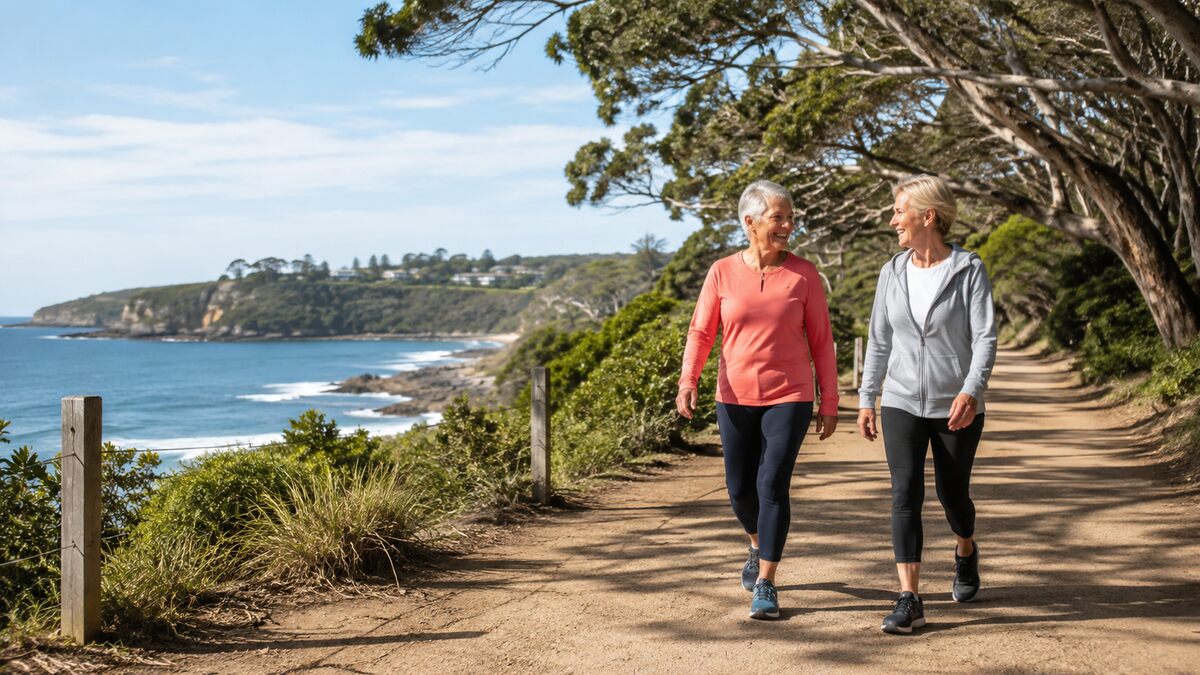
The habits most consistently linked with healthier ageing in large studies are regular physical activity including strength work, enough good-quality sleep, a mostly whole-food eating pattern, strong social connection, and managing long-term stress. Of these, physical activity has the strongest trial evidence in older adults; the others rely mainly on observational studies that show associations, not guarantees. No habit can promise a longer life for any individual.
This guide includes a few product links near the end. As an Amazon Associate, michelle.net.au earns from qualifying purchases, at no extra cost to you.
This guide explains each of the five habits, what the research behind it actually measured, how strong that evidence is, what guidelines around the world recommend, and a simple way to build the habits into an ordinary week. It is educational and written for adults in midlife and beyond.
At a glance
- Movement has the best evidence: in a large trial of adults aged 70 to 89, a structured activity programme reduced major mobility disability compared with health education.
- Sleep: sleep experts recommend 7 or more hours a night for adults on a regular basis.
- Eating pattern beats single foods: research points to overall patterns rich in vegetables, legumes, whole grains and adequate protein.
- Connection counts: loneliness and social isolation are consistently linked with poorer health outcomes in long-term studies.
- Associations are not promises. Talk to your doctor before major changes, especially to exercise if you have a heart or joint condition.
How to read longevity research
Most longevity research is observational. Researchers follow large groups of people who chose their own habits and record what happens over years. That design can show that people who do something tend to fare better, but not that the habit caused the difference. People who sleep well, exercise and keep up friendships also tend to have higher incomes and better access to healthcare, and statistical adjustment never fully separates those threads.
Reverse causation is a second problem. Illness that has not yet been diagnosed can disrupt sleep, activity and social life years earlier, so a habit can look like a cause when it is partly a consequence. Randomised controlled trials, where the habit is assigned rather than chosen, are the stronger design, and they are rare in this field.
| Habit | Main type of evidence | Strength | Typical guideline |
|---|---|---|---|
| Physical activity and strength training | Randomised trials plus large cohorts | Strongest | 150 to 300 minutes moderate activity weekly, plus strength on 2 or more days |
| Sleep | Observational cohorts and expert consensus | Moderate | 7 or more hours a night for adults |
| Eating pattern | Large cohorts; some diet trials on risk markers | Moderate | Mostly vegetables, fruit, legumes, whole grains; limit ultra-processed foods |
| Social connection | Observational cohorts and meta-analyses | Moderate, consistent | No numeric target; regular meaningful contact |
| Managing chronic stress | Observational studies; small trials on wellbeing measures | Weaker | No numeric target; practices that suit you |
Habit 1: Keep moving, and include strength training
Regular physical activity is the most robustly supported habit in healthy ageing research, and the one with genuine trial evidence. In the LIFE study, published in JAMA in 2014, 1,635 sedentary adults aged 70 to 89 were randomly assigned either to a structured programme of walking, strength, flexibility and balance work, or to health education classes, for an average of about 2.6 years. The activity group had a lower rate of major mobility disability (losing the ability to walk 400 metres).
Strength training has gained attention because maintaining muscle mass and strength is closely linked with independence and physical function later in life. The World Health Organization’s guidelines recommend that adults do 150 to 300 minutes of moderate-intensity aerobic activity (or 75 to 150 minutes of vigorous activity) a week, plus muscle-strengthening on two or more days. Adults aged 65 and over are also advised to do varied activity that emphasises balance and strength on three or more days. The WHO reports that, on 2022 data, about 31% of adults worldwide do not meet recommended activity levels.
For practical detail see strength training and bone density, balance habits for healthy ageing and everyday movement beyond the gym.
Habit 2: Prioritise regular, sufficient sleep
A 2015 joint consensus statement from the American Academy of Sleep Medicine and the Sleep Research Society concluded that adults should sleep 7 or more hours a night on a regular basis for optimal health. The panel found it uncertain whether regularly sleeping more than 9 hours is linked with health risk, so long sleep is an open question rather than a target.
Population studies often show a U-shaped pattern, with both short and long sleep associated with poorer outcomes. Long sleep may be as much a marker of existing illness as a cause. Consistent sleep and wake times, daylight in the morning, and less bright light and screen use late at night are widely recommended starting points. Persistent poor sleep, loud snoring or pauses in breathing are worth raising with your doctor. See sleep and healthy ageing for more.
Habit 3: Build meals around plants and enough protein
Rather than any single “superfood”, research points to the overall eating pattern. Patterns rich in vegetables, fruit, legumes, whole grains, nuts and adequate protein, with relatively little ultra-processed food, are the ones most consistently associated with healthier ageing in large cohorts.
An analysis of two large US cohorts (the Nurses’ Health Study and the Health Professionals Follow-up Study), published in the BMJ in 2020, looked at five low-risk factors: a healthy diet, regular activity, a healthy weight, not smoking and moderate or no alcohol. At age 50, women with four or five of these factors had on average about 34 more years free of diabetes, cardiovascular disease and cancer, compared with about 24 years for women with none; for men the figures were about 31 and 24 years. These are associations in health professionals in one country, not results any individual can expect.
Protein needs tend to matter more with age for keeping muscle; see protein after forty. For what the research on “anti-inflammatory” eating does and does not show, see anti-inflammatory foods.
Habit 4: Protect social connection
Strong social ties and a sense of purpose are associated with healthier ageing in long-running studies, while loneliness and isolation are consistently linked with poorer outcomes. A 2015 meta-analysis by Holt-Lunstad and colleagues in Perspectives on Psychological Science pooled 70 studies with more than 3.4 million participants. It reported that social isolation, loneliness and living alone were each associated with an increased likelihood of death during follow-up of roughly 26% to 32%, after adjustment for other factors. All the studies were observational.
The World Health Organization now regards social isolation and loneliness as public health priorities. In practice, connection can mean regular contact with family and friends, clubs, volunteering or group exercise, which also covers Habit 1.
Habit 5: Manage long-term stress
Chronic stress is associated with a range of poorer long-term health markers, including blood pressure and sleep. The evidence that any specific stress-management technique changes long-term outcomes is thinner than for the other habits. What shows up repeatedly is a cluster of supportive practices: regular movement, enough sleep, social support, time outdoors and simple relaxation or mindfulness techniques. Choose what you will actually keep doing.
If worry or low mood is affecting daily life, that is a reason to talk to your doctor rather than a habit to fix alone. The guide to understanding everyday anxiety covers the basics.
What sits alongside these five
The five habits above are not the whole picture. Not smoking, keeping alcohol low, and attending recommended health checks (blood pressure, cholesterol, cancer screening and vaccinations, which vary by country) are among the most established factors in public health guidance.
A simple weekly plan
- Book three or more 20 to 30 minute brisk walks or similar sessions into your calendar.
- Add two short strength sessions (bodyweight, bands or weights) on non-consecutive days.
- If you are 65 or over, include balance work such as standing on one leg near a support, tai chi or dance.
- Pick a regular wake time and keep it within about an hour, including weekends.
- Add a vegetable or legume to two meals a day, and a protein food to breakfast.
- Arrange at least one planned social contact each week: a call, coffee or class.
- Choose one stress practice, such as a daily walk outdoors or ten minutes of quiet breathing.
- Book any overdue health checks, and talk to your doctor before starting vigorous exercise if you have a health condition.
Common mistakes
- Chasing a single protocol or product: the evidence supports ordinary habits applied consistently, not supplements or gadgets. See the truth about healthy ageing protocols.
- Reading associations as promises: population findings describe groups, not what will happen to you.
- Doing cardio only: strength and balance work matter more with age.
- Starting too hard: sudden jumps in exercise raise injury risk; build up gradually.
- Sacrificing sleep to fit everything in: sleep is one of the habits, not a reward for finishing the others.
- Ignoring connection: social contact is often the first thing to slip and the easiest to plan.
Where the evidence is weakest
Most large cohorts were assembled in high-income countries, often in mainly white, professional populations, which limits how far findings apply elsewhere. Follow-up of even several decades captures only part of a life. And these habits cluster together in the same people, so the effect attributed to one may partly belong to the others. The honest summary is that these habits are reliably associated with healthier ageing, and physical activity has the strongest causal evidence.
Sources this guide draws on: World Health Organization guidelines on physical activity and sedentary behaviour and physical activity fact sheet; LIFE study, JAMA (2014); American Academy of Sleep Medicine and Sleep Research Society consensus statement (2015); Li and colleagues, BMJ (2020), using the Nurses’ Health Study and Health Professionals Follow-up Study; Holt-Lunstad and colleagues, Perspectives on Psychological Science (2015); Harvard T.H. Chan School of Public Health Nutrition Source.
Handy kit for this guide
These are practical everyday products, not supplements or medicines. As an Amazon Associate, michelle.net.au earns from qualifying purchases, at no extra cost to you. Prices and availability are set by Amazon and may vary by country.
- The Blue Zones Kitchen by Dan Buettner
100 everyday recipes built around beans, greens and whole grains.
View on Amazon - Bambaw Insulated Stainless Steel Water Bottle (32 oz)
Plastic-free and keeps water cold all day, at home, on walks or at the gym.
View on Amazon - Gaiam Premium 5 mm Yoga Mat
Non-slip mat for yoga, Pilates, tai chi warm-ups and floor exercises.
View on Amazon
FAQ
What is the single most important habit for healthy ageing?
Physical activity has the strongest evidence, including randomised trials in older adults showing benefits for mobility. It also supports sleep, mood and social contact. That said, the habits work together, and not smoking remains one of the most established factors of all.
Is it too late to start these habits at 60 or 70?
No. The LIFE trial enrolled sedentary adults aged 70 to 89, and strength and fitness still respond to training in later life. Start gently, build up gradually, and check with your doctor first if you have a heart, lung or joint condition.
How much sleep do older adults need?
Sleep experts recommend 7 or more hours a night for adults on a regular basis. Sleep often becomes lighter and more broken with age, but persistent poor sleep, loud snoring or daytime sleepiness are worth raising with your doctor.
Do supplements help with longevity?
There is no supplement shown to extend life in healthy people. Some people need specific nutrients for diagnosed deficiencies. Talk to your doctor or pharmacist before taking supplements, as some interact with medicines.
Can these habits guarantee a longer life?
No. They are associated with healthier ageing across large groups of people, but genetics, environment, access to healthcare and chance all play a part. The aim is to improve your odds and your day-to-day function, not to promise an outcome.
None of these five habits is new or flashy, and that is the point: the most consistent findings in ageing research are ordinary habits kept up over years. Choose one step from the weekly plan, make it routine, then add the next, and talk to your doctor about what suits your health.
This guide is general education based on published research and guidelines. It is not medical advice. Talk to your doctor or pharmacist before major changes to exercise, diet or supplements.