
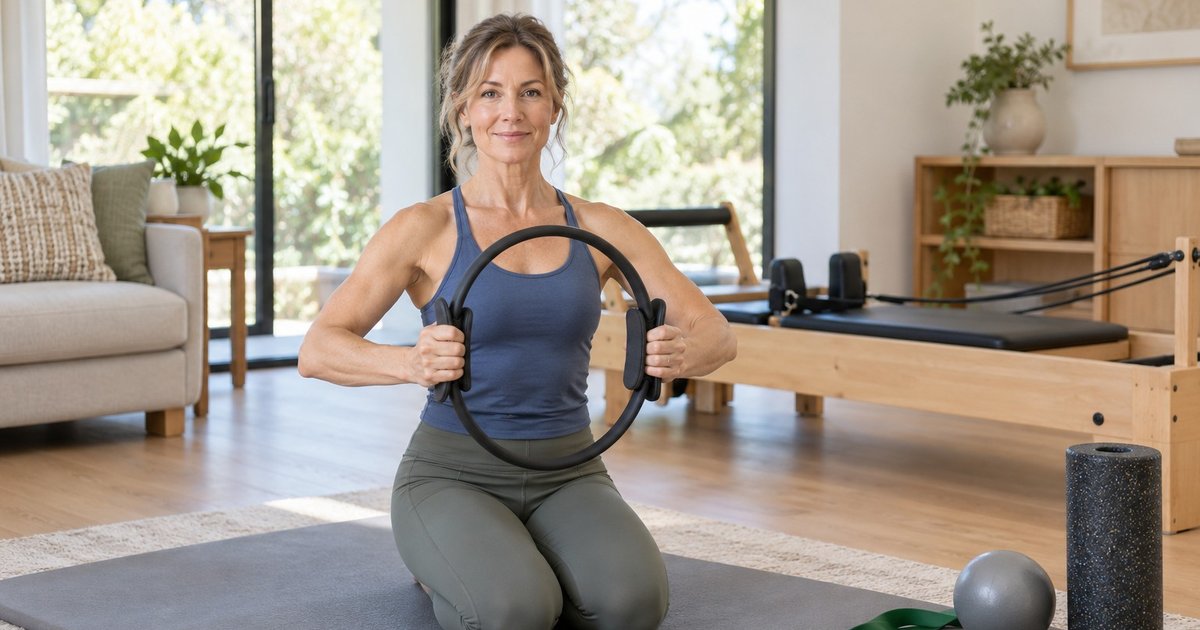
To start Pilates at home you need only a comfortable, non-slip mat with enough cushioning for lying and kneeling work, plus one or two small props such as a resistance band or a soft ball. A reformer is an optional, much larger purchase that is best considered after you have learned reformer work with a qualified instructor and measured your space carefully. Most people can practise well for months, or years, without one.
This article contains affiliate links. As an Amazon Associate I earn from qualifying purchases, at no extra cost to you. Affiliate disclosure.
This guide walks through home Pilates equipment in the order most people buy it: the mat, small props, mid-sized options such as reformer boards, and full reformers. It covers what each item is for, what to check before buying, how much room you need, how to inspect secondhand gear, and the mistakes that lead to expensive regret.
At a glance
- Start with a mat: mat Pilates is a complete method on its own.
- Add props one at a time: a band and a small ball, or a ring, cover a lot of exercises for little money and space.
- Learn before you buy big: take some supervised reformer classes before considering a home reformer.
- Measure twice: allow roughly 2.4 x 3 m (8 x 10 ft) of clear floor for a full reformer in use, plus any storage spot.
- Check safety limits: user weight limits, spring condition and stability matter more than looks.
Before you buy: health and learning first
Equipment is only part of the picture; how you move matters more. If you have an injury, are pregnant or recently had a baby, have had recent surgery, have osteoporosis or live with a heart, joint or other health condition, check with your doctor or a physiotherapist before starting Pilates or adding new equipment. They can tell you which movements to modify or avoid.
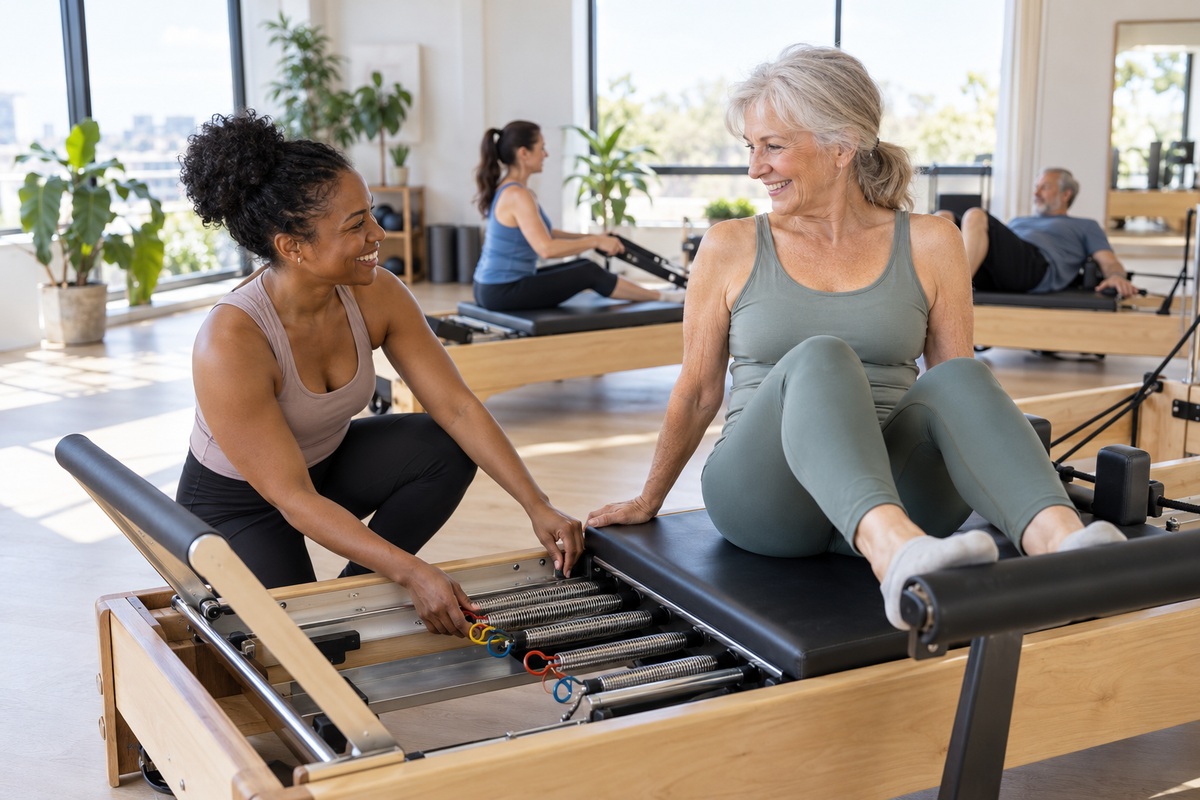
A few sessions with a qualified Pilates instructor, in a studio or online with live feedback, will teach you basic positions, breathing and how to use props safely. The guide to Pilates for beginners and what to expect covers those first sessions, and how to choose a Pilates or yoga studio explains how to check instructor training.
Home Pilates equipment compared
| Equipment | What it adds | Space needed | Learning curve | Best for |
|---|---|---|---|---|
| Pilates mat | Cushioning and grip for floor work | About 1.8 x 2.4 m (6 x 8 ft) to move freely | Low | Everyone starting out |
| Resistance band | Light, adjustable resistance and help reaching feet | Fits in a drawer | Low | Adding gentle challenge to arm and leg work |
| Small soft ball | Support under the back or hips; something to squeeze between knees | Minimal | Low | Comfort and core awareness |
| Pilates ring | Squeeze or press resistance for arms and inner or outer thighs | Minimal | Low | Variety in mat sessions |
| Foam roller | Balance challenge, support and self-massage | Small | Low to moderate | Balance work and gentle mobility |
| Reformer board or mat converter | Imitates some reformer movements with bands or springs | Similar to a mat, plus storage | Moderate | A middle step for small spaces |
| Foldable home reformer | Sliding carriage, springs, ropes and footbar | About 2.4 x 3 m in use; storage spot when folded | Moderate to high | Regular reformer users with limited space |
| Full-frame studio reformer | Most stable, widest spring range; some add a tower or trapeze | About 2.4 x 3 m or more, permanently; extra height for towers | High | Committed users with a dedicated room |
Level 1: the mat
A good mat is the foundation of home Pilates. Many Pilates exercises involve lying on your back, rolling along the spine or kneeling, so Pilates mats are usually thicker and softer than thin yoga or travel mats. Yoga mats tend to be firmer for stable standing balances. A yoga mat you already own is fine to begin with; some people fold a towel under it for rolling exercises.
What to look for in a mat
- Thickness: thicker feels kinder on the spine and knees on hard floors, but very thick, soft mats can feel wobbly when kneeling or standing. Try a few if you can.
- Grip: the top should stop hands and feet sliding, and the underside should stay put on timber, tiles or carpet.
- Size: lying down, your head and hips should both fit. Taller people may need a longer mat.
- Cleaning: a surface you can wipe down makes life easier.
- Getting down and up: if getting to the floor is difficult, ask your instructor about modified or standing exercises, or place the mat near a sturdy chair or bench you can use for support.
Level 2: small props
Small props add variety and resistance to mat work. They are light, relatively inexpensive and easy to store.
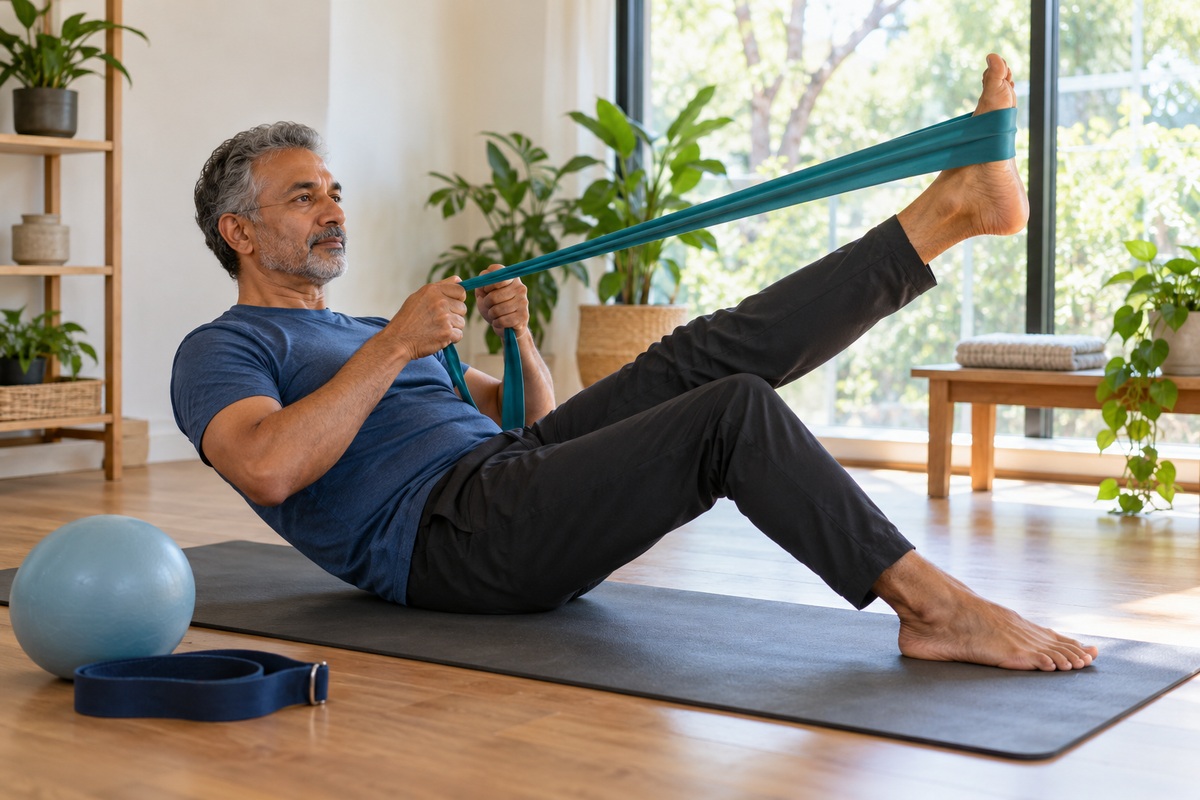
- Resistance bands: flat or looped elastic bands in different strengths. The guide to choosing resistance bands for beginners and older adults explains strengths, types and safety checks.
- Pilates ring (magic circle): a flexible ring with pads that you squeeze or press outward between hands, knees or ankles.
- Small soft ball: partly inflated, often around 20–25 cm (8–10 in) across, used under the back, between the knees or under the hips.
- Foam roller: used for balance work, support and self-massage. If you are deciding between a roller and other recovery tools, see massage gun vs foam roller.
- Blocks and straps: blocks bring the floor closer; straps extend your reach in stretches.
- Light hand weights: some programs use them for arm work; start very light.
How to choose props
Start with what your instructor or chosen program uses most. A band and a small ball, or a ring and a band, give plenty of options. Buy well-made items, check bands for nicks, thin spots or stickiness before each use, and replace them when they show wear, because a band that snaps can hit the face or eyes.
Level 3: reformer boards and mat converters
These are flat, lighter boards that use bands or springs to imitate some reformer movements. They can be a useful middle step if you enjoy reformer classes but lack space or budget for a full machine. They do not have the same sliding carriage, frame or spring system, so the feel and range of exercises are different. Check stability, the user weight limit and how the springs or bands attach.
Level 4: the reformer
A reformer is a frame with a padded carriage that slides along rails. Springs provide resistance, ropes or straps with handles let you push and pull, and a footbar gives you something to press against. Changing springs changes how heavy or light the carriage feels. That adjustability is the appeal, but it also means more to learn: wrong spring settings or losing control of the carriage can catch beginners off guard, which is why supervised learning matters.
Types of reformer
- Full-frame studio reformers: heavy, very stable and built for daily use, but they take a permanent footprint.
- Foldable or upright-storage home reformers: can be folded or stood on end. They save space, though some feel lighter or less stable.
- Reformers with a tower or trapeze: add a frame with extra springs and bars for more exercises, needing more floor space and ceiling height.
How much space does a reformer need?
Plan for roughly 2.4 x 3 m (8 x 10 ft) for a full reformer in use. That includes room to get on and off, reach the springs and move arms and legs through their full range. If it folds or stands upright, measure the storage spot too, including ceiling height, and make sure it can be secured so it cannot tip.
Brands you may come across
International names commonly seen in shops and studios include Balanced Body, Merrithew (STOTT PILATES), Peak Pilates and Align-Pilates. They are mentioned only as examples, not endorsements; many other makers exist, and availability, prices and support differ by country.
What about cost?
Prices vary widely by type, brand, materials, features, condition and country. A light folding model, a full studio machine and a secondhand reformer sit in very different price ranges, and delivery, assembly and replacement parts can add to the total. Compare what you get for the money, and the cost of a few classes to learn first, rather than the sticker price alone.
Where to buy
- Retailers with showrooms: lying on the carriage, changing springs and feeling the frame tells you more than any listing.
- Specialist Pilates suppliers: can usually explain model differences, spare parts and assembly.
- Local studios: some sell equipment or can tell you which suppliers they use and why.
- Secondhand sellers: can save money but need a careful inspection, below.
Our picks on Amazon: starter Pilates kit
If you are starting with mat work at home, these widely available basics cover Level 1 and Level 2 above.
- Amazon Basics Extra Thick Exercise Mat: a thick, cushioned budget mat for floor work.
- Manduka PRO Yoga Mat (6 mm): a dense, long-lasting studio-style mat if you want to buy once.
- Gaiam Pilates Ring: a light resistance ring used in many mat Pilates classes.
- Gaiam Mini Exercise Ball (8 inch): a small soft ball for support and variety in mat exercises.
- Gaiam Yoga Block: a foam block for support when a position feels out of reach.
- Fit Simplify Resistance Loop Bands (set of 5): light-to-heavy loop bands for adding gentle resistance.
Prices and availability change. Check the size, materials and returns policy before you buy, and ask your doctor or physiotherapist first if you have a health condition or injury.
Checklist before you buy a reformer
- Have you taken enough supervised reformer classes to know you enjoy it and can use it safely?
- Does the spring range suit you now and as you get stronger?
- Is the frame solid, with no wobble when the carriage moves?
- Does the maximum user weight suit everyone in the household who will use it?
- Do the carriage, footbar, headrest and straps adjust to your height?
- Is the carriage height easy for you to get on and off? Lower machines can be harder for people with stiff hips or knees.
- Have you measured the space in use and in storage, including doorways, stairs and ceiling height?
- What does the warranty cover, for how long, and who handles claims in your country?
- Are spare springs, ropes and straps easy to get, and how often should they be inspected or replaced?
- Are delivery and assembly included?
- Do you understand the returns policy and your consumer rights where you live?
- Will children or pets have access? Springs and moving carriages can pinch fingers and paws, so plan to store it safely.
Extra checks for secondhand reformers
- Inspect springs for rust, overstretching or uneven gaps between coils.
- Check ropes and straps for fraying, and wheels and rails for smooth, quiet movement.
- Look for torn upholstery that exposes foam or hard edges.
- Ask the machine’s age, how much it has been used and whether there is service history.
- Confirm parts are still available for that model and whether any warranty transfers.
Who a home reformer suits, and who it does not
| A home reformer may suit you if | Mat and props may suit you better if |
|---|---|
| You already attend reformer classes regularly and know your settings | You are new to Pilates or have tried only a class or two |
| You have a dedicated, measured space | Space is tight or shared |
| You will use it several times a week | Your schedule is unpredictable |
| Your health professional and instructor are comfortable with you practising alone | You are managing an injury or condition that benefits from supervision |
Common mistakes
- Buying the big item first. Many people find they prefer mat work, or a studio class, and the reformer becomes a clothes rack.
- Measuring only the frame. You need clearance around it, plus a route in through doors and up stairs.
- Ignoring the weight limit. It applies to every user, not just the buyer.
- Skipping spring checks. Worn springs and frayed ropes are the main safety issues on older machines.
- Using bands past their best. Replace bands at the first sign of nicks or thinning.
- Learning reformer work from videos alone. Without feedback, it is easy to choose the wrong springs or lose control of the carriage.
- Relying on Pilates alone. Pilates sits well alongside walking, strength and balance work; see strength training and bone density and balance habits for healthy ageing.
Sources this guide draws on: Healthdirect Australia, health benefits of yoga and Pilates; World Health Organization, guidelines on physical activity and sedentary behaviour; manufacturers’ published user weight limits and maintenance guidance; consumer protection guidance from national consumer agencies.
Frequently asked questions
Do I need a reformer to do Pilates at home?
No. Mat Pilates is a complete style in its own right, and a good mat plus one or two props is enough for most beginners. A reformer is an optional extra, best considered once you have learned reformer work with an instructor.
Can I use a yoga mat for Pilates?
Yes, especially at first. A thin yoga mat can feel firm during rolling or lying exercises, so some people add a folded towel or move to a thicker Pilates mat later.
Which props should I buy first?
A resistance band and a small soft ball are a common starting pair because they are versatile and easy to store. A Pilates ring is another popular choice. Buy what your instructor or chosen program uses most.
Is a reformer board the same as a reformer?
No. Boards and mat converters imitate some reformer movements but lack the sliding carriage, frame and full spring system. They can be useful in small spaces, but think of them as a different piece of equipment.
Is it safe to learn reformer Pilates on my own?
It is best to learn with a qualified instructor first. The moving carriage and springs take getting used to, and supervision teaches safe settings, how to get on and off, and how to stay in control. Always check weight limits and inspect springs and straps before use.
Is home Pilates suitable for older adults?
Many older adults enjoy Pilates, and exercises can be adapted. If you have osteoporosis, joint replacements, balance concerns or another health condition, talk to your doctor or a physiotherapist about which movements to modify, and consider starting with supervised classes.
Start simple with a comfortable mat and a prop or two, learn the basics with a qualified instructor, and let a reformer earn its place in your home only once you know you will use it.
This article is general information only and is not medical advice. Speak with your doctor or physiotherapist before starting a new exercise program, particularly if you are injured, pregnant or managing a health condition, and always follow the manufacturer’s instructions and safety limits. Brand names are examples only, not endorsements.