
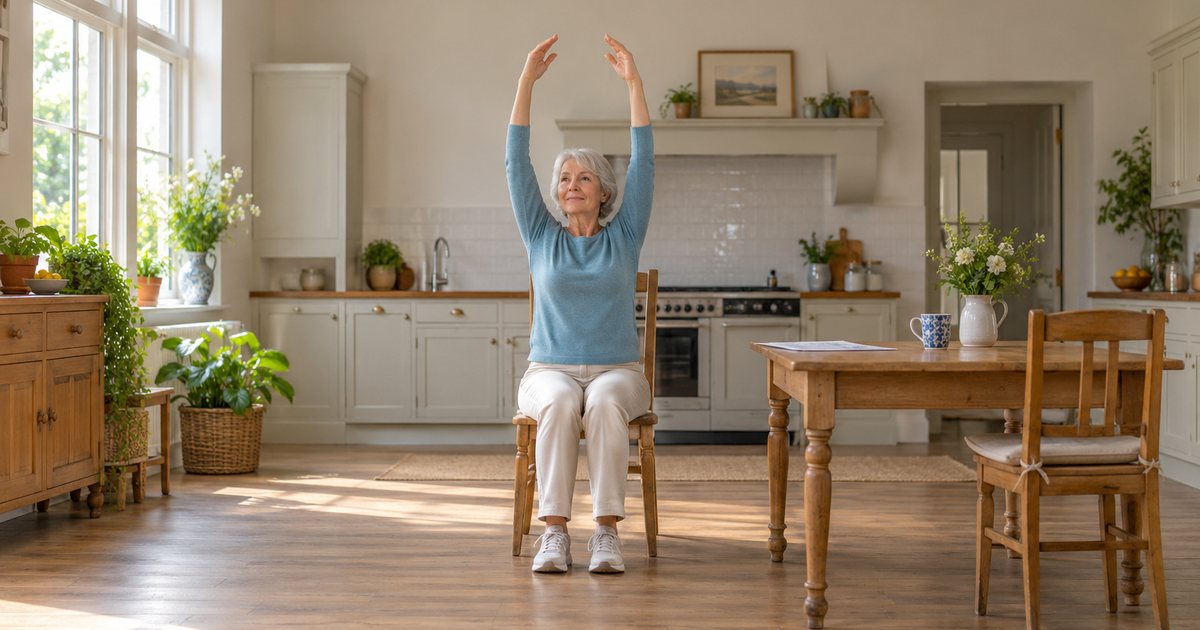
Printable chair yoga for seniors is a short routine of gentle, seated stretches and movements that you can keep on a sheet of paper beside your chair. The routine below has 10 moves and takes about 15 minutes. You do every move sitting on a sturdy chair, breathe slowly and steadily the whole way through, and stop anything that hurts. If you have a heart or lung condition, a joint replacement, osteoporosis or a recent fall, check with your doctor or physiotherapist first.
This guide includes a few product links near the end. As an Amazon Associate, michelle.net.au earns from qualifying purchases, at no extra cost to you.
Below: the full routine with written cues, a one-page print version with a tick chart, a comparison with chair Pilates and chair strength work, what the research shows, and the common mistakes.
At a glance
- Chair yoga is gentle and seated, so it suits people who find getting down to the floor or standing for long periods hard.
- The 10-move routine below takes about 15 minutes. Two or three sessions a week is a sensible start.
- Use a solid chair with no wheels. Sit tall with your feet flat and your knees roughly at right angles.
- Breathe normally the whole time, never hold your breath, and keep every stretch in the comfortable range.
- Chair yoga covers flexibility and relaxation well. On its own it is not a complete exercise plan, so pair it with walking, strength and balance work.
What chair yoga is, and who it suits
Chair yoga takes familiar yoga ideas, such as slow breathing, a tall spine, gentle twists, side bends and stretches, and does them sitting down. Some classes also use the chair for support during a few standing poses. This routine stays seated throughout, which keeps it simple and lowers the risk of losing your balance.
Chair yoga often suits:
- older adults who are new to exercise or coming back to it after a long break
- people with stiff joints who find floor exercise hard to get into and out of
- anyone who wants a calm, low-effort way to move on days when a walk is not possible
Talk to your doctor or physiotherapist before you start if any of the following apply. You have had a hip or knee replacement, because some seated positions and leg crossing may be restricted for a while. You have osteoporosis, because deep forward bending and strong twisting of the spine are often advised against. You get chest pain, dizziness or unusual breathlessness. Or you have had a fall, surgery or a new diagnosis recently. A physiotherapist can mark which moves on your printout to skip or change.
Chair yoga, chair Pilates and chair exercises compared
People searching for chair yoga often come across chair Pilates and general chair exercises too. They overlap, but each one has a different focus.
| Style | Main focus | Typical moves | Effort level | Best for |
|---|---|---|---|---|
| Chair yoga | Flexibility, breathing, relaxation | Seated twists, side bends, cat-cow, arm reaches, breathing | Low | Gentle mobility and winding down |
| Chair Pilates | Trunk control, posture, steady movement | Seated leg lifts with a braced trunk, controlled spine curls, arm work | Low to moderate | Posture and core control |
| Chair strength exercises | Muscle strength | Sit to stand, seated leg extensions, band rows | Moderate | Getting up from chairs, carrying, climbing stairs |
| Standing yoga or balance work | Balance and leg strength | Supported heel raises, tree pose holding a counter | Moderate | Steadiness on your feet |
For a fuller weekly plan, use this chair routine alongside the easy home exercises for seniors, which include sit-to-stand and supported balance moves. Gentle resistance band work for beginners is another good way to add strength from a chair.
Set up before you start
- Choose the chair. Use a solid, armless dining or kitchen chair with no wheels. Push it back against a wall so it cannot slide. Avoid deep sofas and recliners.
- Find your seat. Sit towards the front half of the chair with your feet flat on the floor, hip-width apart, and your knees roughly over your ankles. If your feet do not reach the floor, put a firm cushion or a thick book under them.
- Clear the space. Make sure you can stretch your arms out to both sides and in front without touching anything. Move rugs and cords out of the way.
- Dress for movement. Wear loose clothes and either flat shoes with grip or bare feet on a non-slip floor.
- Keep water and a phone close. This matters most if you live alone.
The 10-move printable chair yoga routine
Move slowly and breathe in and out through your nose if that is comfortable. Each stretch should feel mild, never sharp or painful. The repetitions are a starting point. Do fewer if you need to and add a few more over the weeks as the moves feel easier.
1. Seated mountain with breathing (1 minute)
Sit tall as if a string is lifting the top of your head. Rest your hands on your thighs and let your shoulders drop away from your ears. Breathe in slowly for a count of about four, then breathe out slowly for a count of about four to six. Repeat for 6 breaths.
2. Neck turns (1 minute)
Keep your chin level. Slowly turn your head to look over your right shoulder as far as is comfortable, hold for 3 breaths, then come back to the centre. Repeat to the left. Do 3 on each side. Do not tip your head backwards or roll it in full circles. If turning makes you dizzy, make the movement smaller or leave it out.
3. Shoulder rolls (1 minute)
With your arms relaxed by your sides, lift your shoulders up towards your ears, roll them back, then let them drop down. Do 5 slow rolls backwards, then 5 forwards.
4. Seated cat-cow (1 to 2 minutes)
Place your hands on your knees. As you breathe in, gently lift your chest and draw your shoulders back so your back arches slightly (cow). As you breathe out, round your upper back a little and let your chin dip towards your chest (cat). Repeat 5 times, keeping both movements small. If you have osteoporosis, skip the rounding part. Just lift your chest and come back to sitting tall.
5. Overhead reach (1 minute)
Breathe in and raise both arms forward and up as high as is comfortable. Your hands do not need to go above your head. Breathe out and lower them slowly. Repeat 5 times. If your shoulders are stiff, raise one arm at a time or stop at shoulder height.
6. Seated side bend (1 to 2 minutes)
Hold the side of the seat with your left hand. Breathe in and raise your right arm. Breathe out and lean gently to the left, keeping both sitting bones on the chair. Hold for 2 to 3 breaths, then come back up. Repeat on the other side. Do 2 or 3 on each side.
7. Gentle seated twist (1 to 2 minutes)
Sit tall. Place your right hand on your left knee and rest your left hand on the seat beside you. Breathe in to lengthen your spine, then breathe out and turn your chest a little to the left. Keep your hips facing forward. Hold for 2 to 3 breaths, return to the centre and repeat on the other side. Do 2 on each side. Turning less is fine. If you have osteoporosis or back problems, keep this move very small or ask your physiotherapist about it.
8. Seated marching (1 minute)
Hold the sides of the seat. Lift your right knee a few centimetres, lower it with control, then lift the left. Keep your back tall rather than leaning back. Do 10 slow marches in total.
9. Ankle pumps and circles (1 minute)
Straighten one leg slightly with the heel resting on the floor. Point your toes away from you, then pull them back towards you. Do this 5 times, then draw 5 slow circles with your foot in each direction. Swap legs.
10. Seated hamstring stretch and rest (2 minutes)
Slide your right foot forward so the leg is almost straight with the heel on the floor and the toes pointing up. Keep your back tall and lean forward from the hips only until you feel a mild stretch at the back of your thigh. Hold for 3 to 5 breaths, then swap legs. Finish by sitting tall with your eyes closed or your gaze lowered. Take 6 slow breaths before you stand up. When you get up, do it slowly and pause for a moment before walking.
Print-friendly version
To print just this part, highlight it from the heading down to the end of the weekly chart, then choose Print in your browser and select the option to print the selection only, if your browser offers it. Otherwise, print the page and keep the sheet with this section on it.
Chair yoga: 10 moves, about 15 minutes. Breathe steadily. Stop if anything hurts.
- Seated mountain: sit tall, 6 slow breaths.
- Neck turns: look right, then left, 3 each side, chin level.
- Shoulder rolls: 5 backwards, 5 forwards.
- Seated cat-cow: lift chest on the in-breath, small round on the out-breath, 5 times.
- Overhead reach: arms up on the in-breath, down on the out-breath, 5 times.
- Side bend: one hand holds the seat, other arm reaches over, 2 to 3 each side.
- Gentle twist: hips forward, turn your chest, 2 each side.
- Seated marching: 10 slow lifts, back tall.
- Ankle pumps and circles: 5 pumps, 5 circles each way, each foot.
- Hamstring stretch and rest: heel forward, lean from the hips, then 6 calm breaths.
| Week | Mon | Tue | Wed | Thu | Fri | Sat | Sun | How did it feel? |
|---|---|---|---|---|---|---|---|---|
| 1 | ||||||||
| 2 | ||||||||
| 3 | ||||||||
| 4 |
When to stop
Stop and rest if you feel any of the following. Seek medical help straight away if a symptom is severe or does not settle when you rest:
- chest pain, tightness or pressure
- dizziness, light-headedness or feeling faint
- breathlessness that is more than you would expect from gentle movement
- sharp or shooting pain, or pins and needles that spread down an arm or leg
- joint pain that is worse the next day than it was before you started
Does chair yoga really work? What the research shows
Studies of chair yoga are mostly small, so it helps to keep expectations modest. In a pilot randomised trial published in the Journal of the American Geriatrics Society, 131 community-dwelling older adults with osteoarthritis in the hips or knees did either a chair yoga program or a health education program. Both ran twice a week for eight weeks. The chair yoga group reported less interference from pain in daily life, and that difference was still there at three-month follow-up. Some other short-term improvements faded after the program ended, and the researchers found no effect on balance.
Looking at yoga more broadly, a 2019 systematic review and meta-analysis of randomised trials in older adults found improvements in lower body flexibility and lower limb strength compared with doing nothing. Compared with other forms of exercise, yoga did no better for balance or walking speed. The authors noted that many trials were small and that side effects were not consistently recorded.
In plain terms, chair yoga is a reasonable way to move more gently and comfortably, and people often enjoy it. It is not a replacement for strength and balance training. If keeping steady on your feet is your main goal, add the balance habits in this guide to balance for healthy ageing.
How chair yoga fits into a weekly plan
The World Health Organization’s physical activity guidelines suggest that older adults aim for regular aerobic activity, muscle-strengthening activity on two or more days a week, and varied activities that challenge balance on three or more days a week, all adjusted to what each person can do. Chair yoga is one small piece of that. A simple, realistic week might look like this:
- Chair yoga: two or three mornings, about 15 minutes
- Walking or other easy aerobic activity: most days, building up slowly. The guide to aerobic exercise for older adults explains how.
- Strength: two days, such as sit to stand and band exercises
- Breaking up sitting: stand and move every half hour or so. The guide to moving more when you sit a lot has simple ideas.
If you would like a teacher, many community centres and studios run seated classes. The checklist for choosing a Pilates or yoga studio covers what to ask before you book.
Common mistakes
- Using the wrong chair. Office chairs on wheels, folding chairs and soft sofas can slide or tip. A solid chair against a wall is safer.
- Holding your breath. People often hold their breath during twists and reaches without noticing. Breathe steadily and count out loud if that helps.
- Chasing the stretch. Bouncing or pushing further each day leads to soreness. A mild pull is enough.
- Twisting or folding too far with fragile bones. If you have osteoporosis, ask which spinal movements are right for you.
- Standing up too fast. Sitting still and breathing slowly can leave you a little light-headed. Pause before you stand.
- Relying on chair yoga alone. It does not replace strength, balance and walking.
Sources this guide draws on: NHS sitting exercises guidance; National Institute on Aging exercise and physical activity guidance for older adults; World Health Organization guidelines on physical activity and sedentary behaviour (2020); Park and colleagues’ pilot randomised trial of chair yoga in older adults with lower extremity osteoarthritis (Journal of the American Geriatrics Society); Sivaramakrishnan and colleagues’ systematic review of yoga in older adults (International Journal of Behavioral Nutrition and Physical Activity, 2019).
Handy kit for this guide
These are practical everyday products, not supplements or medicines. As an Amazon Associate, michelle.net.au earns from qualifying purchases, at no extra cost to you. Prices and availability are set by Amazon and may vary by country.
- Gaiam Premium 5 mm Yoga Mat
Non-slip mat for yoga, Pilates, tai chi warm-ups and floor exercises.
View on Amazon - Fabric Resistance Bands (5-Band Set)
Loop bands in graded resistance for home strength exercises.
View on Amazon - Bambaw Insulated Stainless Steel Water Bottle (32 oz)
Plastic-free and keeps water cold all day, at home, on walks or at the gym.
View on Amazon
Frequently asked questions
Is there a free printable chair yoga routine for seniors?
Yes. The print-friendly section of this guide sets out all 10 moves with short cues and includes a four-week tick chart. Print it from your browser and keep it next to your chair. Ask your physiotherapist to cross out or change anything that does not suit you.
Does chair yoga really work?
For gentle flexibility, comfort and relaxation, small trials are encouraging. One trial in older adults with hip or knee osteoarthritis found less pain interference with chair yoga than with health education. The evidence for balance is weaker, so chair yoga works best as part of a wider routine.
How often should seniors do chair yoga?
Two or three sessions a week of about 15 minutes is a manageable start. If you feel well the next day, gentle seated moves are often fine more often.
What is the difference between chair yoga and chair Pilates?
Chair yoga focuses on breathing, stretching and relaxed mobility. Chair Pilates focuses more on controlled movement, posture and holding the trunk steady while the arms or legs move. Both are low impact, and many people enjoy doing a little of each.
Can chair yoga help with balance?
Seated moves alone have shown limited effects on balance in trials. To improve steadiness, older adults are generally advised to practise balance activities standing up while holding a counter or a sturdy chair, ideally with guidance at first.
Is chair yoga safe after a hip or knee replacement?
It often can be, but some positions may be restricted for a period after surgery. Check with your surgeon or physiotherapist which moves to avoid before you begin.
Keep the sheet by your chair, start with fewer repetitions than you think you need, and tick off each session. Gentle and regular will take you further than ambitious and occasional.