
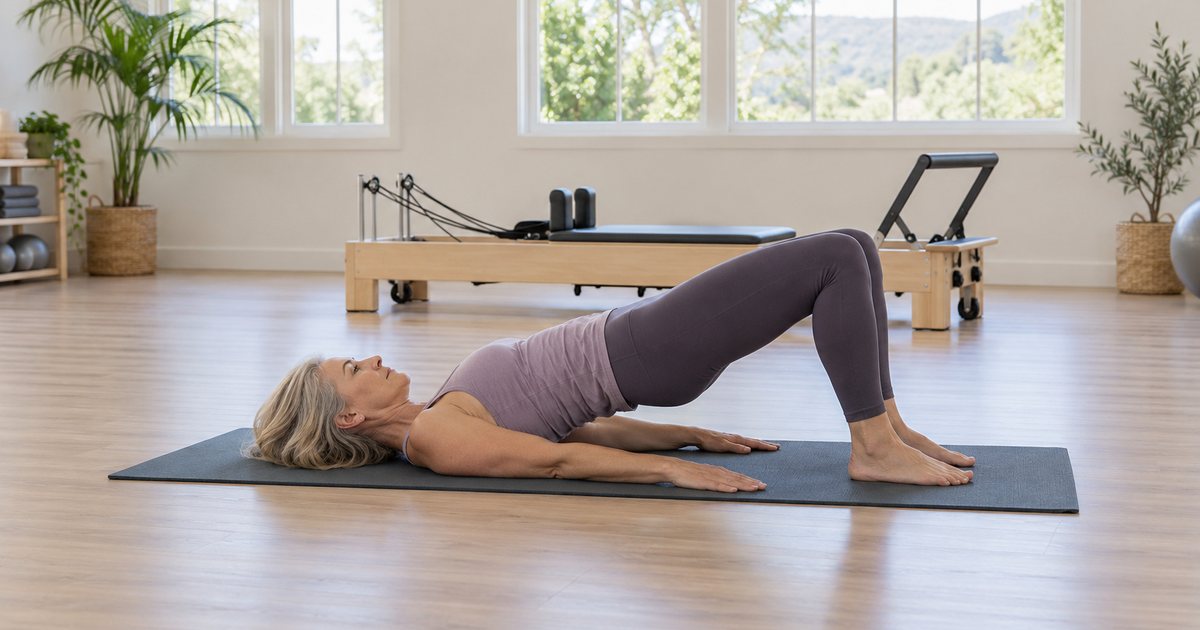
Mat Pilates is done on the floor using your own body weight, sometimes with small props, while reformer Pilates uses a sliding carriage with springs that can add resistance or give you support. Both teach the same core principles of control, breathing and alignment. For most adults over 40, the better place to start is whichever one you can do regularly, at a level that suits your joints, balance and budget.
This article contains affiliate links. As an Amazon Associate I earn from qualifying purchases, at no extra cost to you. Affiliate disclosure.
This guide compares mat Pilates and reformer Pilates side by side: what each one feels like, what a typical class involves, what research on Pilates and older adults has looked at, how the costs stack up, and a simple checklist for deciding where to begin. If you are brand new and want to know what happens in a first class, read our Pilates for beginners first-class guide alongside this one.
At a glance
- Mat Pilates works against gravity and your own body weight. It is portable, low cost and easy to practise at home, but it involves getting down to and up from the floor.
- Reformer Pilates uses springs, a footbar, straps and a moving carriage. The springs can make a move easier or harder, and the raised bed means less time kneeling or lying on the floor.
- Neither is automatically “better”. Research on Pilates and balance in older adults includes both styles, and results vary from study to study.
- Reformer classes usually cost more per class than mat classes because of the equipment and smaller class sizes.
- If you have osteoporosis, joint replacements, a recent injury or a balance problem, talk to your doctor or a physiotherapist before choosing.
What is mat Pilates?
Mat Pilates is the original floor-based repertoire. You lie on your back, side or front, sit, kneel and sometimes stand, moving slowly through exercises that ask your deep abdominal and back muscles to hold your trunk steady while your arms and legs move. The “resistance” is your own body weight and the length of your levers: a straight leg held away from you is harder than a bent knee close in.
Many classes add small props such as a Pilates ring, a soft ball, a foam roller or light resistance bands. These can make an exercise more supportive (a cushion under the head, a ball between the knees) or more challenging. Our guide to Pilates equipment, mats and props covers what is worth buying if you want to practise at home.
Common mat Pilates exercises
You are likely to meet a familiar set of moves in a beginner mat Pilates class. Instructors usually teach simpler versions first.
- Pelvic curl or bridge: lying on your back and peeling the spine off the mat, then rolling back down.
- The hundred (modified): a breathing pattern with gentle arm pumps, often with the head down and feet on the floor for beginners.
- Single-leg stretch: drawing one knee in while the other leg extends.
- Side-lying leg series: lifts and circles that work the hips while you hold the trunk still.
- Swimming or quadruped reaches: lifting an opposite arm and leg while keeping the back long.
- Spine stretch forward and roll-down: controlled bending, which instructors often modify for people with low bone density.
What is reformer Pilates?
A reformer is a bed-like frame with a padded carriage that rolls along rails. Springs of different strengths attach the carriage to one end. You push against a footbar, pull on straps, or kneel and stand on the carriage while the springs either resist the movement or steady it. Changing the springs changes the load, so the same exercise can be made lighter or heavier without changing the shape of the move.
What to expect in a reformer Pilates class
Most group reformer classes are smaller than mat classes because each person needs a machine. Expect the instructor to show you how to adjust the footbar, headrest and springs, and how to get on and off the carriage safely. A beginner class usually starts with footwork (lying on your back and pressing the carriage out with your feet), then moves through arm work with straps, leg work, kneeling or seated exercises, and a stretch.
Some studios also offer jumpboard Pilates. A jumpboard is a padded board that attaches at the foot end of the reformer so you can do a lying-down jumping action against the springs. It raises your heart rate while your body weight is supported on the carriage. It is still a jumping action, so check with your doctor or physiotherapist first if you have pelvic floor, knee, hip or bone density concerns.
Mat Pilates vs reformer Pilates compared
| Factor | Mat Pilates | Reformer Pilates |
|---|---|---|
| Resistance | Body weight and lever length, plus small props | Adjustable springs, plus body weight |
| Support | Cushions, props and modified positions | Springs can assist a move; the carriage and straps add support |
| Floor transitions | Frequent (lying, kneeling, getting up and down) | Fewer; the carriage sits above floor height |
| Balance demand | Standing and kneeling work on a stable floor | Kneeling or standing on a moving carriage can feel less stable at first |
| Feedback | You rely on cues and body awareness | The springs and carriage give instant feedback if you lose control |
| Class size | Often larger | Limited by the number of machines |
| Cost per class | Usually lower | Usually higher |
| Home practice | Easy with a mat and a few props | Needs a home reformer or converter, which costs more and takes space |
| Learning curve | Simple set-up; the challenge is control | Set-up and spring changes to learn |
Benefits: what research on Pilates and older adults has looked at
People searching for “mat Pilates benefits” or “Pilates reformer before and after” usually want to know what changes they can realistically expect. The honest answer is that research on Pilates is growing but still mixed, and individual results depend on how often you train, your starting point and your health.
A systematic review and meta-analysis of randomised controlled trials on Pilates and balance in older adults, with a literature search running to July 2023, pooled 15 Pilates interventions. Around half showed a significant improvement in balance measures, with dynamic balance (balance while moving) more consistently improved than static balance (standing still). The trials used different programmes, lengths and equipment, which makes it hard to say that one style beats another.
What this means in practice:
- Pilates is one of many types of exercise that research has looked at for balance and strength in older adults. It sits alongside walking, strength training and balance practice rather than replacing them.
- Studies have not settled whether mat or reformer Pilates is better for balance, posture or strength in older adults.
- “Before and after” photos on social media are not evidence. Lighting, posture, clothing and selection all change how a photo looks.
If balance is your main goal, our guide to everyday balance habits for healthy ageing has simple practices you can add on non-Pilates days. If bone health matters to you, read strength training and bone density, because loaded strength work is a separate piece of the puzzle.
Joint, balance and health considerations after 40
The best choice often comes down to your body rather than the style itself. These are the questions worth thinking through, ideally with your doctor or a physiotherapist if any apply to you.
Getting up and down from the floor
Mat Pilates involves many transitions between lying, sitting, kneeling and standing. For some people that practice is useful. For others, stiff knees, hip replacements or dizziness make those transitions the hardest part of the class. A reformer sits above the floor, so getting on and off is usually easier, although you still need to step on and off a low moving frame.
Kneeling and wrist load
Both styles include kneeling and weight on the hands. On a mat you can add padding or swap to a forearm or standing version. On a reformer, kneeling on the carriage can feel wobbly because it moves. Ask the instructor for alternatives before the class starts.
Bone density
People with osteoporosis or low bone density are often advised to be cautious with deep, repeated forward bending of the spine and with twisting under load. Many classic mat exercises (roll-ups, rolling like a ball) and some reformer exercises include those shapes. A teacher with training in this area can swap them for safer options. Talk to your doctor or physiotherapist about which movements suit you.
Balance on a moving surface
Standing or kneeling on a sliding carriage adds a balance challenge. For some people that is a good, supervised challenge; for others it feels unsafe early on. If you have had a fall or feel unsteady, starting with mat work, or with a one-to-one reformer session, may feel more comfortable.
Clinical and rehabilitation Pilates
In some countries, physiotherapists run “clinical” Pilates sessions that start with an assessment. If you are recovering from an injury or managing a long-term condition, this can be a sensible starting point before joining a general group class.
Cost: classes vs at-home mat practice
Prices vary widely by country, city and studio, so this guide does not quote figures. What tends to hold true:
- Reformer classes usually cost more per class than mat classes because each person uses a machine and classes are smaller.
- Mat classes at community centres, gyms and local councils are often the cheapest group option.
- Class packs, memberships and introductory offers change the real cost per class. Work it out by dividing the total cost by the number of classes you will realistically attend before the pack expires.
- At-home mat practice costs little after you buy a suitable mat. A home reformer is a much larger purchase and is best left until you know the movements well.
Our guide on how to choose a Pilates or yoga studio explains how to compare packs, cancellation rules and contract terms.
Our picks on Amazon: for mat and reformer beginners
If you decide to start with mat Pilates at home, a good mat and a ring are all you need. Many reformer studios ask for grip socks.
- Amazon Basics Extra Thick Exercise Mat: an affordable, cushioned mat for home mat Pilates.
- Gaiam Pilates Ring: a classic mat Pilates prop for gentle resistance.
- Grip Socks for Pilates and Barre (6 pairs): non-slip socks of the kind many reformer studios require.
Prices and availability change. Check the size, materials and returns policy before you buy, and ask your doctor or physiotherapist first if you have a health condition or injury.
Which should you start with? A decision checklist
Work through these steps in order. Your answers usually point clearly to one option.
- Check your health first. If you have osteoporosis, a joint replacement, a recent injury, pelvic floor concerns, a heart condition or balance problems, talk to your doctor or physiotherapist and ask whether a clinical or one-to-one start is better.
- Test the floor. Can you get down to the floor and back up again without much difficulty? If not, a reformer or a chair-based class may be a better starting place.
- Decide how often you can go. Regular practice matters more than the style. If you can afford one reformer class a week or two mat classes, think about which you will actually keep doing.
- Think about home practice. If you want to practise between classes, mat Pilates transfers to your living room easily.
- Look at the teaching. A smaller class with a well-trained instructor who offers options is worth more than the equipment.
- Try both if you can. Many studios offer introductory classes. One of each will tell you more than any article.
- Review after six to eight weeks. Note how you feel, what you can do now that you could not before, and whether the cost and timing still suit you.
Who each option tends to suit
| Mat Pilates may suit you if… | Reformer Pilates may suit you if… |
|---|---|
| You want a low-cost way to start | You find floor work hard on your knees or hips |
| You want to practise at home between classes | You like adjustable resistance and feedback |
| You are comfortable getting up and down from the floor | You prefer smaller, closely supervised classes |
| You want to learn the basics of control before adding equipment | The budget allows for a higher cost per class |
Common mistakes
- Choosing by trend. Reformer classes are popular, but popularity is not a reason to choose them over a mat class that suits you better.
- Jumping into an advanced or “fast-paced” class. Some reformer classes are high-intensity workouts. Start in a class labelled beginner or foundation.
- Not telling the instructor about health issues. They can only offer alternatives if they know.
- Using too much spring. On a reformer, heavier is not always harder in a useful way. Lighter springs can demand more control.
- Holding your breath. Both styles use steady breathing. Holding your breath while straining is a sign to ease off.
- Buying a home reformer too early. Learn the exercises with a teacher first; see our home equipment buying guide before spending big.
- Expecting dramatic “before and after” changes. Changes in strength, control and confidence are usually gradual.
Sources this guide draws on: a systematic review and meta-analysis of randomised controlled trials on Pilates training and balance in older adults (literature search to July 2023), and standard descriptions of mat and reformer repertoire used in Pilates teacher training.
Frequently asked questions
Is mat Pilates as good as reformer Pilates?
Both can be effective, and research has not shown that one is clearly better for adults over 40. Mat Pilates relies on body weight and control, while the reformer adds adjustable springs. The best choice is the one that suits your body and that you can keep doing regularly.
Is reformer Pilates harder than mat Pilates?
Not necessarily. The springs can make some exercises easier by supporting you, and others harder by adding load. Many people find mat work surprisingly challenging because there is nothing to assist them.
Can I do mat Pilates at home as a beginner?
Yes, many people do, but a few classes with a qualified instructor first will help you learn safe technique and modifications. If you have any health conditions, check with your doctor or physiotherapist before starting at home.
What should I expect in my first reformer Pilates class?
Expect a smaller group, an introduction to the springs, footbar and straps, and simple exercises such as footwork and arm work. A good instructor will show you how to get on and off the machine safely and offer easier options.
Is jumpboard Pilates suitable for older adults?
It can be for some people, because your body weight is supported on the carriage. It is still a jumping action, so check with your doctor or physiotherapist if you have concerns about your joints, bones or pelvic floor.
How often should I do Pilates?
Many beginners start with one or two classes a week. What matters most is consistency and combining Pilates with other activity such as walking and strength training.
Mat and reformer Pilates share the same foundations, so you cannot really pick the “wrong” one. Start with the style that fits your body, budget and routine, learn with a well-trained teacher, and adjust as your confidence grows.