
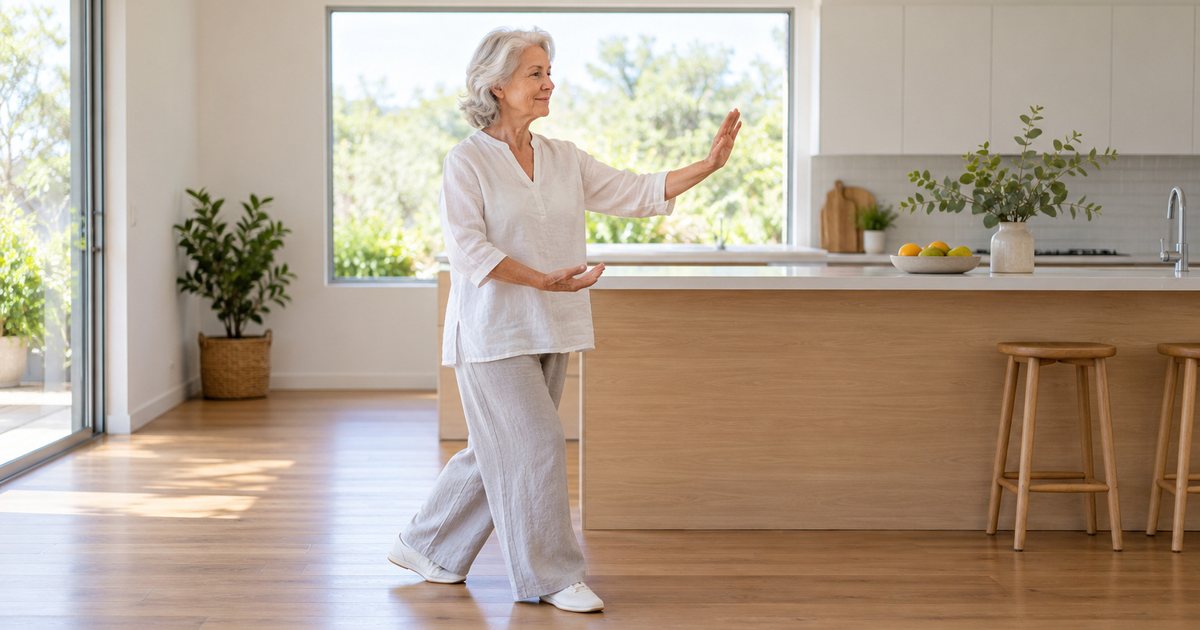
Tai chi walking is a slow, deliberate way of stepping that borrows the weight shifts and posture of tai chi: you move your weight fully onto one leg, place the other heel down gently, then roll your weight forward before taking the next step. It is a gentle balance practice rather than a workout for speed, and beginners can start with five to ten minutes beside a wall or kitchen bench.
This guide includes a few product links near the end. As an Amazon Associate, michelle.net.au earns from qualifying purchases, at no extra cost to you.
This guide explains what tai chi walking is (often searched as “thai chi walking”), gives written step-by-step cues you can follow at home, sets out a 10-minute starter session, and summarises what the research on tai chi and falls in older adults actually found, including how strong that evidence is.
At a glance
- What it is: a slow walking drill built around full weight shifts, heel-first placement, soft knees and relaxed breathing.
- Why people use it: it trains the moment of balancing on one leg, which is when many trips and stumbles happen.
- What the research says: a Cochrane review found tai chi programmes may reduce the rate of falls in older people living in the community by about 19%, though the certainty of that evidence was rated low.
- How to start: beside a wall or bench, in flat supportive shoes, on a clear floor, for 5 to 10 minutes.
- Check first: talk to your doctor or physiotherapist if you have had a fall, feel dizzy, or have joint, heart or nerve problems.
What is tai chi walking?
Tai chi is a Chinese movement practice made up of slow, flowing postures linked by continuous weight shifts. Tai chi walking takes one of its core skills, transferring weight smoothly from one foot to the other, and turns it into a walking exercise. Instead of the quick “fall forward and catch yourself” pattern of ordinary walking, every step is controlled from start to finish.
You do not need to learn a full tai chi form to practise it. That makes it a useful entry point for people who are curious about tai chi but not yet ready for a class, and a handy home drill for people who already attend one.
Tai chi walking vs ordinary walking
| Feature | Ordinary walking | Tai chi walking |
|---|---|---|
| Speed | Brisk or comfortable pace | Very slow, often several seconds per step |
| Weight transfer | Body falls forward onto the next foot | Weight shifts fully onto the back leg before the front foot moves |
| Foot placement | Automatic, often heavy heel strike | Heel placed lightly, then the foot rolls down |
| Knees | Straighten at each step | Stay softly bent throughout |
| Main focus | Moving from A to B, heart and lungs | Balance, control, posture and attention |
| Where to do it | Anywhere | A clear, flat space with support nearby |
The two complement each other. Regular walking supports heart health and everyday fitness, as the guide to aerobic exercise for older adults explains, while tai chi walking practises the balance skills underneath every step.
What the research on tai chi and falls shows
Most of the research is on tai chi programmes as a whole, not on tai chi walking on its own. It is reasonable to see tai chi walking as one ingredient of those programmes, but no large trial has tested it in isolation.
The Cochrane review
A 2019 Cochrane review led by Catherine Sherrington pooled trials of exercise for falls in people aged 60 and over living in the community. For tai chi, seven trials with 2,655 participants suggested tai chi may reduce the rate of falls by about 19% compared with control groups. The reviewers rated this evidence as low certainty, meaning future studies could change the estimate. By comparison, balance and functional exercise overall had the strongest evidence (high certainty, about a 24% lower rate of falls), and programmes combining several types of exercise also performed well.
The Oregon tai ji quan trial
A randomised trial by Fuzhong Li and colleagues, published in JAMA Internal Medicine in 2018, enrolled 670 adults aged 70 and over (average age about 78) who had fallen in the past year or had impaired mobility. Participants attended two 60-minute classes a week for 24 weeks in one of three groups: a tailored programme called Tai Ji Quan: Moving for Better Balance, a multimodal exercise programme (balance, aerobic, strength and flexibility), or stretching. At six months, the tai ji quan group had about 58% fewer falls than the stretching group and about 31% fewer than the multimodal exercise group.
How to read these results
- The trials tested supervised, structured classes, usually twice a week for months, not occasional practice at home.
- The Oregon trial used a specific programme adapted for older adults at higher risk of falls; results may differ for other styles.
- The Cochrane estimate for tai chi is low certainty, so it is fair to say tai chi looks promising for balance, not that it is guaranteed to reduce falls for any one person.
- Falls have many causes, including eyesight, medicines, footwear, home hazards and blood pressure, so exercise is one piece of a bigger picture.
Before you start: safety checklist
- You have checked with your doctor or physiotherapist if you have fallen in the past year, feel dizzy or unsteady, or have heart, joint or nerve conditions.
- You are practising beside a kitchen bench, wall or sturdy rail you can touch at any time.
- The floor is clear of rugs, cords, pets and clutter.
- You are wearing flat, closed, supportive shoes with grippy soles, not socks or slippers.
- The room is well lit.
- Someone is nearby, at least for your first few sessions, if your balance is a concern.
- You will stop if you feel pain, dizziness, chest discomfort or unusual breathlessness.
How to do tai chi walking: step by step
Read through the cues once, then practise them slowly with one hand on your support.
- Set your stance. Stand with feet about hip-width apart, toes pointing forward. Imagine two railway tracks rather than a tightrope; your feet stay on their own track.
- Soften and lengthen. Bend your knees slightly, let your shoulders drop, and imagine a thread gently lifting the crown of your head. Rest your hands at your sides or lightly on your support.
- Shift your weight. Slowly move your weight onto your left leg until your right foot feels light. Pause here for a breath.
- Step with the heel. Lift the right foot slightly and place the right heel down a short step ahead, on its own track. Do not put weight on it yet.
- Roll forward. Lower the sole of the right foot to the floor, then slowly shift your weight forward onto it, letting the back heel lift as the weight leaves it.
- Bring the back foot through. When your weight is fully on the right leg, bring the left foot forward and place its heel down lightly.
- Repeat and breathe. Continue step by step, breathing naturally. Many teachers suggest breathing in as you shift back and out as you roll forward; if that feels awkward, simply do not hold your breath.
- Turn safely. At the end of your space, stop with feet side by side, then turn using small steps rather than pivoting on one foot.
Written diagram: one full step
| Stage | Where your weight is | What your feet do | Cue to remember |
|---|---|---|---|
| 1. Ready | Even on both feet | Hip-width, side by side | “Soft knees, tall head” |
| 2. Shift | All on the back (left) leg | Front (right) foot light | “Empty the stepping foot” |
| 3. Place | Still on the left leg | Right heel touches down ahead | “Heel first, no weight” |
| 4. Roll | Moving forward onto the right leg | Right sole lowers, left heel lifts | “Pour the weight forward” |
| 5. Arrive | All on the right leg | Left foot ready to step | “Pause, then repeat” |
A 10-minute starter session
| Time | Activity | Notes |
|---|---|---|
| 0 to 2 min | Standing warm-up: gentle shoulder rolls, ankle circles holding support, slow side-to-side weight shifts | Keep both hands near your support |
| 2 to 4 min | Forward and back weight shifts with feet staggered, no stepping | Rock slowly from back heel to front foot |
| 4 to 8 min | Tai chi walking along your bench or wall, forward only | Aim for smooth, not slow at all costs |
| 8 to 9 min | Optional: a few backward tai chi steps, toe first, holding support | Skip this until forward steps feel steady |
| 9 to 10 min | Stand still, breathe and notice your posture | Finish seated if you feel tired |
Start with this session two or three times a week. As it becomes easier, you can lengthen the walking section, take your hand off the support for a few steps at a time (only if you feel steady), or add the gentle routines in 10 easy exercises for seniors. If standing for ten minutes is hard, the printable chair yoga routine is a seated way to build up.
Common mistakes
- Stepping before the weight has shifted. If the moving foot still carries weight, the drill becomes ordinary slow walking.
- Locking the knees. Straight, braced legs make you stiffer and less stable; keep a slight bend.
- Walking a tightrope. Placing one foot directly in front of the other narrows your base; keep feet on separate tracks.
- Looking at your feet. Glance down if you need to, but keep your gaze mostly ahead so your head stays balanced over your body.
- Holding your breath. Concentration often makes people stop breathing; keep it soft and natural.
- Taking long steps. Short steps are easier to control and safer while you learn.
- Practising without support or in socks. Use a bench or wall and proper shoes, especially at first.
Free and low-cost ways to learn more
Many people search for tai chi walking for seniors free of charge, and there are good options. Local councils, community health centres, libraries and seniors’ centres in many countries run low-cost tai chi classes, and some health services offer falls-focused programmes. In the United States, the US CDC’s STEADI materials list evidence-based programmes for older adults; other countries have their own equivalents through health departments. When choosing tai chi classes for seniors, look for an instructor who asks about your health, offers seated or supported options, and keeps class sizes small enough to correct technique. The guide on choosing the right movement studio has questions that apply equally well to tai chi.
How tai chi walking fits a wider routine
Tai chi walking is a balance skill, not a full exercise plan. Health authorities such as the World Health Organization advise older adults to combine aerobic activity, muscle-strengthening and balance work across the week. Simple daily balance habits, covered in essential balance habits for healthy ageing, and breaking up long periods of sitting, covered in the guide to moving more, round out the picture.
Sources this guide draws on: Sherrington C and colleagues, Cochrane systematic review of exercise and falls in older people living in the community, Cochrane Database of Systematic Reviews, 2019; Li F and colleagues, tai ji quan randomised clinical trial in older adults at high risk of falls, JAMA Internal Medicine, 2018; US CDC STEADI older adult falls resources; World Health Organization guidelines on physical activity and sedentary behaviour, 2020; Harvard Health Publishing material on tai chi.
Handy kit for this guide
These are practical everyday products, not supplements or medicines. As an Amazon Associate, michelle.net.au earns from qualifying purchases, at no extra cost to you. Prices and availability are set by Amazon and may vary by country.
- Gaiam Premium 5 mm Yoga Mat
Non-slip mat for yoga, Pilates, tai chi warm-ups and floor exercises.
View on Amazon - Fabric Resistance Bands (5-Band Set)
Loop bands in graded resistance for home strength exercises.
View on Amazon - Bambaw Insulated Stainless Steel Water Bottle (32 oz)
Plastic-free and keeps water cold all day, at home, on walks or at the gym.
View on Amazon
Frequently asked questions
Is tai chi walking good for seniors?
Tai chi walking is gentle, needs no equipment and practises weight shifting and single-leg balance, so many older adults find it a comfortable place to start. Research on full tai chi programmes suggests benefits for balance and falls, though the certainty of the evidence varies. Check with your doctor or physiotherapist first if you have fallen recently or feel unsteady.
Is it “thai chi” or “tai chi”?
The usual English spelling is tai chi (also written taiji or tai ji quan). “Thai chi” is a common misspelling; the practice comes from China, not Thailand.
How long should I do tai chi walking each day?
Beginners often start with 5 to 10 minutes, two or three times a week, and build up gradually. The trials that found benefits used supervised classes of about an hour, twice a week, for several months, so regular practice over time matters more than long single sessions.
Can tai chi walking replace regular walking?
Not really. Tai chi walking trains balance and control, while brisk walking works the heart and lungs. Most people benefit from doing both, along with some muscle-strengthening activity.
Can I do tai chi walking if I use a walking stick?
Many people practise beside a bench or rail instead of using a stick, but whether that is safe for you depends on why you use one. Ask your physiotherapist to show you a supported version that suits your balance.
Tai chi walking asks for nothing more than a clear floor, good shoes and a few quiet minutes. Start slowly with support nearby, practise regularly, and let a qualified instructor or physiotherapist help you progress when you are ready.